News
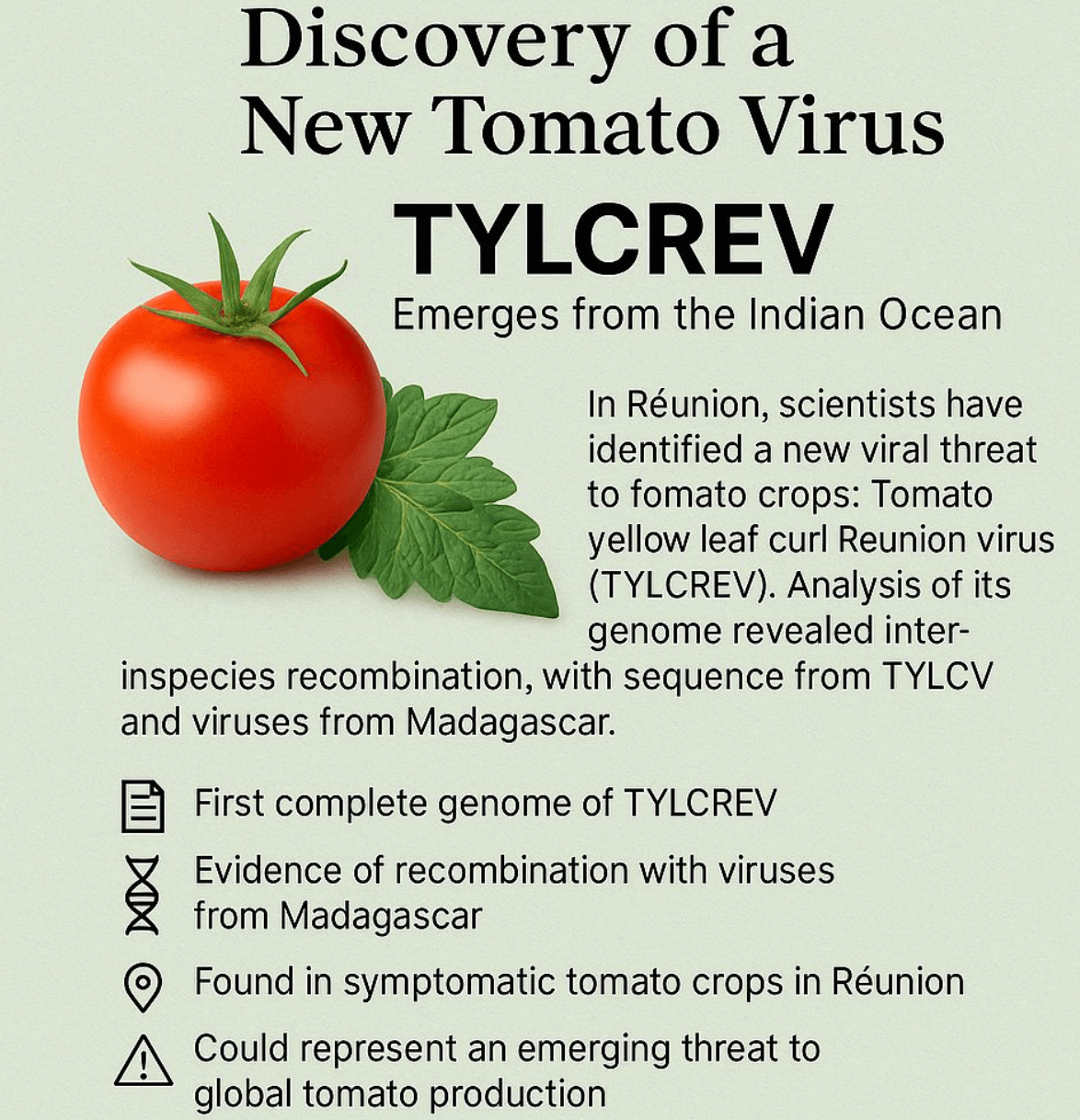
TYLCREV: A New Tomato Virus Emerges from the Indian Ocean
In the heart of the Indian Ocean, on the tropical island of Réunion, researchers have uncovered a new viral threat to tomato crops that may have major implications for plant health and virus evolution globally.
The newly identified virus, Tomato yellow leaf curl Reunion virus (TYLCREV), was found in two symptomatic tomato plants in greenhouses in St. Louis and Le Tampon. These plants exhibited classic signs of tomato yellow leaf curl disease (TYLCD), such as severe leaf curling and yellowing between veins. But what the scientists uncovered went far beyond a routine diagnosis.
Using advanced molecular tools, the team sequenced the complete genome of TYLCREV and discovered that it is a monopartite begomovirus—a type of plant virus known for its rapid evolution and destructive impact on agriculture. More importantly, TYLCREV turned out to be a recombinant virus, meaning it has genetic material from different parent viruses that combined into a new strain.
The genome is made up of 52% sequence similar to Tomato yellow leaf curl virus (TYLCV), one of the most notorious plant viruses worldwide, and 48% from lesser-known tomato-infecting viruses from Madagascar: ToLCMGV and ToLCDiaV. This mix raises fascinating questions about how such genetic exchanges happen across different islands and ecosystems.
What makes this discovery significant isn’t just its novelty—it’s the potential epidemiological threat. TYLCREV meets the genetic criteria to be classified as a new species. While it currently exists only in a localized area, recombination between viruses is often a key driver of host adaptation, increased virulence, and geographic spread. Given the history of TYLCV’s global expansion, TYLCREV must now be closely monitored.
The study calls for urgent surveillance of tomato crops in the region and beyond, particularly because such viruses are primarily transmitted by whiteflies, which are common in greenhouse and open-field agriculture.
Reference: Leclair P, Hoareau M, Parvedy E, et al. Tomato yellow leaf curl Reunion virus: a novel tomato-infecting monopartite begomovirus from Reunion Island. Archives of Virology. 2025;170(7)
Full text: https://link.springer.com/article/10.1007/s00705-025-06345-y
Source : AgriFacts Alliance