News
Interview: Antonio Casana, CEO of Solana SpA & President of AMITOM
In this interview, Madeleine Royere speaks with Antonio Casana, CEO of Solana SpA and President of AMITOM, about the structural and technological evolution of Italy’s tomato processing sector. Combining his background in molecular genetics with a private equity-backed growth strategy, Casana outlines Solana’s acquisition of Grupo Desco—a strategic move to build climate resilience by uniting Northern and Southern Italian harvesting basins. He details the group’s multi-million euro investments in energy efficiency and sustainable, aseptic logistics, while addressing broader industry pressures like rising input costs and the need for European trade reciprocity. Ultimately, Casana emphasizes that navigating today’s volatile agricultural cycles requires a unified operational platform, strong grower relationships, and a healthy dose of structural optimism.
Madeleine Royere: Well, today I have the pleasure to interview Antonio Casana, CEO of Solana Spa, and also president of Amitom.
Career & Leadership
Let’s start with your career. To begin, could you briefly introduce yourself and your company, Solana, for those who may not be familiar with your career? I mean, I made some discoveries myself, because I didn’t know, for instance, that you began in tomato genetics. Can you tell us a bit more about that?
Antonio Casana: Okay, okay. Thank you, Madeleine. It’s a pleasure to be here. So, yes, I hold a degree in agricultural science from the Università Cattolica del Sacro Cuore in Piacenza, with a thesis in the molecular genetics of tomato. And I started my career in the processing tomato industry as a quality assurance manager in our previous company.
To introduce Solana a little bit: Solana today is a leading industrial group in the B2B sector for tomatoes, fruit, and vegetables. Our main plant is near Lodi, in Lombardy, which has a capacity of around 240,000 tonnes of fresh raw material. To this, we add roughly 15,000 tonnes at the Suncan plant for tomatoes and paste in Castelvetro Piacentino, which also processes basil and fruits.
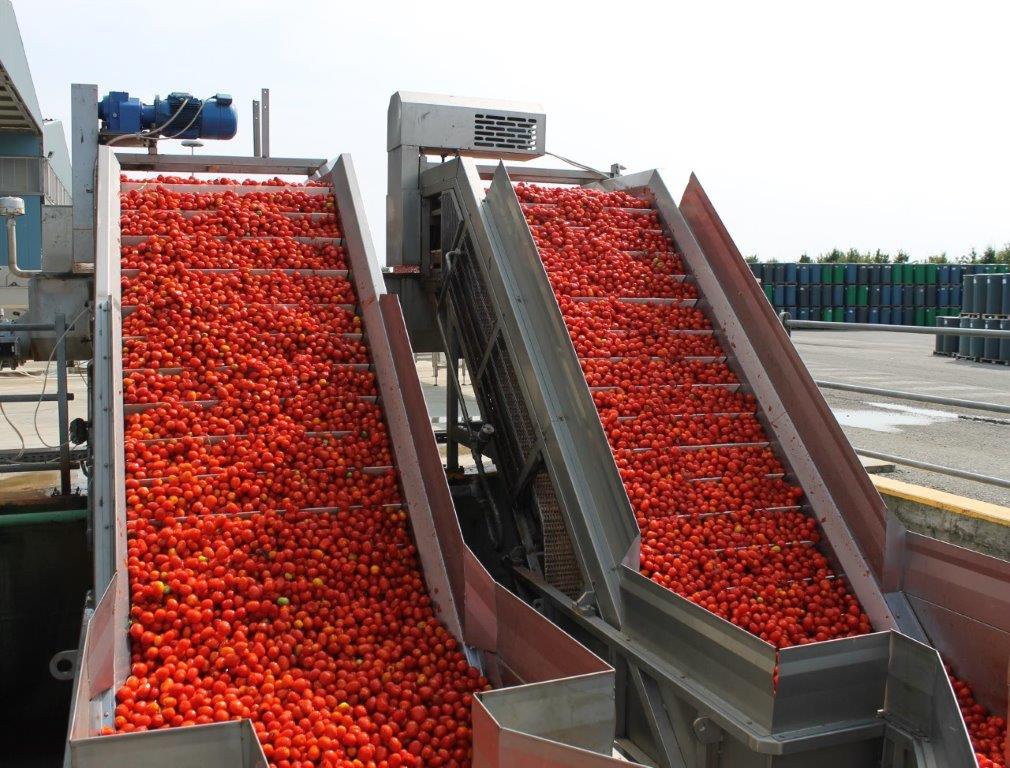
And since January, we have also added 50,000 tonnes at DESCO, in Agro Pontino, Latina, in central Italy. On top of that, our plants process about 10,000 tonnes of other crops and other vegetables, including squash, fruit, and basil. So all together, the group reaches a capacity of around 280,000 tonnes per year, with a consolidated revenue of about 90 million euros for the last fiscal year.
Picture: Solana’s plant, elevators for diced lines
That’s all, though I also serve as the president of the vegetable products division in Unione Italiana Food, and I’m a board member in Anicav. As you know regarding Anicav, yesterday we elected a new president, Aldo Rodolfi, whom you know well.
Exactly, and we already published it in Tomato News. Okay, great. So, from tomato genetics, and then into Solana first – well, then you went to quality management for another company, and then you moved to Solana. How does your scientific background shape your vision for product innovation and quality control for Solana?
Okay, yeah, the scientific background for me is a lens that I never quite put down. My thesis was in the molecular characterization of genes involved in oxidative stress in tomatoes. Then, when I started my first job as a quality assurance manager, I had to start signing declarations of the absence of GMOs in our products. So, that’s what I can say.
Thirty-five years later, Europe is finally moving, perhaps, towards a new regulation on NGTs—the new genomic techniques based on CRISPR-Cas technology. I genuinely hope that a real shift in the European attitude towards science and technologies is coming, because this would allow mindful progress in biotic and abiotic resistance of tomato plants, as well as improvements in quality and sustainability.
Beyond that, the scientific frame of mind shapes the way I run the business every day. It teaches respect for figures and data, because in a supply chain like tomato, where the raw material can vary every season and every field, the only available compass is a systemic, methodical approach. This is also why we invest in proprietary varietal selection — including our patented Solanino seed (cherry tomato).
Then, if you allow me something more personal, my passion for tomatoes is combined with another hobby of mine, which is the mountains and alpinism. And alpinism has taught me something that applies very directly to running a business. It has taught me that it’s better to give up a summit when the conditions make the climb impossible, so that you can come back another day to attempt the ascent, stay alive, and keep enjoying this magnificent journey that is life. In our industry, where every season brings its own weather and its own risks, knowing when to push and when to step back is, in my view, one of the most undervalued skills for a career and business perspective. I share this hobby with my son, so it’s…
Yeah, I really like this analogy that you have with the alpinism. So, the goal is not the end, the goal is the path.
Yes, the goal is the journey, always, yes.
Great! Well, thank you for sharing that. You joined Solana in 2003?
It was earlier, it was 2001, because the company was founded in 2001. I was one of the founders, and then we started operating in 2003, because we started from a greenfield.
Oh, okay. So you were one of the founders. And then you took the helm of Solana in 2013.
Yes, I started as a general manager, and then as a CEO, yes, in 2013.
Okay, so you were mentioning 35 years of career, so it’s, like, 23, 25 even then, with Solana. Most of it. So, if you look back at all those years, those 25, 30 years, what would you say is the most significant shift in the culture of the Italian tomato processing industry?
Thank you for this question. What I see, looking back at the industry, is a really deep transformation that I want to highlight. Italian processing tomato production has grown from around 3.5 million tons in the early 2000s to about 5.8 to 6 million tons today. That’s a great increase, about 65 to 70%. At the same time, Italy has consolidated its position as a world-leading exporter of processed tomatoes, with export value that has grown by approximately 1.2 billion euros over the last decade alone. That is by far the largest absolute growth among all tomato-producing nations. So, we can say that the Italian industry has not shrunk; it has grown internationally.
What has changed in the structure and mindset behind these numbers? Twenty-five years ago, we had more than 200 processing companies in Italy. Many of them were subscale and opportunistic, focused only on a single campaign. Today, we have around 100 companies, but they are structurally different. They are better invested, more international, and more disciplined on quality, sustainability, and traceability.
So, the sector has achieved more with stronger players, and this, in my view, is the right kind of consolidation. That is the main trend that I have seen. Quality stopped being just a marketing claim, and sustainability, which 15 years ago was a side topic, is now really important.
So consolidation, structure, organization, okay, thank you.
Solana’s Growth
So, let’s talk about Solana for a minute. You mentioned in the introduction that you also process some vegetables, you process basil, I suppose you do pesto with it?
Yes, we do the ingredient for pesto. The semi-processed basil that is an ingredient for the processing industry, that they use to produce pesto or a tomato basil.
You mentioned that you also process squash? And some fruits, I think I remember you had mentioned you were processing pears puree. Do you have in mind what percentage of your volume the non-tomato lines represent?
Yes, tomatoes remain, of course, the heart of our group, accounting for about 91% of last year’s revenues. The remaining 9% is split across fruit preserves, squash, and basil. Those are minor, but strategically very important. For us, the main goal of maintaining these different vegetables is that it allows us to extend operations beyond the tomato crop, which usually runs from July to September. It allows us to use our industrial capacity throughout the year while preserving the deep know-how that the market recognizes in our tomato business. That’s the main reason.
And do you manage to open the factory all year long, then?
Antonio Casana: No, it’s always based on the season, but the season is longer. Basil processing takes place earlier than tomatoes, and fruit happens after the tomato campaign—so starting from October until January or February. This is because the fruits are preserved in cold storage, and we manage them there until we transform them.
Then it’s kind of closed between February and June?
Closed the operation but a lot of work to do with the maintenance. In our business, a tomato processing plant is much like a Formula 1 car. Before the season kicks off, it has to be tuned up to the very last detail — every system fine-tuned, every weakness ironed out, nothing left to chance — so that, once the campaign begins, it can run flat out for two straight months without breaking down and without slowing down. Efficiency is not a virtue here, it is a precondition: in just sixty days of campaign, an entire year of work is on the line.
You recently acquired Grupo Desco. It’s a major milestone. Was it driven by the desire to have a North of Italy / South of Italy strategy? Was that the main reason, or was there another one?
One of the main reasons was that we are complementary, in the sense that we have the same mindset to target the premium level of the B2B sector. And then, also, to find, some synergy and to decrease the risks of raw material supply. Desco is well managed by Marco, Fabio, and Valerio Serafini, the Serafini family, who continue to lead the operations, and it was already a long-standing partner for Solana. So, the M&A transaction simply is a formalization of a broader relationship that was already industrially mature.
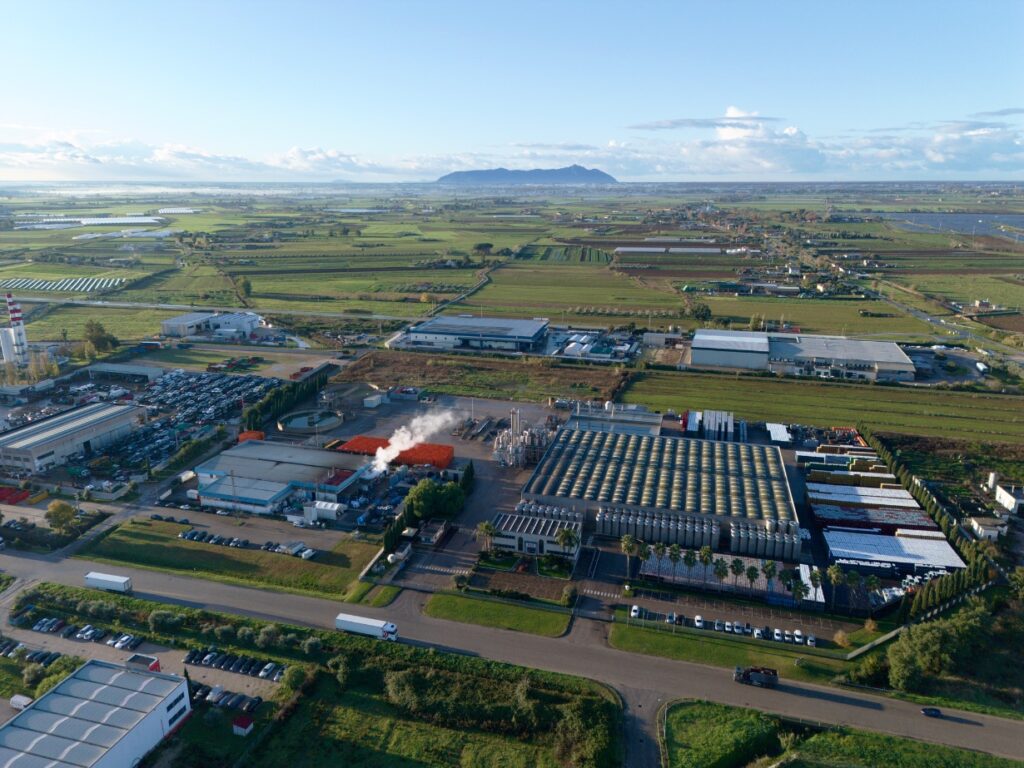
So, the strategic logic is mainly climate resilience. Northern and Southern Italy have historically shown opposite campaign results. When the harvest is stronger in the Po Valley, it’s often difficult in central-southern Italy, and vice versa. So, mitigating risks across both areas, in a market where climate variability is becoming one of the most significant operational risks, is a competitive advantage.
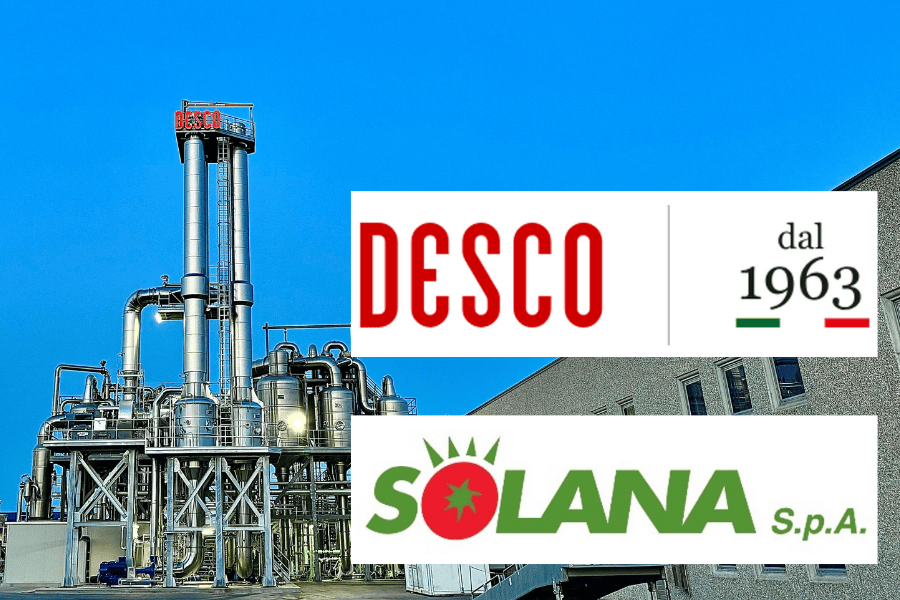
Picture: Desco’s plant
Yes, so it allows you to mitigate the risks indeed.
Behind that, of course, the acquisition brings cross-selling opportunities, expanded product portfolio, particularly in the lower brix tomato segment, where Desco excels.
Okay, thank you. Let’s talk technology. So, Solana is well known for its Ohmic heating technology, which offers superior pasteurization, and we saw in the news that, and we thought, oh, Antonio must be so happy, because you recently acquired the Apollo. So, do you plan to roll out those advanced technologies across the Desco plant as well to have a unified standard? Is it just the beginning, or what’s the plan?
So, Ohmic heating is a pasteurization method that we apply both in Solana and also in Suncan, because it comes from the fruit industry mainly. It’s more expensive in terms of operating costs, but it brings more natural flavor and freshness to the finished product. We have it in these two companies, while MVR (mechanical vapor recompression equipment) had already been installed in Desco two years ago. We have installed it this year in Solana, and there is a plan to install it next year in Suncan as well, but this relies mainly on the reduction of energy costs and emissions.
So, coming to your question, extending these technologies to have the same standard is certainly a possibility. But it’s not the only lever, and, frankly, it’s not the most urgent.
Already, Desco brings a unique strength that complements, rather than overlaps with, our existing setup. Desco, particularly, has an aseptic tank storage facility—a large cantina of aseptic tanks dedicated to low-brix products, such as passata and tomato pulp. This is a remarkable asset from a sustainability standpoint, because we can ship the product in aseptic tanks instead of packing it into drums or bags. Shipping by the truckload without any primary packaging is a major benefit, and it’s a unique system for the fruit sector, but Desco has it also for tomatoes. It was a huge investment made some years ago, but these are stainless steel tanks and they are always as good as new; they don’t have any issues with age. On top of that, the Desco plant benefits from the unique pedoclimatic conditions of its sourcing basin in the Pontinia area: the tomato has a colour and a depth of taste that our customers recognise immediately, and Desco’s products are particularly prized for the colour intensity of the finished tomato products. So, we can say that we have a large capital investment across the three factories.
We have installed roughly 3 megawatts of photovoltaic capacity at the group level. MVR is fully operating in Desco and will start operating in Solana. And our CAPEX plan from 2026 to 2028 is approximately 20 million euros for further investments, focused on energy efficiency, sustainability, and increasing our food service installation capacity. This is the plan that we manage.
Okay, and with the 3 megawatt, this was for one of the factories?
No, for all three. And it accounts for about 30% of our total electricity needs, as it’s difficult for an industry that is very energy-intensive for a short period to completely cover its electrical supply this way. We also acquire green energy, but it’s not possible to self-produce 100% of that capacity.
Yes, I understand. Thirty percent is already a good number. Okay, So, you bought Desco, as we discussed. Is it a signal that you’re looking for more acquisitions in Italy, or are you maybe planning for an international expansion? Is there anything you can share, or can you even talk about that?
Yes, frankly speaking, Xenon is a private equity fund that acquired Solana in 2024, and it was conceived from the beginning as a platform play in a sector that, regarding consolidation, still suffers from what I call “dwarfism”—you know, too many small companies. So, yeah, there are too few players with the resources to invest in technology, sustainability, and international growth.
Our priority, of course, remains focused in Italy, but I am not saying that it will conclude in Italy. It could be that we will be part of an international group in the coming years, because I think the internationalization of our sector will grow more and more in a few years. It’s already happening for some big groups, but it will come to the rest of the Italian industry framework as well.
Okay, okay. Thank you.
The Italian Industry
So, well, let’s talk about the Italian industry. From your perspective, how resilient do you think the Italian processing tomato industry is? We are being challenged with, Hormuz, Iran and so on, with rising costs and so forth. So, what’s your view on that?
I think that, today, the Italian industry is more resilient than 10 years ago. But resilience is not immunity, of course. We know we are the second largest processor of tomato worldwide, depending on China’s decision, and the leading exporter of processed tomato products. But this is not just a slogan; it is a position earned by industrial investment, sourcing models, and technology, not just for tomatoes, but across the board with know-how, new product and receipt, marketing and history, that is difficult to replicate.
As you know, Italian tomato fields structurally have lower yields compared to California or China, but our product range is different compared to those countries. We have a stronger identity, and we even export to the United States. Our product range has low substitutability; it is much less commodity-based compared to other industries.
Let’s say, “Made in Italy” alone is not enough. It never was. The premium is, for me, a combination of three different things: the history of the product and of the industry; the reliability and credibility of country-of-origin labeling and traceability; and the quality of the raw material, combined with using technology the right way to make the products that are preferred by consumers. These are the three main factors that will keep the premium of Italian tomato products around the world.
Thank you. So, let’s talk about the supply chain. You have a history of working closely with the farmers. In the current climate, what do you think the biggest challenges your suppliers are facing? What are those? And also, how are you supporting them to ensure the stability of the supply chain?
Yes, it’s another challenging point, because our growers are facing a perfect storm of input cost pressures, fertilizer, plant protection products, diesel, and all of those are amplified by climate volatility. This week, we are having 35 degrees in Northern Italy, which is completely out of the ordinary. in recent years we had some season with water scarcity accompanied than by water access issues in other years. Which really brings a lot of challenges to the grower every year.
Our responsibility as an industry, as a processor, is to build up a solid path forward together with the producer organizations and the farmers. This means making the right crop plans at the right time within an agreement framework, fixing prices and quality. All of this is also handled under the umbrella of the industry associations. We have the OI Pomodoro Northern Italy in our tomato district, and they are trying to do the same in the South. We both rely on permanent, good relations with the farmers because, as a processor, we cannot move forward without the raw material. So that is vital.
Okay, thank you. So, let’s talk about the international situation. You are currently the president of Amitom, but you are also a past president of Tomato Europe. What would you say that the main values are that those international organizations bring?
Yes. The value these organizations bring to our industry is fundamental, in my view. They provide the ability to look at the tomato chain as a system rather than a collection of competing companies. AMITOM gathers processors across the Mediterranean basin—from Italy to Spain, Portugal, Tunisia, Turkey, Iran, Greece, France, Egypt, Morocco countries that compete on the market, of course, with different challenges. Managing production forecasts, statistics, and common problems together gives us a level of knowledge that no single country could have alone. So, it’s really important for research, varietal innovation, sustainability, and technology.
Then, relating to my role in the Tomato Europe association, we are trying to give a voice to our concerns regarding the regulatory systems being introduced within the European Union. There are many dossiers affecting our industry, such as ETS, PPWR, and NGTs. I try to bring an optimistic view to the Commission, in the sense that we share the same goals, but we want to point out the critical issues on the path to getting there. We want to be very pragmatic and ensure this industry has the opportunity to be sustainable from an economic point of view, not just the other two pillars: social and environmental.
Recently, we had some people in the EU, and particularly in Italy, who have been very vocal about protecting the internal market from unfair imports. I can remember a few articles in the Italian press about Egypt, for instance. So, what, in your opinion, should be done?
Frankly speaking the point is not to be against any single producing country. The point is that, as Europeans, we should demand reciprocity and transparency.
Reciprocity means that products entering the European market should be subject to standards comparable to those that we impose to our own producers in terms of agricultural practices, environmental respect, working conditions, environmental impact, and food safety.
And transparency means, for us, mandatory country-of-origin labeling for the raw material, not just the location of the final packaging. That way, consumers can be fully informed make choices aligned with their wishes. Without these two elements, reciprocity and transparency, it is difficult to call it fair competition. We are simply asking for a level playing field, that’s all.
Okay, thank you.
The International situation & 2026 Macro-Climate
Let’s come back to the Iran conflict, and Hormuz, and so on. The prices are soaring for energy, fertilizer, diesel, and so on. How is Solana adapting its logistics, and how can you insulate your margins from those rising input costs? Okay. Have you made some changes?
It’s difficult to completely reshape everything based solely on recent events. The impact has been significant along the entire supply chain, as I already mentioned for the farmers, who have to absorb higher costs for fertilizer, agrochemicals, and diesel. As a processor, we have seen an energy cost increase of around 30% compared to the last crop, alongside rising packaging costs and higher transport costs, both for bringing the raw material to the factory and for delivering the finished product to our customers worldwide.
So, of course, we will face difficulties in this high-inflation period for our industry, and we will see how it is received by the market. For sure, it won’t only be tomatoes that are affected; many supply chains will feel this, and the ripple effect on the food chain will be relevant. It might seem like it isn’t fully there right now, but it will be there in six months, into next year.
If you look at the FAO report from last week, they are showing a real concern for the next six months. Most of the main commodities on the world food market are expected to increase in price and decrease in quantity due to the lower inputs used by farmers. Because what do farmers do when they face increased costs with no margin? They reduce fertilizer use, or they simply cannot get it, and so the output will for sure be shortened in the future. So, let’s see what will happen, but we are definitely bracing for the next six months, and we will certainly see big changes by the end of this year.
Looking Ahead
So now let’s look at 2026 season. From your perspective, do you think it’s balanced this year? And do you think we are moving from price wars to securing supply? What’s your view on that?
What to say? Yes, as you know, we have an economic cycle that can be different region by region but generally operates under a world perspective. Globally, processed tomato production fell from about 46 million tonnes in 2024 to roughly 40 million tonnes in 2025. That 6-million-tonne swing was driven almost entirely by the decrease in China, where production collapsed by about 50%.
This rebalancing represents, I think, a tangible shift in market priorities. As recently shown by statistics, buyers, especially in Europe, the US, and Japan, are increasingly asking not how cheap a product is, but how valuable, how reliable, how compliant, and how sustainable it is compared to the past. Security of supply, ethical sourcing, and ESG compliance are becoming the primary criteria of choice for buyers. So, while the price war has not disappeared at the bottom of the market, at the top, the conversation has fundamentally changed.
The Italian export data confirms this. Despite a big gap in price levels, Italy remains the main exporter, with a decrease in volumes of less than 1.5% after a very challenging 2024 season. This confirms the strong message that the market is not only looking at price, but at much more than that.
In my view, looking also at the recent article published by Tomato News on the Euromonitor perspective, we can say that two structural drivers give us reason for optimism. The global market for tomato derivatives reached approximately 35 million tonnes of finished product in 2025, up nine percent from 2019, and is projected to grow to nearly 39 million tonnes by 2030, with every single category — sauces, ready meals, pastes and purées, canned tomatoes — expected to accelerate its growth rate in the 2026-2030 period compared to 2019-2025. On this basis we can say that two structural drivers give us reason for optimism: 1) The first is the rise in Asia-Pacific consumption, which represents a genuine new consumption hub for the tomato market. Sauces in that region are growing by about 5%, and ready meals are following. Tomato is becoming a global ingredient in cuisines where, in the past, it was only a staple of Western cooking; now it is integrating into Asia-Pacific culinary culture. That is the first driver. 2) The second driver is convenience and premium quality in mature markets like Europe and North America. Consumers there are willing to pay more for a product that has a recognizable origin, a transparent supply chain, and high quality. These, for me, are two trends for the future that will serve as a core strength for our industry.
Thank you for that. We’re approaching the end with the last two questions. Looking ahead now, you’ve been in this sector for more than 25 years. How has your approach to management changed as Solana, as a company, has evolved from a broader shareholder base into a private equity-backed industrial group?
The partnership with Xenon started in 2024, almost two years ago, and that has been important and transformational, but in a way that respects what Solana was. The operational management has remained fully independent and stable; the team that built this company is the team that runs it today.
What has changed mainly is our strategic horizon. We now have access to capital, to M&A expertise, and to a structured approach to development that allowed us to complete the expansion we already discussed. Personally, my approach has evolved in two directions through working with this private equity group. First, I learned to think in terms of a platform rather than just a product. Every investment, every decision, and every acquisition is evaluated through a multi-year perspective, rather than a single year or a speculative structure.
Second, I learned the value of institutional governance: board reporting, sustainability frameworks, and ESG—because the fund that acquired Solana is an ESG fund. It gives us the opportunity to accelerate our growth. Xenon brings discipline and capital to a sector that suffers from structural fragmentation and “dwarfism,” and for our company, it’s exactly what we needed to expand.
Solana had 48 shareholders at the start, so it was more like a public company than a traditional family business. Some of them were farmers, some were just investors, but it was a large number of shareholders to bring together.
Thank you. So, last question for you today. If we were to speak again one year from now, what would you consider the most important milestone for the new Solana-Desco group to have achieved?
On the industrial side, the milestone is the full integration of the three companies into a single operating model: Solana, Suncan and Desco, working as a coordinated platform. This gives us two complementary crops in Northern and Central-Southern Italy, a richer product portfolio, and the first round of identified synergies being translated into concrete results. We want to bring the synergies we planned into reality. We have projected about 10 million euros of revenue synergies between 2026 and 2028, so we will implement these investments over the next two years, and we expect to see the first results within the next 12 months.
But the most important milestone I see is cultural: the people across all three companies recognizing themselves as part of a single industrial project. This project will preserve each company’s identity, history, and distinctive competencies, but with a mindset focused on the direction of the group. We share common goals, and we are aligning our teams around them.
Let’s say that the numbers will speak for themselves. We expect to remain a solid, well-financed group with a strong position in the premium B2B segment. to stay highly competitive in this space.
And let me close with a thought. We know our industry well: it moves in cycles, where years of euphoria are followed by years of hardship, where feast and famine come around in turn.
We have lived through enough of these cycles to know that every storm we ride out leaves us a little stronger for the next one. We are always braced for the worst, and yet we hope, and we work, for the best. Because in the end, steering a company through today’s complexity calls for a healthy dose of incurable optimism.
Okay, well, that’s what I wish for you, then. Okay. Well, thank you very much, Antonio, for this very interesting interview, and for all your insights and the energy you put into it. Thanks very much, and I wish you a great 2026 season in Italy.
Fingers crossed, because you never know.
Exactly. Time will tell, as usual.