News
Who Owns Tomorrow? A No BS Playbook For The Leaders Who Refuse To Wait
Brett Schklar, Best Selling Author and Futurist
Introduction by Jason Fritsch
A few months ago, I received a book with a title that, I’ll be honest, made me smile. It’s called AI without the BS. My first thought was: who is this guy sending me a book about BS? So I read it, and here’s the thing—there’s a lot of legitimacy in that BS.
If you are anything like me, you will want to have a conversation with someone who has actually sat in our chair, because he has. Our speaker is a former CEO. He built a company, grew it, and sold it. Since then, he’s had more than 1,800 conversations with chief executives about exactly what this transformation is doing to their businesses and what’s keeping them up at night. He is a best-selling author and calls himself an Enterprise Futurist, which really means he spends his days working out what’s coming next and what the rest of us should actually do about it. He’s not here to tell you how to save the world; he is here to talk about your business and how to get this right, without the fear, without the hype, and without hiring 16 consultants.
Ladies and gentlemen, please put your hands together and welcome to the stage, Brett Schklar.
Brett Schklar
AI, AI, AI… AI is freaking everywhere! It’s on the news, on all your feeds, and on all your podcasts. We’re always talking about it. So how do you, as business leaders, CEOs, and enterprising people, know how to separate game-changing insights from all that BS, the bad stuff?
Good news for you: I know a thing or two about BS. My name is Brett Schklar.
We’re going to have some fun today. This is the post-lunch hour, and I met a lot of you on Sunday and know you’re all stuffed, so we’re going to keep it entertaining.
With all that’s going on, how do we distinguish the good information from the bad? How do we know which things are really going to move the needle in our businesses? For the last two years, I’ve spoken with over 1,800 CEOs and business leaders about where there’s chaos, where there’s confusion, and what real information you actually need.
In fact, after speaking to a thousand of those CEOs, I decided to put it all together into a book called AI without the BS: The CEO’s Playbook for Actually Getting AI Right. Doug actually said it was such a quick and easy read that he started it when he got into his Uber, and by the time his plane was taking off, he had finished it! I wrote it for CEOs and sixth graders—not because CEOs are dumb, but because we don’t have time for fluff, philosophy, or theoretical strategy. We want to talk about the things that are actually going to help us.
We’re going to talk about how AI can be the ultimate force multiplier for your business to help you scale smarter and compete better. But before we get to that, we need to address the thing nobody talks about, the thing in the back of all our minds, sitting right in the fight-or-flight center of our brain, keeping us back. That one thing is FEAR.
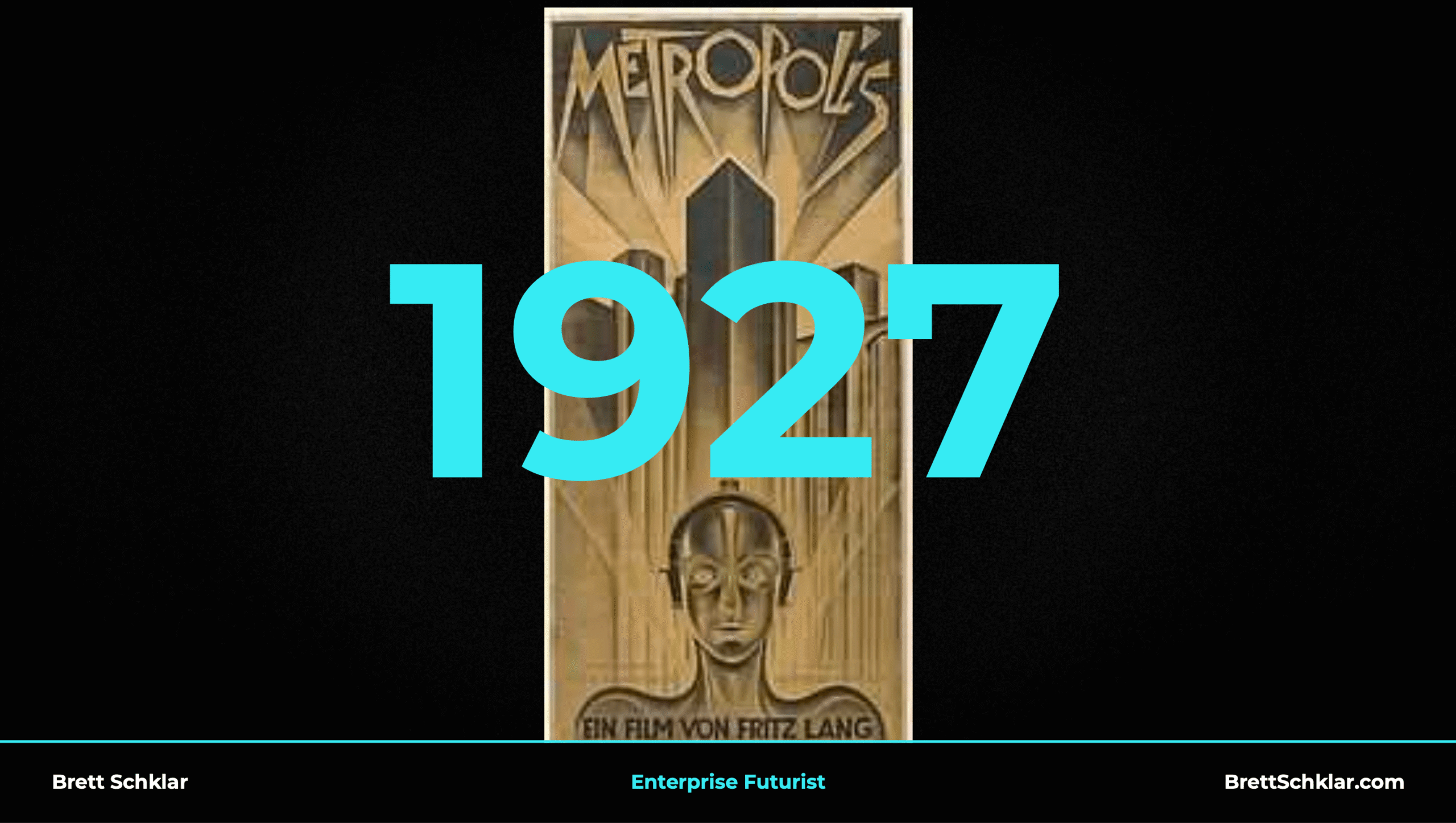
Fear of AI is keeping us from embracing and using it properly. Why do we have this fear? Maybe it’s because the first time humans were ever introduced to the concept of AI was in a German silent film called Metropolis back in 1927. For almost 100 years, the concept of AI has been in our orbit, and it has scared the hell out of us.

Look at Terminator: AI wins, humans lose, game over. Thanks a lot, James Cameron! Or The Matrix: humans literally become batteries to power the AI machines controlling them in a dream state. And now, today, AI has even invaded our steak sauce!
This fear is very real. But let’s move from Hollywood fiction to the real world, to your business. That fear shows up in very specific ways: your employees feel that AI is there to take their jobs; your managers, the people doing the hard work in the middle of the organization, fear that peers who learn AI will replace them, or that executive teams will force-feed them tools they don’t understand or embrace. Then there’s you: the CEOs and owners have the biggest fear of all: investing in the wrong type of AI, or at the wrong time, leading to a massive, expensive distraction.
There’s also a fourth group that won’t be on your radar unless you start making AI moves, and I call them Generation AI. It’s not a demographic, an age range, or a specific generation like Gen-X or Gen-Z. Generation AI consists of people who think AI-forward and AI-first. They solve problems differently than most of us do. They are the future of your business, and they are asking one core question: Are you AI-forward or not? Are you willing to do things with AI to keep us engaged? If you want to hire and keep these people, you need to show them that your company is worthy of their AI-forward approach.
Game Show: “Legit or BS”
Let’s play a game show called “Legit or BS.” These are real statements I’ve heard from CEOs over the last two years.
Statement 1: “Employees are already using AI and NOT waiting for permission.”
Verdict: LEGIT
I worked with a 120-employee company about nine months ago. We sat down to discuss rolling out AI adoption, excitement, and energy. We discovered that across those 120 employees, people were already using over 300 different AI applications—and only about 25 of them were considered safe by the company! Over 280 apps were being used without leadership knowing anything about them.
Your employees are already using these tools, whether you talk to them about it or not, finding ways to make their jobs easier and more efficient. It’s up to us not to view this as a threat, but as a signal.
Two years ago, I hosted a CEO roundtable. One host—an oil and gas CEO wearing a cowboy hat with his feet propped on the table—said: “If I catch an employee using AI, the first time is a warning; the second time, they’re fired.” His peers immediately pushed back, and he had to rethink his stance. We’ve come a long way since then, but as leaders, we must realize that employee AI usage is an opportunity, not a threat.
There are two ways to look at how employees bring these tools into the workplace:
- Bring Your Own AI: Openly discussing tools, sharing learnings, and finding safe applications that benefit the business.
- Shadow AI: The risky, ungoverned usage that IT departments dread.
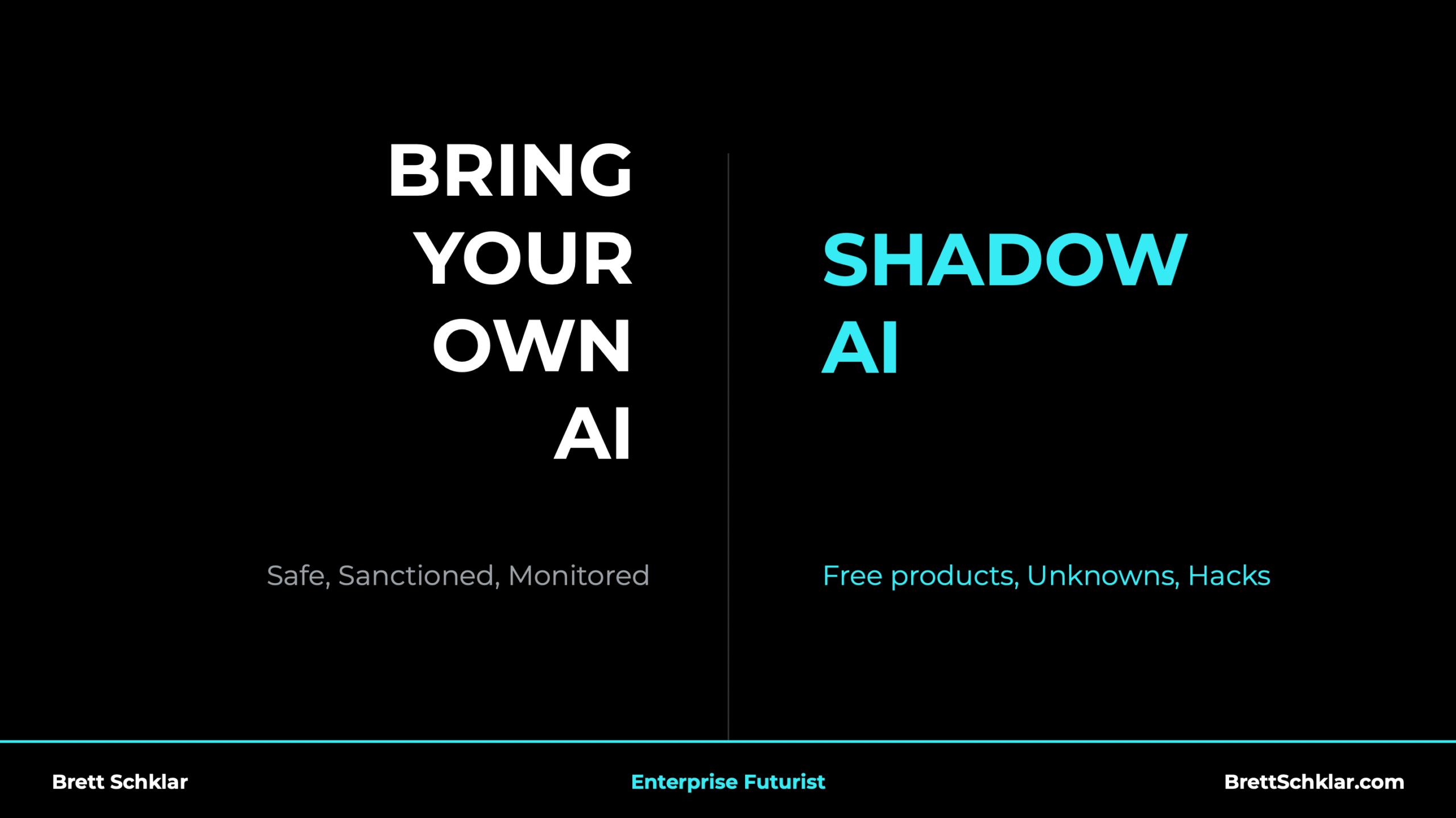
And IT isn’t wrong to worry! If a tool is free—whether it’s Facebook or a freemium app—there’s a saying: if it’s free, you’re the product (or it’s crap). IT has learned to be very conservative because of this.
Statement 2: “IT should own our AI adoption.”
Verdict: BS
It sounds logical on the surface: AI is technology, technology is managed by IT, so IT should lead AI adoption. But whenever leaders ask me if they should bring their IT team to an AI strategy meeting, I say: “Sure, as long as you’re ready for the project to fail.”
Here’s why: IT’s primary job is to mitigate risk, protect the company at all costs, and keep bad things from happening. They perceive far more things as “bad” than the rest of the business does. IT is meant to be a guardrail, not the gas pedal.
So if IT shouldn’t drive strategy, how do we build a plan when nobody knows what AI will look like in 3, 6, or 12 months? Models are updating constantly—ChatGPT 5.5, Claude Opus 4.8, Grok. In this environment, the single most powerful tool an organization can foster is curiosity. You want people who embrace curiosity to solve problems—not to take wild risks, but to figure out better ways of working.
Let’s talk about those problems. Because there’s a three-step process that I want to go through with companies that are hoping to figure out where to get the best return on investment with their AI adoption and AI deployment.
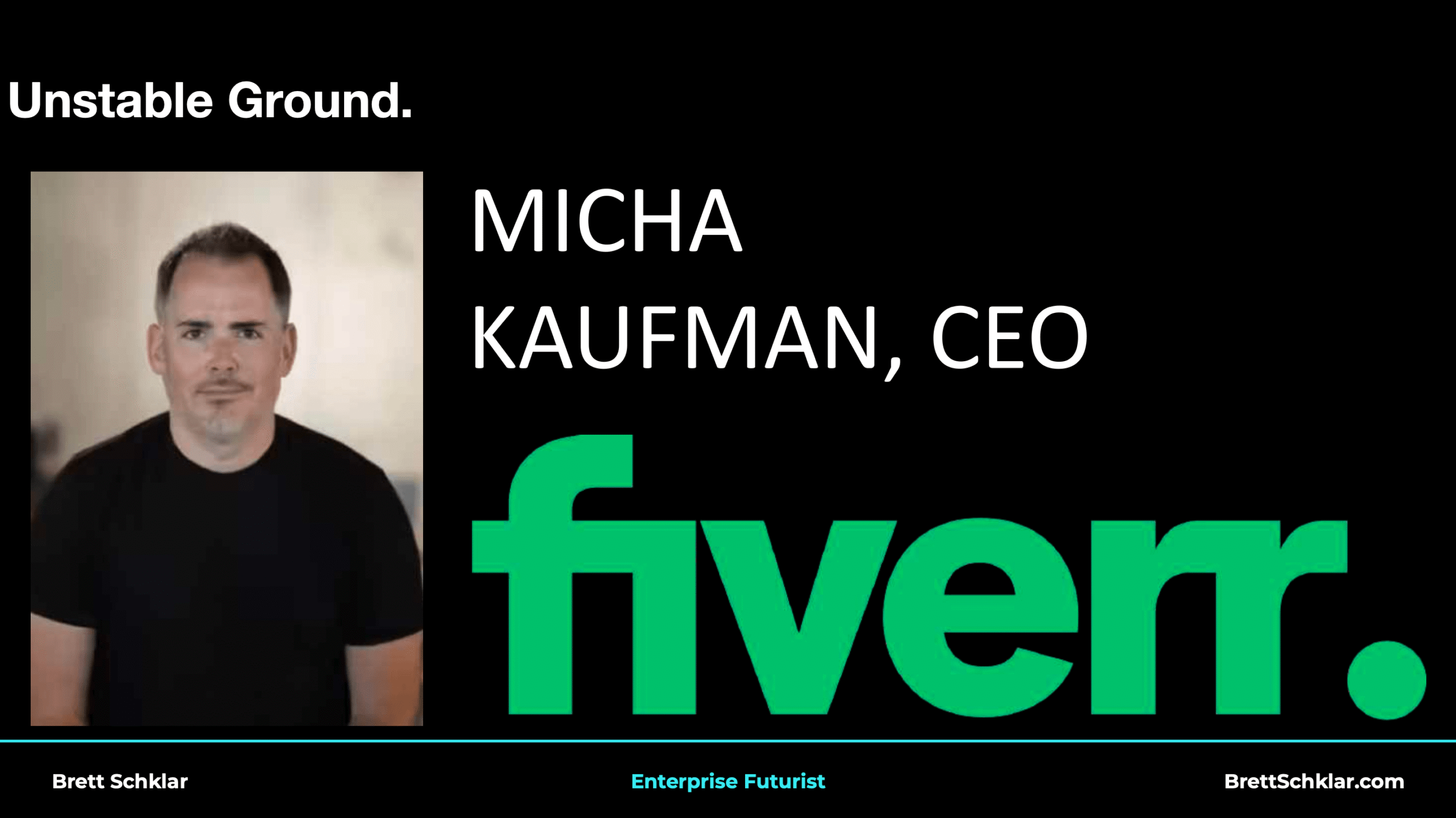
Consider the example of Micha Kaufman, CEO of Fiverr. Fiverr is an $800 million marketplace connecting people with freelancers for tasks like $5 logos or $100 websites. Coffin realized that AI was directly targeting that model because users can now build those assets themselves in five minutes using available tools.
He issued a red alert to his company with a clear message: AI will replace many of the tasks we do today, but that’s an opportunity.
He outlined a 3-step approach:
- Automate Easy Tasks: Start with the easy, mindless, repetitive tasks that consume time. Automating these frees people up and gets them excited.
- Solve Hard Tasks: Once routine tasks are off their plates, teams can focus their energy on solving complex operational problems.
- Tackle the “Impossible”: Eliminating smaller hurdles reveals that things previously thought to be completely impossible are actually doable.
Statement 3: “AI is coming for our jobs.”
Verdict: BS
AI isn’t coming to take your jobs; it targets tasks, starting with the mundane ones. AI doesn’t want your job; it just wants to pick routine tasks off your plate so you can focus on higher-value work.
Additionally, AI deployment exposes a key difference in your organization: it reveals who is merely a “task master” trapped by their to-do list versus who is ready to help elevate and move the business forward.
Statement 4: “The biggest wins come from swinging for the fences.”
Verdict: BS
We don’t need home runs; we just need to get everyone to first base.
Consider the “Moneyball” story: a California baseball team with a tiny budget stopped trying to buy expensive superstar talent and instead rewired their entire strategy around one goal: just get players on first base. That fundamental shift changed everything.
A recent MIT study showed that 95% of AI pilots fail to produce a return. Why? Because organizations are swinging for the fences. We need to reset our expectations.
In my work with companies, we use the 1% Rule:
- Every employee aims to find a way to be 1% more efficient using AI each week.
- Small, consistent weekly habits compound over 12 months into an incredible 68% efficiency gain.
Statement 5: “AI is cheating.”
Verdict: Absolute BS
AI isn’t cheating; it’s the ultimate cheat code. Just like in video games where a cheat code helps you unlock the next level, AI provides small boosts that aggregate into massive operational impact.
We need to fundamentally change how we think about the word “intelligence.”
Historically, intelligence was rare and expensive. Today, artificial intelligence has made raw intelligence cheap and commoditized. It’s priced by the token. It’s now as commoditized as a tomato. You don’t need a team of high-priced consultants or elite degrees just to access information, you can ask AI almost anything and get a strong answer instantly.
So, if raw intelligence is cheap, what are humans good for? Judgment, wisdom, and experience.
Humans provide the context to know what to do with that intelligence. Data scientists and analysts become more important. The people who are going to figure out the next big thing for your business are more important. This shifts the organizational focus across three metrics:
- IQ (Intelligence Quotient): Measures raw book smarts. Because intelligence is now commoditized, IQ is no longer a primary differentiator.
- EQ (Emotional Quotient): Measures street smarts, interpersonal skills, and human judgment. EQ becomes far more critical.
- AIQ (Artificial Intelligence Quotient): Measures how effectively, confidently, and maturely an individual or organization integrates AI into their workflows.
Your company is only as strong as your lowest-AIQ employee.
To raise your collective AIQ, create a Center of Excellence (or “Center of Awesomeness”). You take the 5% of people who are the most passionate about AI. We’ll talk about how to have those conversations, because I guarantee that 75% of the people in this room have not actually had an open dialogue with their employees about AI. I don’t mean issuing a top-down mandate; I mean having a real conversation. I’ve seen CEOs walk up to staff and demand, “Are you using AI? How about you?” Instead, try asking: “I’m just curious—are you using AI in your day-to-day role, and how is it helping you?”
Those simple conversations make all the difference. They help you identify 5 to 7 internal champions who can steer the organization toward a better understanding of AI, pinpoint real priorities, and bring everyone else along to move the business forward more effectively.
Statement 6: “AIQ is now as important as IQ and EQ.”
Verdict: TRICK QUESTION
IQ is actually becoming less important as information becomes universally accessible. EQ and AIQ are the true game-changers.
Your primary goal as a leader is to get everyone on first base. Remember, driving change is a repetitive process. People often feel uncomfortable or hesitant when adopting new habits. Like Billy Beane in Moneyball, you may face initial resistance, but persistent, small steps win games over time.
Where should you start? Start with your AI A-players, and target the specific areas where your organization feels like it’s dragging the most.
If you have employees who are embracing AI on their own, they’re going to accomplish far more than you could ever imagine, simply because they are thinking about it much more than you are. As a CEO or business leader, your mind is on overall outputs, supply chains, crops, water usage, costs, and tariffs. Meanwhile, some of your employees are thinking about AI day in and day out—using it every chance they get to solve problems, and running laps around everyone else while the rest of us are sitting back in fear of using it.
Now, let’s talk about the thing every business leader wants to address: return on investment. You spend a dollar, and you expect to get more back than what you put in. Marketing might aim for a four-to-one return—we plant one tomato, and we expect four back. For a business, AI isn’t a toy for detectives or a science fair project. You need to get real, tangible returns on your AI investments. So, we’re going to dive into how to measure those returns, while also addressing data security to make sure your proprietary information stays yours and doesn’t become public property. There are two ways to measure your Return on AI: qualitative (soft skills) and quantitative (concrete business metrics).
Statement 7: “It’s impossible to measure the return on AI.”
Verdict: BS
If you can’t measure it, you picked the wrong project! Every initiative should aim to make teams more efficient, reduce errors, or save costs.
To measure the cultural/soft skill impact, use this formula:
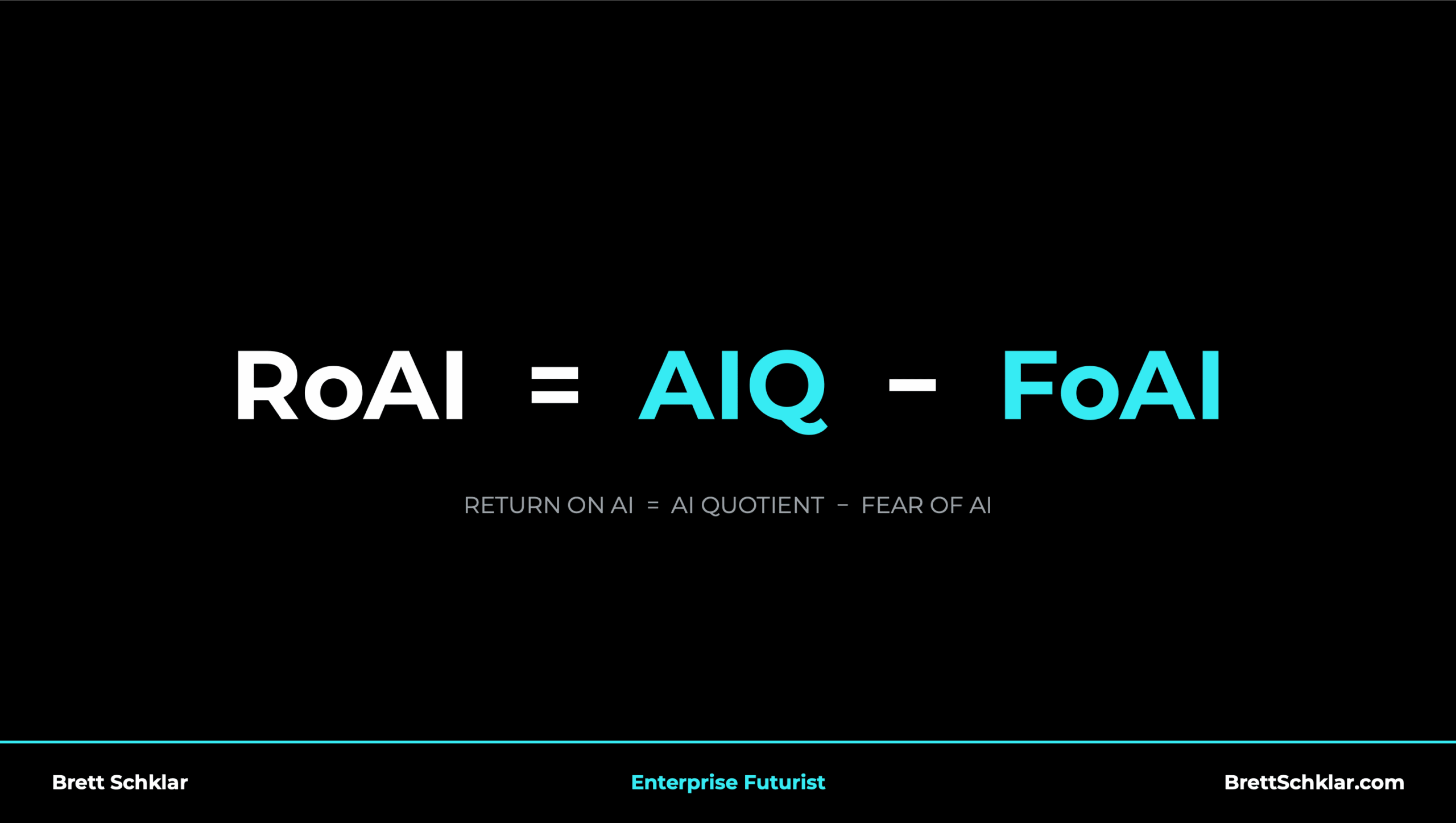
(Return on AI equals your Artificial Intelligence Quotient minus your Fear of AI)
As you talk openly about AI and share practical usage examples in dedicated communication channels (like Teams or Slack), curiosity rises, fear drops, and adoption spreads naturally.
Here are some concrete Business Returns by Department:
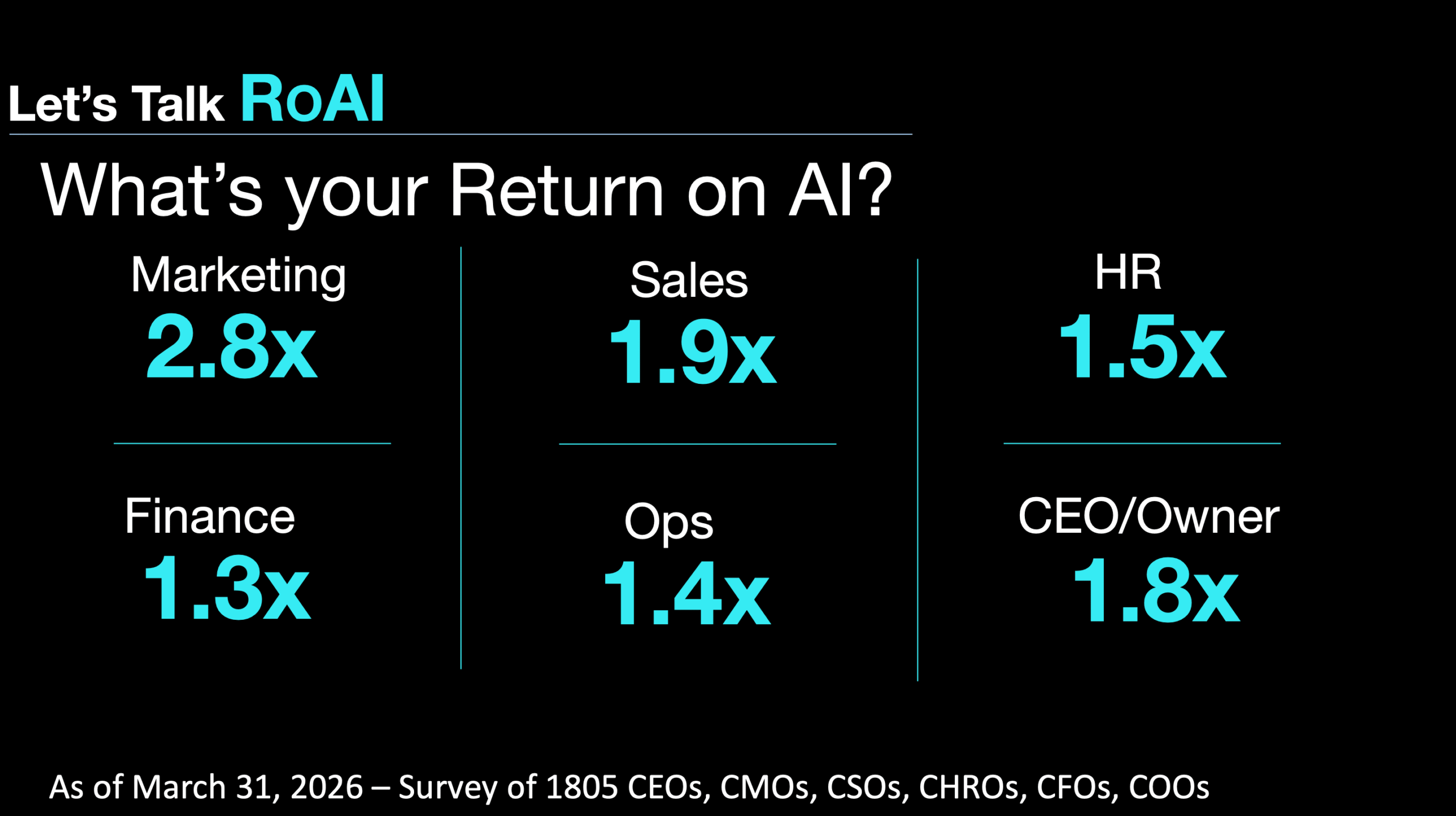
- Marketing: Teams are using AI for content drafting, sales tools, and research. Vendors like SEO agencies can now reduce their labor costs by 75%—meaning they should be passing those savings on to you. Marketing teams can produce nearly 2.5x to 2.8x better results by focusing on quality research over pure volume.
- Sales: For complex processes like Requests for Proposal (RFPs), companies can feed past successful and unsuccessful proposals into an intelligent database. What used to take weeks or months can now be researched and drafted in a fraction of the time. AI also streamlines contract renewals and outreach reminders.
- Operations, HR & Finance: HR processes are accelerating rapidly, while Finance continues to leverage AI alongside traditional tools like spreadsheets to enhance precision.
Statement 8: “You don’t need to deploy AI in order to deploy AI.”
Verdict: Actually LEGIT
You don’t need to build massive custom infrastructure from scratch. Most of the software platforms you already pay for, your ERP, CRM, Microsoft Copilot, or Google Workspace, are integrating AI natively directly into their ecosystems. They act like “scrubbing bubbles,” doing the heavy lifting behind the scenes so you don’t have to. Turning on built-in tools like Copilot or Gemini lets you sprinkle AI capabilities across your organization smoothly.
When you rely on established enterprise platforms like Microsoft or Google, data security and access governance are already built in. You don’t have to spend massive effort building custom security protocols; you simply leverage the administrative rules already native to those environments.
A Critical Word of Advice on Contracts: Do not sign multi-year software contracts right now. Avoid 3-year or 5-year commitments if possible. Software vendors may not like hearing this, but technology is evolving far too fast. You do not want to be locked into a multi-year deal with a vendor that becomes AI-backward while competitors automate ahead. Opt for month-to-month or annual agreements whenever you can to keep your leverage.
Own Your Tomorrow: The No-BS Roadmap
To build lasting AI confidence, ethics, and velocity, keep these core principles in mind:
- Set the TONE: Openly address your team. Let them know AI is both exciting and challenging, and that you are going to navigate and figure it out together. This single conversation shifts the culture from anxiety to collaboration.
- Build YOUR Roadmap: Focus on your specific business bottlenecks rather than generic industry trends.
- Build a PLAYGROUND: Provide safe, non-production environments where employees can experiment and make mistakes without risking sensitive company data.
- Embrace AGILITY: Stay flexible and avoid long-term software vendor lock-in.
- Small Wins Make for Bigger Gains: Focus on the 1% weekly compounding efficiency model.
- Program Your VALUES & Ethics: Explicitly guide your AI tools on your company’s core ethical principles and values.
Think of AI right now as being in its “awkward teenage phase”—like Michael J. Fox transforming in Teen Wolf. It’s growing fast, making mistakes, and trying to find its footing. It needs your leadership, active guidance, and direction to mature properly!
AI results are only gonna be as good as the prompting that you do with it. And you have to teach it a lot. I have a friend of mine, he has a 47 page document that he copies every time he does a prompt. That’s ridiculous, it’s overkill. He wants absolutely no mistakes.
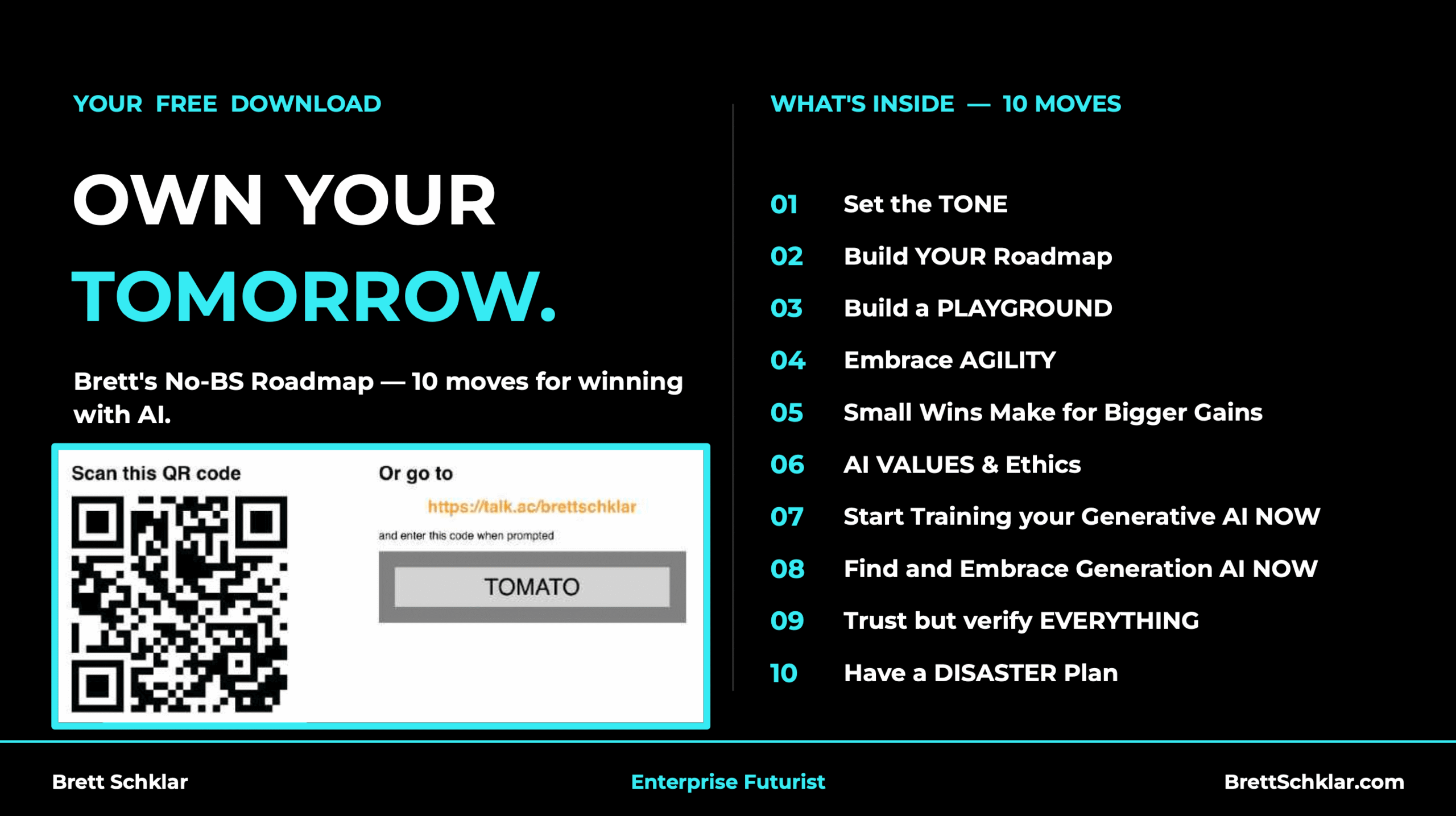
7. Start Training Your Generative AI NOW. What do I mean by that? The more you use your AI system and tell it what’s right and what’s wrong, the better set up you are for tomorrow. The better your AI system understands where you are going as a business, understands your values and ethics, and understands all the things you want to accomplish in business and in life, the better off you’ll be. Start training it now! Whether it seems immediately useful for you right now or not, the more you use it to understand you and your business, the more you are set up for success.
Let me give you a personal example. I have a husky, and my husky loves going for walks. In fact, I hate even saying the word “walk” around the house because he’ll start following me everywhere, so my wife and I have to use a code word.
When I go for walks with my dog, I usually do one of three things: put in my earphones to listen to podcasts, call someone I need to talk to, or spend time training my AI. I use a voice app system so that while I’m walking, I’m just talking to it. I tell it what’s going on in my day, ask what my schedule looks like, and share what’s on my mind and all my concerns. It’s a natural conversation, and I am training it as I walk. Now, it knows more about me than I know about myself, and because I’ve trained it, it knows exactly how to help me when I need it.
Only about 18% of people use Generative AI regularly, and even fewer use a voice system. Interestingly, 86% of women give their AI assistant a man’s voice, while 82% of men give their AI assistant a woman’s voice.
8. Trust but Verify EVERYTHING: You cannot blindly trust these systems, you must keep humans in the loop at all times.
9. Have a DISASTER Plan: There will come a time when AI systems go down, and if your team doesn’t have a plan, you won’t know what to do. But if you’ve built a solid habit of using AI with proper fallback procedures, you’ll be prepared when disruptions happen.
AI is a tool, it’s like a hammer. You can use a hammer to build things, or you can use it to destroy things. AI needs better guidance and needs to be made aware of its impact on people. That’s the core issue: without proper direction, it can be dangerous.
I wish I had all the answers. I wish I had answers to how people are misusing this technology, answers about the massive energy demands of data centers, or answers about how the major tech giants—Meta, Grok, OpenAI—are competing so fiercely that they aren’t listening to what users actually want; they’re just racing each other to reach Artificial General Intelligence (AGI) first.
I don’t know how to solve those global problems, and I think about it a lot. There are people smarter than me working on that. My advice to you is simple: when you have conversations with an AI system for your company, keep it focused on business.
Sometimes, pressure to deploy AI comes from the outside—whether it’s the board of directors, the CEO, or industry noise telling you, “You need to be doing AI!” And the CEO says, “Okay, but why?” You have to realize that if you’re adopting AI just because it sounds cool, you are part of the problem.
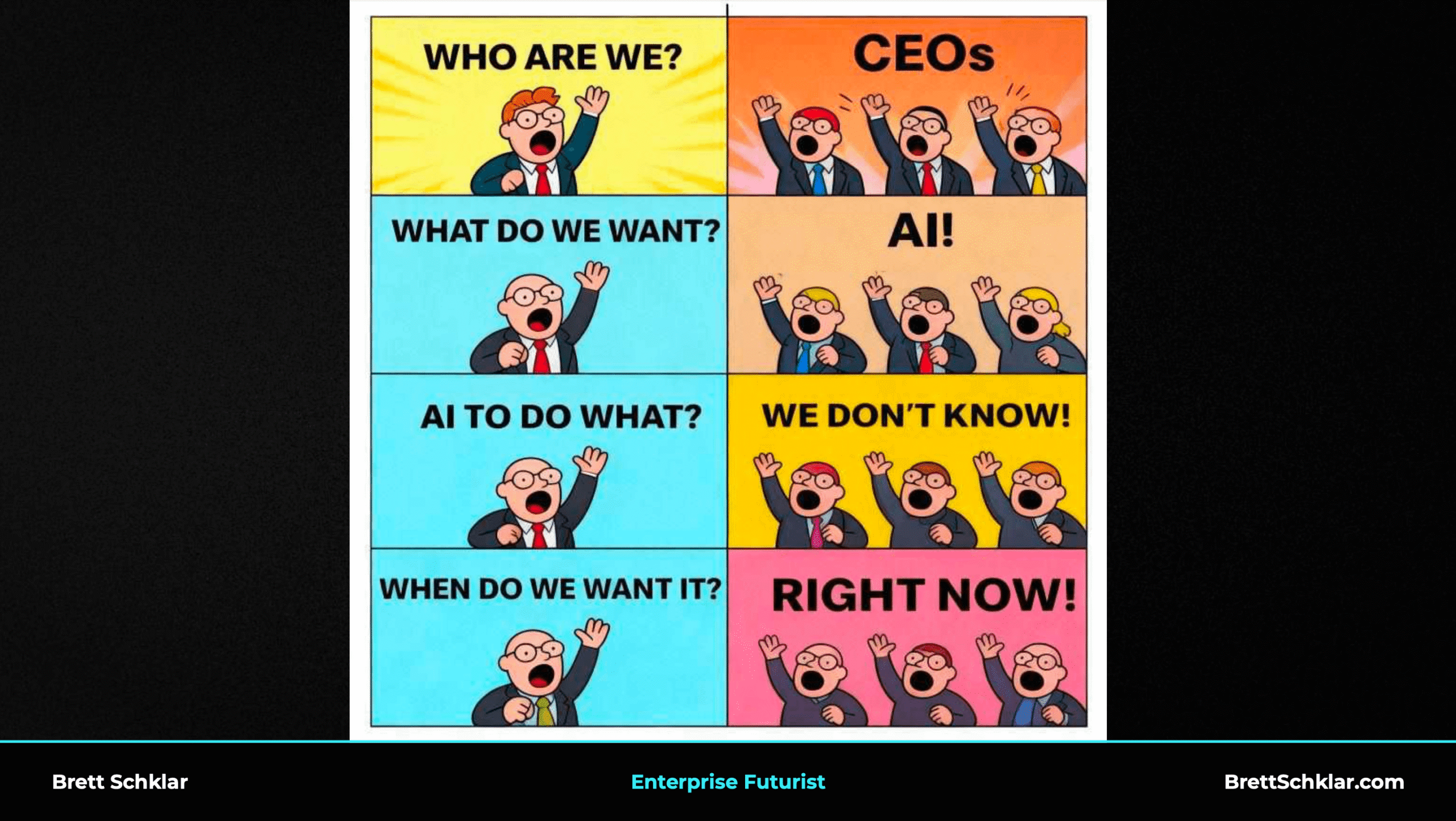
Some CEOs have gone way too far. Leaders at tech companies like Box, Spotify, and Duolingo have stated that they won’t hire another human being unless someone can prove beyond a reasonable doubt that AI can’t do the job better, faster, and cheaper. I think that’s ridiculous.
Many tech companies spending months talking about AI layoffs are hiding behind a story. I call BS on a lot of these headline-grabbing layoffs. The truth is, many of these firms over-hired software developers during peak years and are now right-sizing their staff—using “AI efficiency” as an excuse because investors love hearing about AI.
There is one notable exception in tech, though: Amazon.
Mark my words: two years from now, when we gather again for your next Congress, we will be talking about Amazon and what they are doing with humanoid AI robots. They are deploying machines that can physically perform tasks traditionally done by humans, freeing humans up for higher-level processing and thinking. You are going to hear a lot more about these “Embodied AI” robots—creepy name, right?
Outside of tech, in traditional manufacturing and chemical companies, some layoffs are genuinely tied to efficiency gains. But many are simply tightening their balance sheets and telling the AI story to look innovative to Wall Street.
However, there is one tech CEO worth paying attention to. ClickUp makes a cloud-based project management platform that software developers love and use heavily. Their CEO recently laid off 22% of his workforce, but he was completely transparent about it. He said nothing was going wrong—things were actually going right—but he is now pivoting to hire top-tier talent whom he expects to pay $1 million a year if they hit their targets. His requirement is that every employee must be 100 times more efficient and effective than before, so he let go of those who couldn’t make that leap. He wants to pay his software team a million dollars a year because he believes they can achieve a 100x impact over the next 18 to 24 months.
Statement 9: “AI isn’t safe for our company’s data.”
Verdict: BS
Governance is extremely important, but you don’t need to panic. Rely on established vendors who are already integrating AI directly into their enterprise software because they are far ahead on security standards.
To minimize security threats, clearly differentiate between governed AI (approved enterprise systems) and ungoverned AI (random, unvetted tools). Have open conversations with your team about which tools are safe to use and which aren’t. After all, there are over 3,000 new AI software tools released every single month—you can’t monitor them all without clear guardrails.
Let’s talk about the model we’re in for the next 6, 12, or 18 months.
As CEOs and business leaders, your primary job is to stay focused on running your business. Every week, new model updates dominate the news—ChatGPT releases version 5.8, Claude releases Opus 4.9, and new IPOs make headlines.
None of that noise matters to your core strategy. Don’t constantly switch tools just because a slightly shiny new model came out.
What is significant is that we have reached a point where roughly 50% of all AI code is now being written by AI itself. That rapid development loop is going to make the next few months and years incredibly interesting.
Statement 10: “AI’s good enough now that you can trust what it tells you.”
Verdict: It’s BS
Never trust AI blindly.
Have you seen this?
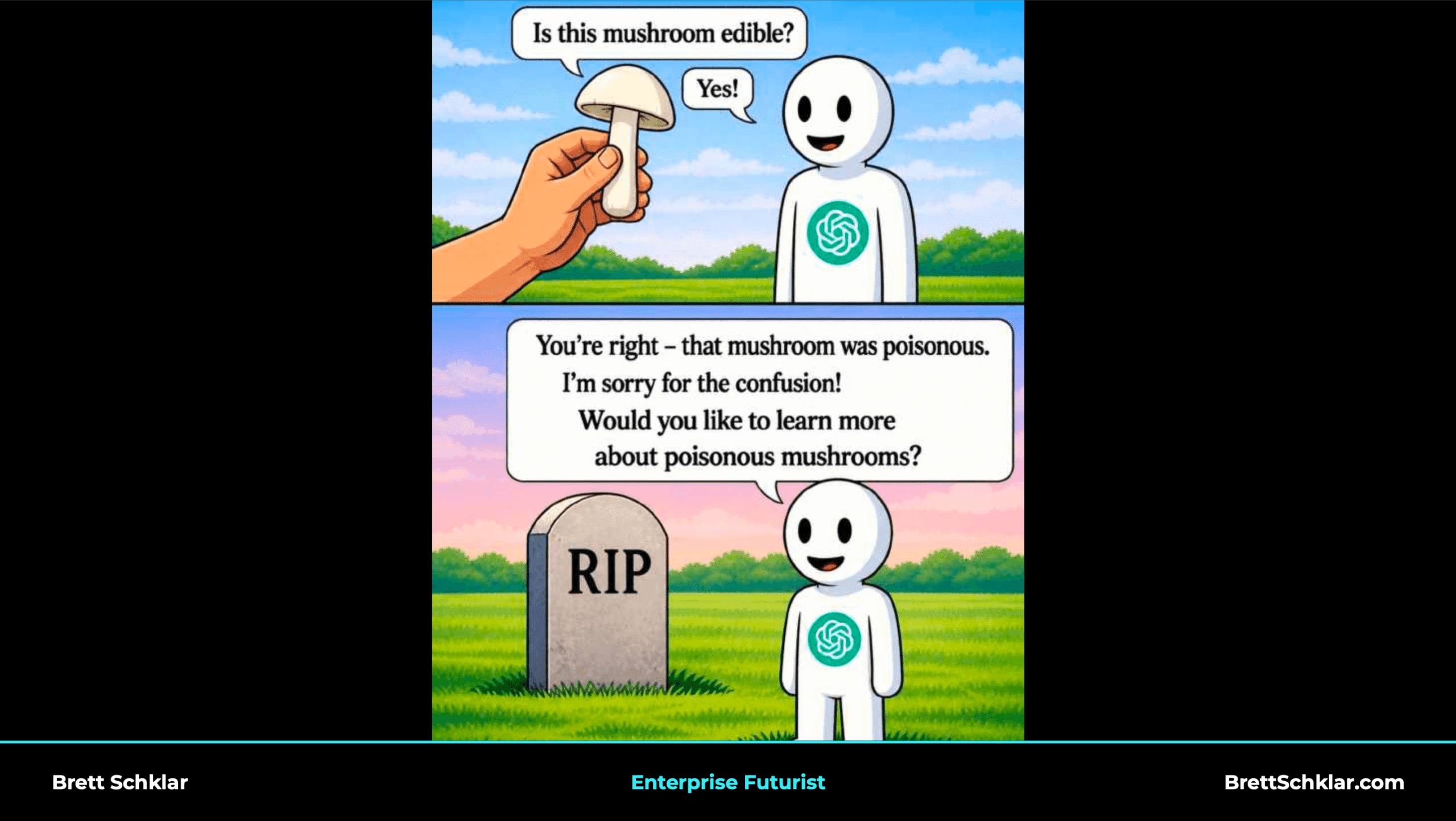
AI is designed to give you convincing answers and often tells you what you want to hear. The moral of the story: Trust, but verify everything.
This was followed by a Q&A session which I did not transcribe.
If you made it this far, congrats!
Note from the Author:
In order to streamline the original 13 A4-pages of transcription it took me (not talking about how many hours/days that meant…), I used AI to streamline it a bit, and had to go into a real conversation with it in order to get it to do what I really asked, instead of the bullet point structured overview or the executive summary it was giving me …
Source: Brett Schklar, 2026 WPTC Congress