News
New Tool Maps California’s Water Future
Managing California’s water system has long involved balancing the competing demands of agricultural irrigation, urban consumption, and ecosystem conservation. As climate volatility intensifies the region’s dry and wet cycles, a new project led by the University of California, Berkeley aims to clarify how shifted management priorities and climate change could affect the state’s agricultural footprint and surrounding communities.
Supported by a California Climate Action Grant, the Collaboratory for Equity in Water Allocation (COEQWAL) has introduced an online platform designed to make state water data accessible to the public and industry decision-makers. Unveiled on Sept. 3, the COEQWAL site (https://coeqwal.org/) processes and visualizes data from more than 100 water management scenarios using CalSim 3, the primary planning tool operated by the California Department of Water Resources.
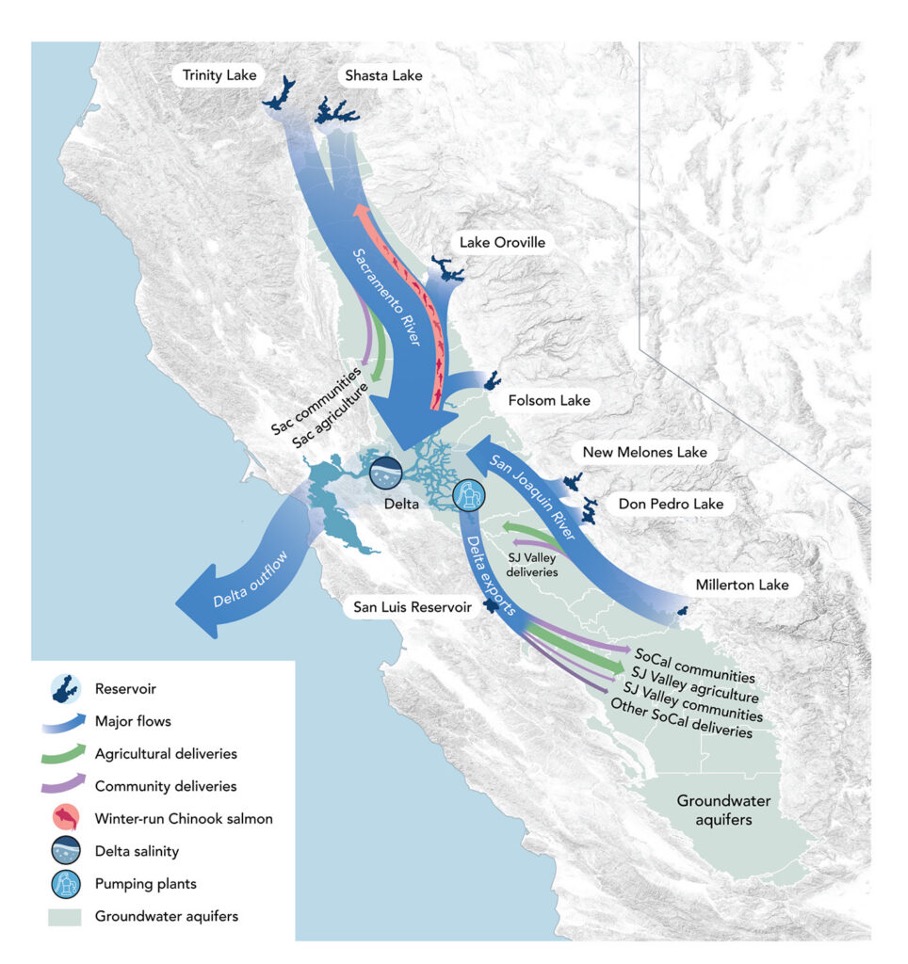
The modeling tool allows users to evaluate potential policy shifts, including regulations governing sustainable groundwater usage in the Central Valley, increased river flows for salmon habitats, and drinking water availability.
“CalSim is a very complex model in part because it’s a very complex system, but the way it was designed makes it almost impossible for anyone other than a highly specialized engineer to interact with the data,” said project lead Ted Grantham, an associate professor of cooperative extension in Berkeley’s Department of Environmental Science, Policy and Management. “A big part of what we wanted to do with this project is explore a much broader range of scenarios [than have been published by the Department of Water Resources] to help people understand not only how water is managed today, but what’s possible in the future.”
To build the scenarios, the research team conducted workshops with nearly 100 organizations spanning environmental justice groups, water districts, tribal organizations, and agricultural stakeholders.
“It’s really, really unique to be asked, ‘What if we managed water for entirely different priorities than we do today?’” said Jonathan Rosenfield, science director at San Francisco Baykeeper, who participated in a number of the workshops. “Usually, when you get access to the CalSim model, you’re creating alternative management scenarios that differ really around the margins. It’s not, ‘What if we reoriented our water management to a different kind of future?’ This is a real example of the university helping the public and decision-makers understand their options.”
Data accessibility is central to the project, giving smaller regional entities direct insight into complex hydrological models that directly impact farming and local infrastructure.
“Being able to have access to some of this modeling and understand the complex elements that currently interact and influence the Delta watershed is going to be very, very powerful for tiny organizations like ours,” said Morgen Snyder, director of policy and programs at Restore the Delta. “I am really impressed with the way the COEQWAL team has brought together a myriad of different stakeholders — water contractors, water districts, environmental justice groups and tribal organizations — and using science to find a common path forward.”
Despite concerns regarding how stricter environmental or groundwater controls might destabilize water supply lines, project organizers noted that the interconnectedness of California’s reservoirs, rivers, and aqueducts provides notable resilience.
“We found that a lot of these strategies don’t have as big of an impact as you might expect,” Grantham said. “It shows that we’re not risking putting the entire system at collapse by sustainably managing groundwater or protecting the environment or ensuring that everyone has access to clean drinking water. We can actually do these things. They may come with trade-offs, but they are trade-offs that we can manage.”
Looking ahead, the COEQWAL team has secured additional funding from the Delta Science Program to expand the platform’s scope toward tribal engagement. The next iteration aims to model Indigenous relationships with water that extend beyond traditional quantitative metrics.
“We want to explore how we can better integrate or weave these values and relationships to water into how we represent them in these models,” Grantham said. “We’d like to try to draw attention to the fact that these systems are much more than just a volume of acre feet being delivered from point A to point B.”
COEQWAL operates as a multi-institutional collaboration involving UC Berkeley, UC Agriculture and Natural Resources, UC Davis, UC Merced, UC Santa Cruz, UC San Diego, UCLA, California State University, and other regional partners.
Sources: UC Berkeley, COEQWAL platform