News
California Water Constraints and the El Niño Transition
The 2026 processing tomato season is currently being shaped by two significant climatic shifts: the depletion of California’s snowpack and the emerging transition toward a potentially strong El Niño pattern. While global reservoir levels remain stable following the 2025 campaign, the rapid loss of mountain snow water equivalent and shifting Pacific temperatures are introducing new variables for the year’s production targets.
California’s Snow Drought and Water Availability
The current situation in California presents a unique challenge for the 2026 crop. Despite surface reservoirs holding near-average levels for late April, the state’s “frozen reservoir”—the Sierra Nevada snowpack—has experienced a significant and premature melt.
Recent surveys from the California Department of Water Resources (DWR) indicate that statewide snowpack has dropped to roughly 18% of the April 1 average, with the Northern Sierra reporting levels as low as 6%.
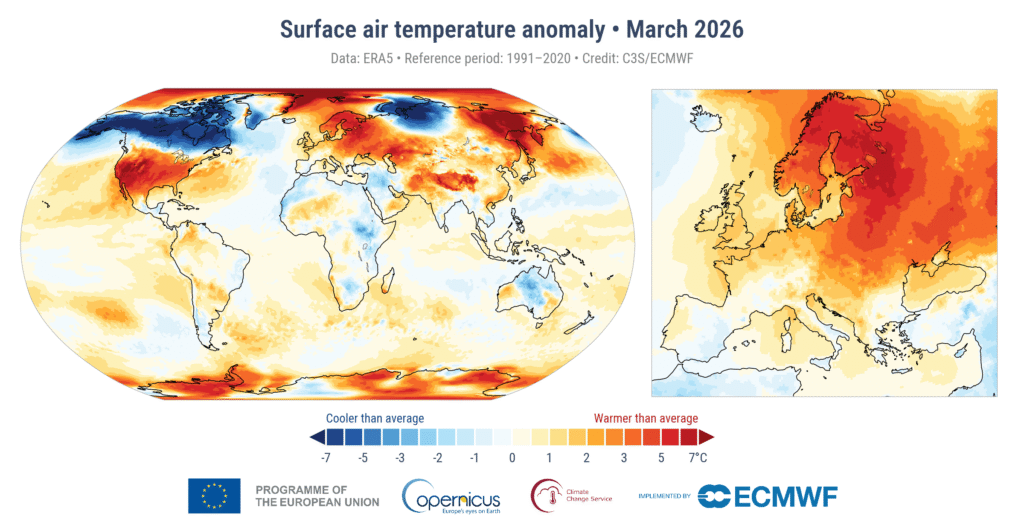
Data from the Copernicus Climate Change Service contextualizes these local conditions within a broader global trend of thermal extremes. During the early spring, the United States experienced a sustained heatwave that disproportionately affected western regions, breaking numerous March temperature records and accelerating the runoff of the snowpack into storage. This intense regional warmth stood in sharp contrast to the unusually cold anomalies observed across Alaska, much of Canada, and southern Greenland. Similar temperature spikes were noted across the Arctic and northeast Russia, while northwest Siberia experienced cooler-than-average conditions. This premature heat in the West has left little snow to replenish water systems later in the season.
Consequently, the Central Valley Project (CVP) has maintained conservative initial water allocations. For growers, this suggests a season where irrigation timing and groundwater management will be critical to meeting tonnage goals, as the natural buffer provided by summer snowmelt is largely absent.
The Return of El Niño: Global Production Impacts
On a global scale, the World Meteorological Organization (WMO) and NOAA have confirmed an active El Niño Watch, with a high probability of the cycle fully developing by July 2026. This shift in the Southern Oscillation is expected to alter weather patterns in several key production hubs. In China, the world’s third-largest producer of tomato paste, historical data suggests that El Niño years often bring increased rainfall to major growing provinces during the critical August and September harvest window. This poses a risk to harvest efficiency and final solids content, as excessive moisture can complicate field access and influence Brix levels.
Across the Mediterranean, long-range forecasts from the Copernicus Climate Change Service suggest a higher likelihood of sustained summer heat for major producers in Spain, Italy, and Turkey. While the tomato is a heat-loving crop, growers in these regions are monitoring for the risk of “blossom drop,” which occurs when extreme daytime temperatures consistently exceed 35°C (95°F) during the flowering stage, potentially impacting final yields. As the 2026 campaign progresses, the industry will be watching closely to see if this El Niño intensifies into a “strong” event, which would further heighten the risk of erratic weather during the peak processing months.
Sources: California Department of Water Resources (DWR), NOAA Climate Prediction Center, World Meteorological Organization (WMO), Copernicus Climate Change Service.