News
Bridging India’s Tomato Processing Gap
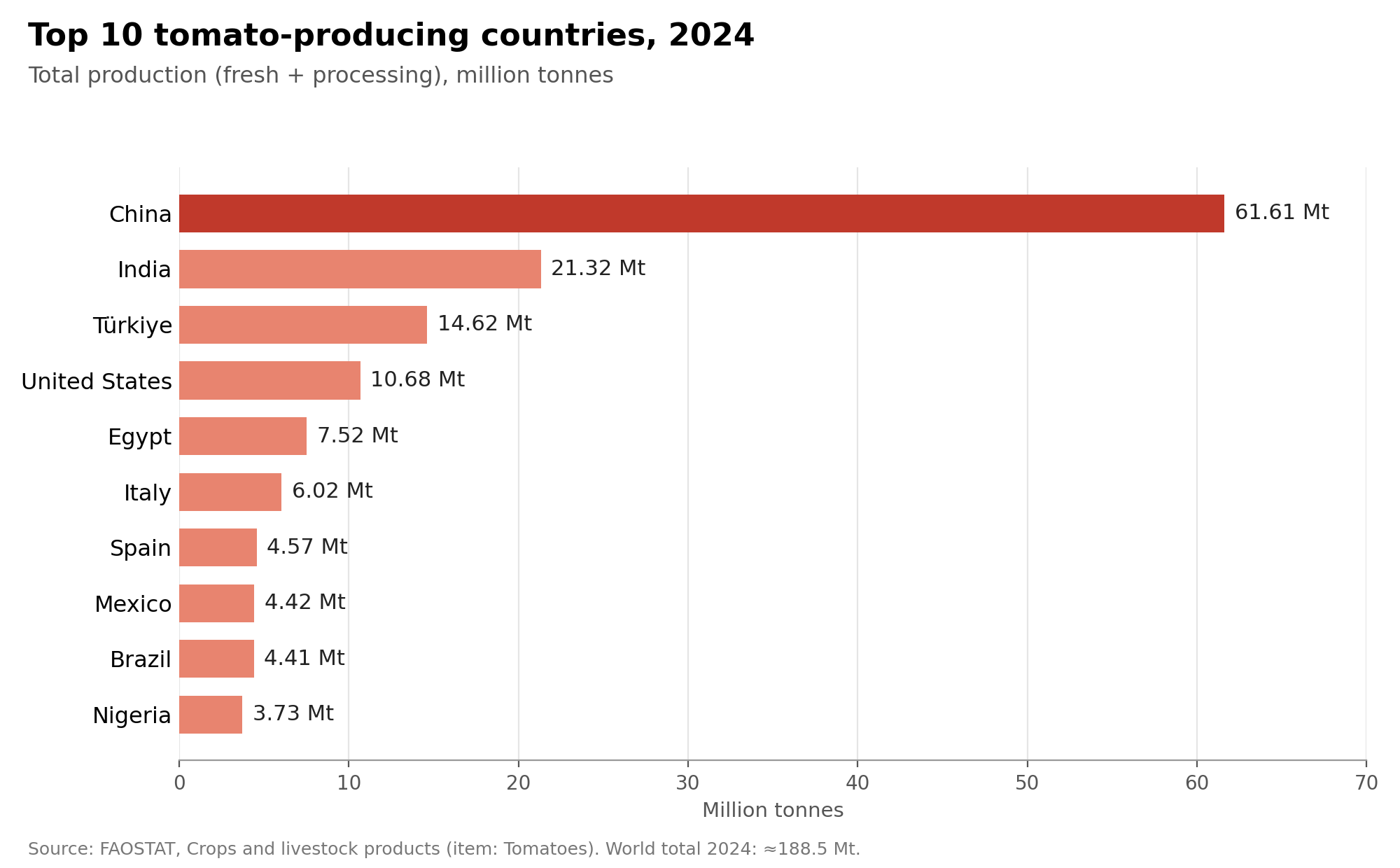
While consumers worldwide enjoy fresh tomatoes on their tables, the global food industry relies on a completely different agricultural engine to supply ketchups, pastes, and juices, with roughly twenty to twenty-five percent of all harvested tomatoes funneled into processing plants globally. Yet, massive agricultural producers like India face a stark industrial paradox: despite producing over twenty-one million tonnes—accounting for more than eleven percent of total world production—the country industrially processes less than one percent of its harvest. A comprehensive scientific review by researchers at the Indian Institute of Vegetable Research explores this exact disconnect, detailing the physiological and genetic bottlenecks holding back the sector and highlighting concrete experimental results designed to close the gap.
To understand how to bridge this chasm, the study investigated why traditional table varieties fail on the factory floor and what specific traits industrial processors actually require. Processing tomatoes cannot simply be surplus fresh fruit; they require high total soluble solids exceeding five and a half degrees Brix. When a tomato packs a higher concentration of natural sugars and soluble components, factories expend significantly less thermal energy and time evaporating water during paste production, which drastically slashes manufacturing costs and increases product recovery. Furthermore, processors demand a low pH below four and a half for natural microbial safety, high lycopene concentrations above twelve milligrams per hundred grams for an intense red color, and a thick outer pericarp wall to survive the crushing weight of bulk transport and mechanical harvesting.
The core of the study shifts from these industrial requirements to actionable solutions, demonstrating how modern breeding science can overcome the historical trade-off between high crop yield and high metabolite concentration. Because these complex traits are controlled by multiple genes and heavily influenced by environmental variables, conventional selection alone is no longer enough. To combat this, the researchers evaluated the integration of advanced molecular tools, including marker-assisted selection, quantitative trait loci mapping, and CRISPR-based gene editing. By targeting master regulators—such as the ripening-inhibitor genes and sugar transporters like Lin5—scientists can breed plants that naturally accumulate more sugars and resist harsh environmental stressors like drought and high heat without sacrificing productivity.
Crucially, the study moves beyond theoretical genetics by showcasing real-world breeding results from their own institutional pipeline. The research team successfully developed and evaluated high-sugar open-pollinated lines and hybrids tailored for industrial use. Promising experimental lines such as VRTH-24-58, VRTH-24-41, and VRTH-24-56 achieved total soluble solids ranging from 5.91 to 5.95 degrees Brix, alongside open-pollinated lines like EC-620456 reaching similar high-sugar milestones. Additionally, advanced hybrids like Kashi Shreshth have been released as dual-purpose varieties suitable for both fresh and processing markets. The study concludes that if India wants to lift its domestic processing sector, it must combine these high-performing genetic lines with stronger public-private partnerships, regional breeding programs tailored to industrial needs and streamlined value chains that turn raw agricultural potential into commercial success.
Sources: FAOSTAT, Current Horticulture
Tiwari, J. K., Singh, J., Singh, M. K., & Rai, N. (2026). Breeding tomato (Solanum lycopersicum) for processing quality: integrated perspectives.
DOI: 10.5958/2455-7560.2026.00032.4






Latest news
Tomato Products Wellness Council Redefines Quality
California: Weekly tonnage as of 17 October 2026
Heritable and Kagome Partner on AI-Driven Disease-Resistant Crops
Final results of the 2026 campaign in Northern Italy: yields among the lowest in recent years
Global Tomato Paste Trade in 2025/2026: slow emergence of secondary origins