
News
Fuelled by unusually warm ocean waters in the tropical Pacific, El Niño conditions are developing and are set to influence global temperature and rainfall patterns, increasing the risk of extreme weather over the coming months, according to the World Meteorological Organization.
On 2 June 2026, the World Meteorological Organization (WMO) has issued an authoritative climate alert, projecting an 80% likelihood that a new El Niño event will officially lock in between June and August 2026. Forecasters are exceptionally confident in the system’s longevity, tracking a 90% probability that conditions will persist through at least November. Fuelled by a massive tropical Pacific heat reservoir with subsurface temperatures measuring a staggering 6°C above average, consensus models indicate this upcoming cycle will be at least moderate, with a distinct potential to become severe.
WMO Secretary-General Celeste Saulo warned that communities worldwide must immediately prepare for volatile environmental disruptions, including intensified droughts, torrential rainfall, and extreme heatwaves. This rapidly developing system threatens to mirror the powerful 2023–2024 El Niño, which famously propelled global temperatures to record-breaking heights. “El Niño conditions will pour fuel on the fire of a warming world,” warned UN Secretary-General António Guterres.
Stressing that the resulting impacts will cross international borders with devastating speed, Guterres called on global leaders to treat the arrival as an urgent mandate to protect vulnerable populations, deploy robust early warning systems, and aggressively accelerate the transition toward renewable energy.
A strong El Niño cycle can present a very specific set of challenges for the global processing tomato industry as it can affect some of the major centres of production. Based on previous major El Niño episodes—most notably 1997–1998, 2015–2016, and 2023–2024—here is the likely global impact on the crop.
Typical effects of El Niño on major tomato processing regions
California
Historically, a strong El Niño acts as a double-edged sword. It typically brings heavy winter and late-spring rainstorms to California. While water is good, timing is everything. Excessive rain in March, April, and May delays the transplanting into the fields. Delayed planting pushes the harvest window deep into September and October. This leaves the ripening fruit highly vulnerable to early autumn rains, which can lower the Brix and trigger devastating outbreaks of mold, fruit rot, and bacterial tomato speck.
The 1997–1998 Super El Niño hammered California’s processing tomato sector. The USDA noted at the time that the 1998 crop was drastically smaller, significantly delayed, and ravaged by wet-weather diseases, causing a sharp dip in global paste inventories.
South America
- Chile: During strong El Niño years, Central Chile experiences dramatically increased rainfall and a high risk of flash flooding. Similar to California, this disrupts spring planting and threatens late-season harvests with rot.
- Brazil: El Niño typically triggers severe droughts in northern Brazil but unseasonably heavy, severe rainfall in the southern agricultural states. This complicates field machinery access and increases reliance on heavy fungicide applications to save the crops.
- Argentina: In the western Cuyo region (Mendoza and San Juan), atmospheric instability triggers fierce convective storms and catastrophic hail that can instantly shred entire fields. Yet, the heavy mountain snowfall provides a crucial silver lining: massive reservoir recharge that secures water rights for the subsequent two growing seasons.
- Peru: The arid coastal valleys, which usually enjoy stable desert conditions perfect for tomatoes, experiences some of the most violent and immediate agricultural disruptions during a strong El Niño due to the rapid warming of adjacent Pacific waters.
The Mediterranean area
Here, the correlation between El Niño and Mediterranean weather is less direct than it is in the Americas. However, historical data shows El Niño years often correlate with more volatile, intense summer heatwaves across Southern Europe. Extreme temperatures above 35°C during summer flowering can cause blossom drop, where the plants fail to set fruit, ultimately capping overall yield potential.
China
Xinjiang’s and Inner Mongolia’s continental climate is largely insulated from direct El Niño ocean dynamics, but it can lead to very high temperatures which may negatively impact blossom and fruit set.
Australia
El Niño brings hotter, significantly drier conditions to southeastern Australia. The immediate threat is water scarcity. Irrigation water allocation prices in the Murray-Darling Basin often skyrocket during drought years, dramatically increasing production costs for growers. Furthermore, prolonged heatwaves exceeding 35°C can cause blossom drop and cause sunscald on ripening tomatoes. On the upside, the dry weather drastically reduces fungal diseases, black mold, and rot. If growers have secured water rights, they often see an uninterrupted harvest with exceptionally high Brix levels.
South Africa
In the dominant Limpopo Province, El Niño generally brings intense summer heatwaves and severe drought. Plummeting water reserves force processors to scale back their planted acreage significantly, while extreme solar radiation causes widespread sunscald, ruining fruit quality before it can be mechanically harvested.
Regional Risk Profile Summary
| Region | Typical El Niño Weather Shift | Primary Threat to Processing Tomatoes |
| California | Wet, cool winters & late spring rains | Delayed planting, compressed harvest, autumn fruit rot |
| Chile | Increased rainfall & flash flood risks | Muddy fields blocking machinery, root rot, delayed cycles |
| Brazil | Increased rainfall | Muddy fields blocking machinery and disease outbreaks |
| Argentina | Convective hail & harvest rains | High localized crop damage risk but good long-term water |
| Peru | Flooding, high humidity, warm nights | Severe risk of total crop failure and disease outbreaks |
| Mediterranean area | Limited but can bring unpredictable, intense summer heatwaves | Blossom drop, accelerated crop maturity, water constraints |
| China | Weak direct correlation | Blossom drop if high temperatures. |
| Australia | High water prices & heatwaves | Reduced yields but excellent fruit quality/Brix |
Background
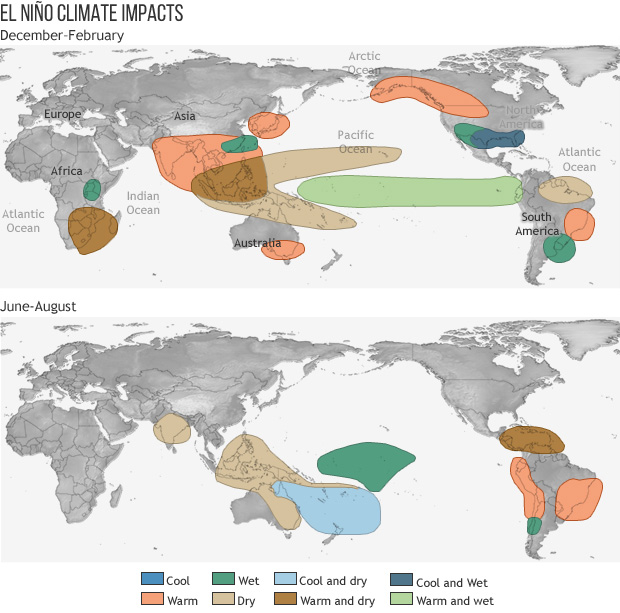
Source: NOAA
Sources: WMO, NOAA, WPTC














