News
Research: Economic and Environmental Impact of Innovative Tomato Peeling Methods
A study from the University of Salerno and ENEA in Italy published in Sustainabilty presents a comparative assessment of the economic and environmental impacts of adopting innovative peeling technologies, including infrared, ohmic heating-assisted lye, and ultrasound-assisted lye peeling, relative to conventional steam and lye peeling methods. The impacts of these methods on productivity, water and energy consumption, wastewater generation, and environmental footprint using Life Cycle Assessment methodology, were evaluated.
Peeling is a key step in the industrial production of canned peeled tomatoes, vital for optimizing efficiency, yield, product quality, waste reduction, and environmental impact.
Chemical peeling via lye solution and steam peeling methods have long been prevalent in the tomato processing industry. These methods boast scalability and ease of operation. Lye peeling typically involves immersing tomatoes in a hot solution of NaOH at various concentrations (8–25%) for a predefined time (15–60 s), effectively removing the outer peel through a synergistic combination of high temperature and chemical reaction. This approach is favored in the fruits and vegetables industry due to its efficacy, versatility, and superior product quality. However, the generation of wastewater with high pH and chemical oxygen demand (COD), along with potential chemical residue presence inside the fruits, poses environmental and food safety concerns.
During steam peeling, the tomatoes are rapidly heated in a scalder by pressurized steam (50–200 kPa) before undergoing vacuum cooling and mechanical skin removal. The steam heats the outer layer of the fruit, causing the moisture beneath the skin to rapidly vaporize during the vacuum cooling stage. This buildup of vapor loosens the skin, creating cracks that make it easy to peel off. Although steam peeling is a more eco-friendly alternative to lye peeling, it often results in softer fruit, reduced firmness, and greater peel loss. Both methods, however, are energy- and water-intensive and produce substantial amounts of wastewater.
In response to these challenges, research is increasingly focusing on innovative and sustainable peeling techniques that reduce or eliminate chemical substances, minimize water and energy consumption, and improve yields and product quality. Among these approaches, unconventional technologies such as infrared radiation (IR) heating, ohmic heating (OH), ultrasound (US), and pulsed electric fields (PEF) are gaining significant attention. These methods offer promising alternatives or complements to traditional peeling techniques, paving the way for sustainable and efficient fruit and vegetable processing.
The study presents a comparative assessment of the economic and environmental impacts of adopting innovative peeling technologies, including infrared (IR), ohmic heating-assisted lye (OH-lye), and ultrasound-assisted lye (US-lye) peeling, relative to conventional steam and lye peeling methods. Focusing on a medium-sized Italian tomato processor, the impacts of these methods on productivity, water and energy consumption, wastewater generation, and environmental footprint using Life Cycle Assessment (LCA) methodology, were evaluated.
Findings from this preliminary research indicate that adopting innovative peeling techniques like US-lye, OH-lye, or IR, known for high peeling efficiency, can enhance production capacity by 2.6–9.2%, boosting revenue by a similar range (2.5–9.2%) and decreasing solid waste generation by 16–52% when compared to conventional peeling methods. However, while OH-lye and IR peeling significantly reduce water and energy usage, these advantages are not consistent across all innovative methods, with US-lye showing higher water and energy demands. Additionally, IR and OH-lye peeling methods either eliminate or significantly lower NaOH requirements, cutting chemical consumption and minimizing wastewater generation. This reduction in wastewater offers substantial environmental and economic advantages by easing the load and cost of wastewater treatment.
Life cycle assessment (LCA) results show that, beyond water and energy demands, chemical peeling methods using high NaOH concentrations, such as conventional lye and, to a lesser extent, US-lye, have a more significant environmental footprint compared to OH-lye and physical methods like steam and IR peeling, which use little to no NaOH.
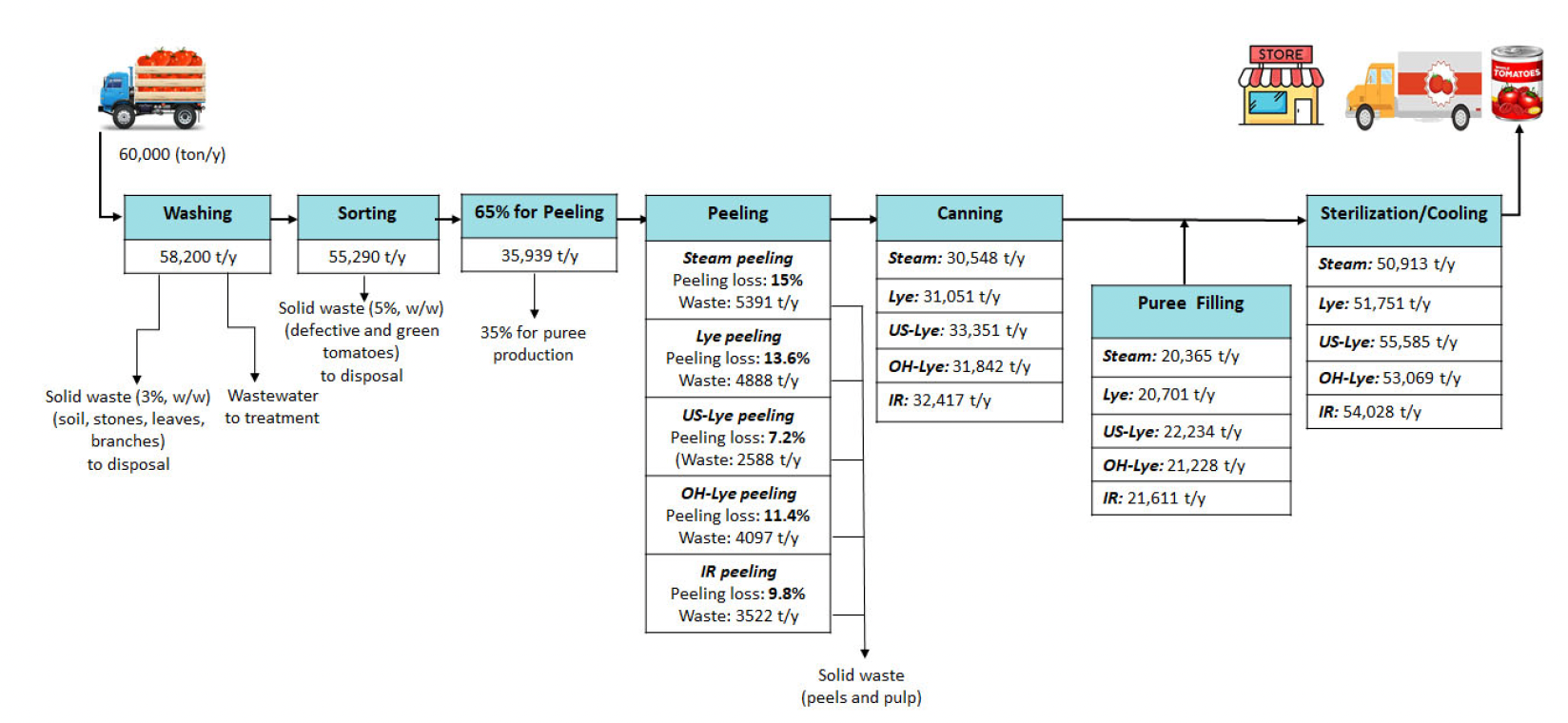
Figure: Current value stream map for a plant processing whole peeled tomatoes with a production capacity of 60,000 tons per season
(copyright: sutdy authors).
(copyright: sutdy authors).
Across all considered environmental indicators, the implementation of innovative peeling methods yielded improvements of 22–57% for US-lye and 53–92% for steam, OH-lye, and IR peeling. The potential benefits arising from the adoption of these novel peeling methods can motivate company management to explore opportunities for enhancing peeling efficiency and increasing the economic and environmental sustainability of the tomato processing industry. However, their implementation requires careful evaluation of initial costs, operational complexities, and long-term benefits.
Further research is needed to optimize these technologies for large-scale industrial use, as scaling up may present challenges. In, particular, it is crucial to conduct engineering studies based on data validated at pilot and industrial scales to assess the technical and economic feasibility of each measure, comparing their costs with potential cost savings, and estimating the expected payback period.
Reference: Elham Eslami & Giovanni Landi & Miriam Benedetti & Gianpiero Pataro, 2024. "Economic and Environmental Impact Analysis of Innovative Peeling Methods in the Tomato Processing Industry,"Sustainability, MDPI, vol. 16(24), pages 1-18, December.
Fulltext: https://www.mdpi.com/2071-1050/16/24/11272





Latest news
California: Weekly tonnage as of 17 October 2026
Heritable and Kagome Partner on AI-Driven Disease-Resistant Crops
Final results of the 2026 campaign in Northern Italy: yields among the lowest in recent years
Global Tomato Paste Trade in 2025/2026: slow emergence of secondary origins
Global Exports of Tomato Paste, Updated October 15, 2026