News
Heat Resilience in Tomatoes via Shoot Meristem Control
As the mercury climbs and heatwaves become the norm, the threat to our food supply intensifies. For every degree Celsius rise above pre-industrial levels, we brace for a significant 6-8% dip in crop yields. The burning question for scientists has been: how can we equip our plants to weather this increasing heat?
Now, a team of researchers at the Institute of Genetics and Developmental Biology (IGDB), led by Prof. Xu Cao, has unearthed a fascinating survival strategy employed by the humble tomato plant. Published in Developmental Cell on April 2nd, their groundbreaking study reveals a novel mechanism that allows tomato plants to actively combat heat stress and maintain stable yields by cleverly tweaking the development of their shoot apical meristems (SAM) – the crucial command center for above-ground growth and ultimately, fruit production.
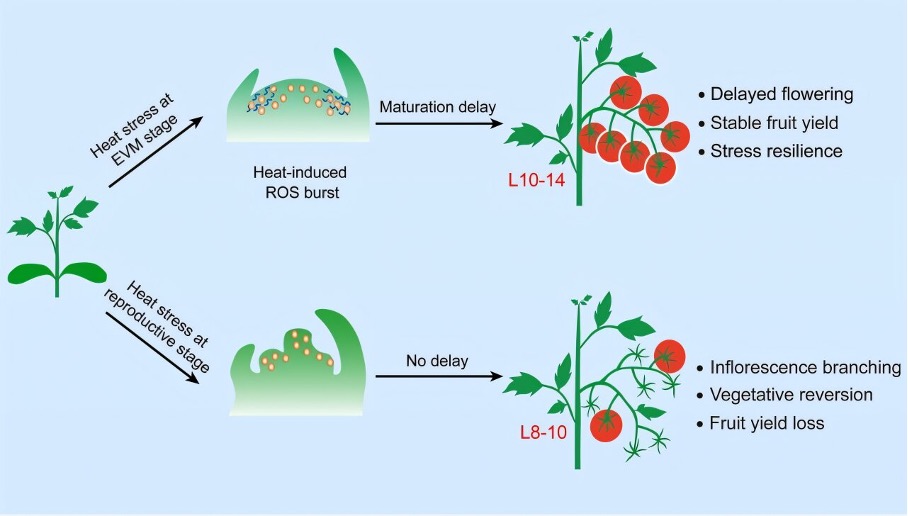
Image credit: IGDB
The SAM is vital for a plant's architecture and directly influences how much we harvest. However, when heat strikes, it can wreak havoc on these stem cells, leading to developmental hiccups, plant death, and significant yield losses. Understanding how these SAM cells adapt is therefore paramount for securing our future harvests.
Prof. Cao and his team discovered that under heat stress, tomato plants experience a surge in reactive oxygen species (ROS). Far from being simply damaging, these molecules trigger a remarkable molecular dance. They promote the phase separation of a protein called Terminating Flower (TMF), a key repressor of flowering. This results in the formation of TMF condensates that linger longer, effectively silencing the genes that initiate flower development.
The outcome? The plant hits the brakes on shoot maturation, extending its vegetative growth phase. This delay allows the plant to sidestep premature reproductive transitions during unfavorable hot spells. Remarkably, young tomato plants can even enter a temporary dormancy-like state, suspending their march towards maturity until temperatures ease. This strategic pause has been shown to prevent a staggering 34-63% of yield losses in the crucial first fruit cluster, highlighting its profound impact on heat resilience.
The researchers propose that this "redox-controlled bet-hedging mechanism" acts as an elegant survival strategy for these rooted organisms. It grants them the ability to postpone flowering during harsh conditions, ensuring reproductive success when the environment becomes more hospitable.
This pivotal discovery offers a fresh perspective for developing climate-smart crops capable of maintaining stable yields in an increasingly volatile world. The intricate molecular mechanisms identified in this study could pave the way for precision breeding efforts, empowering us to cultivate more resilient and productive crops for the challenges ahead. It seems the seemingly simple tomato holds a sophisticated secret to surviving the heat – a secret that could hold the key to future food security.
Reference: Xiaozhen Huang et al. ROS Burst Prolongs Transcriptional Condensation to Slow Shoot Apical Meristem Maturation and Achieve Heat-Stress Resilience in Tomato, Developmental Cell (2025). DOI: 10.1016/j.devcel.2025.03.007.
www.cell.com/developmental-cel … 1534-5807(25)00154-6
Sources: hortidaily, phys.org