News
Global trade: the TOP 15 best trade balances
The total value of trade surpluses for the world's fifteen leading exporters of tomato products amounted to over USD 7 billion over the period April 2023-March 2024, up 22% on the corresponding result for the previous year (USD 6.6 billion).
For the twelve months from April 2023 to March 2024, Italy remains unquestionably the country with the highest tomato product export results in the world. Among the fifteen most active national industries in this sector, Italy once again posted record financial results, buoyed by the general rise in world prices for tomato products, but also by a slight increase in the quantities absorbed by manufacturers.
While Italy's trade surplus for the period under review (April 2023-March 2024) stood at around USD 3.3 billion, up 29% on the average annual figure for the previous three years (USD 2.56 billion), China's result benefited from a sharp acceleration in foreign sales, both in terms of quantity (+30%) and value. The Chinese result jumped by 65% compared to the previous three years, to USD 1.37 billion, exactly twice as high as that of Spain, the world's third top performer with a surplus of USD 674 million. These three sectors alone accounted for three quarters of the surplus generated by global exports of tomato products over the period reviewed.
With results ranging from USD 110 to 440 million, the following five countries (Portugal, Türkiye, Chile, the United States and the Netherlands) accounted for 20% of total sales for the period (April 2023-March 2024).
With results ranging from USD 110 to 440 million, the following five countries (Portugal, Türkiye, Chile, the United States and the Netherlands) accounted for 20% of total sales for the period (April 2023-March 2024).

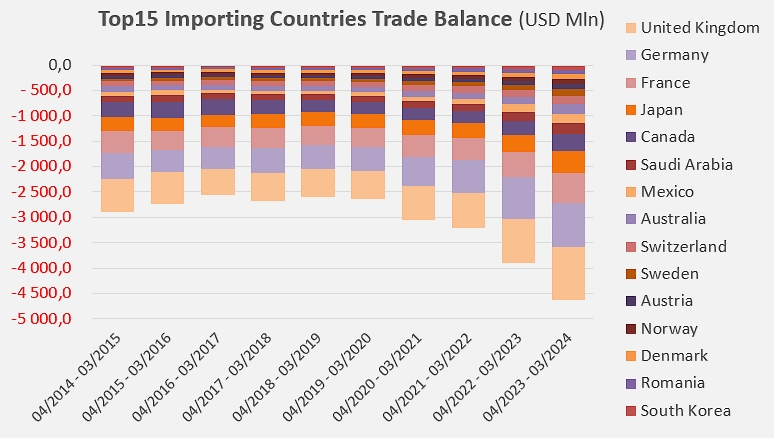
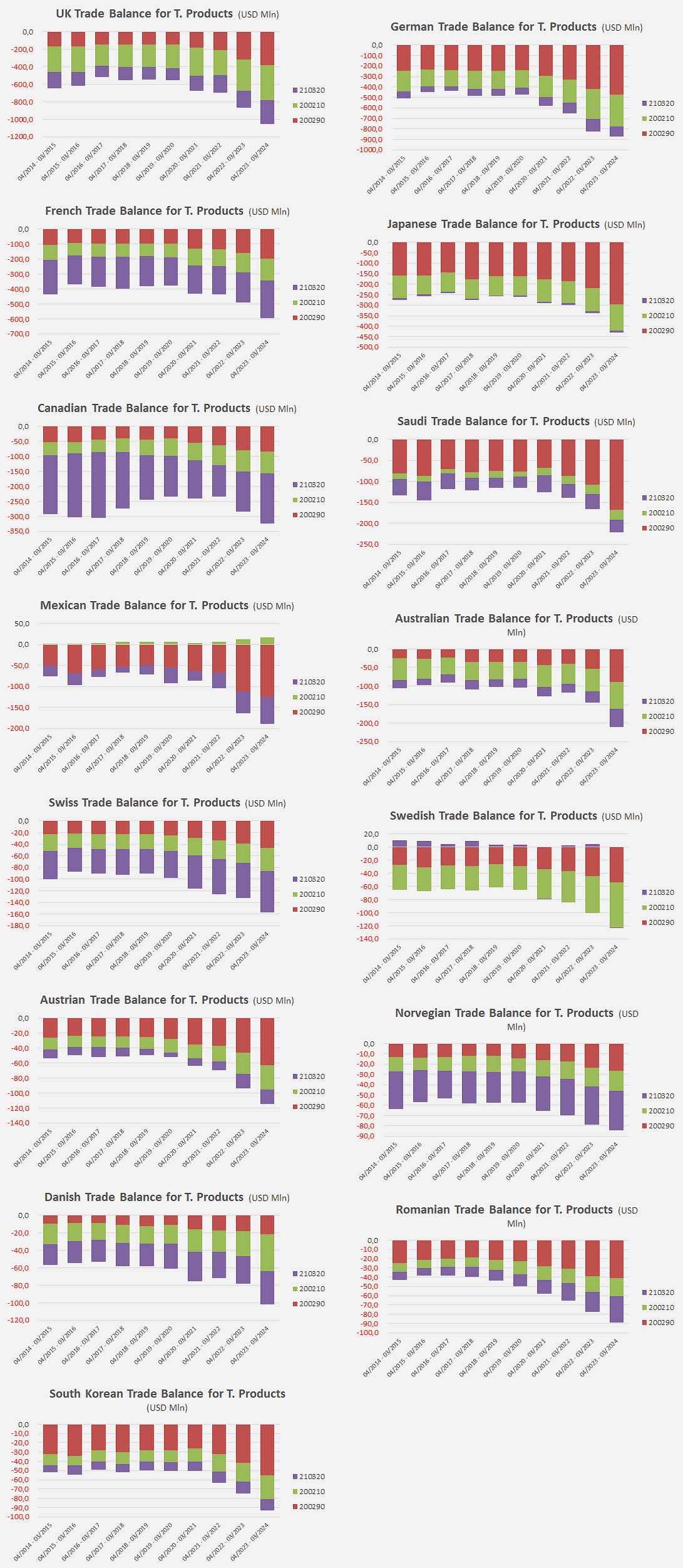
At the other end of the tomato products trading landscape, the trade balances of the UK, Germany, France, Japan, Canada and Saudi Arabia also recorded impressive values. These six countries alone accounted for half of the accumulated deficits of the countries that import tomato products. UK foreign purchases generated a deficit of USD 1.05 billion over the period April 2023-March 2024, 41% higher than the average deficit for the three previous corresponding periods. Germany, which is also highly dependent on foreign supplies of tomato products, posted a deficit of USD 872 million over the period reviewed. France is in the same situation, with a deficit of USD 592 million, as are Japan (USD 430 million), Canada (USD 320 million) and Saudi Arabia (USD 220 million). All these deficits have increased compared with the average values for the previous three years, from 20% to over 50%, depending on the country.
The histograms below show the evolution and composition of the trade balances for the world's fifteen main national industries that export tomato products, over the last ten years, based on the three main product categories: tomato pastes (HS Codes 200290), canned tomatoes (HS Codes 200210) and tomato sauces and ketchup (HS Codes 210320).
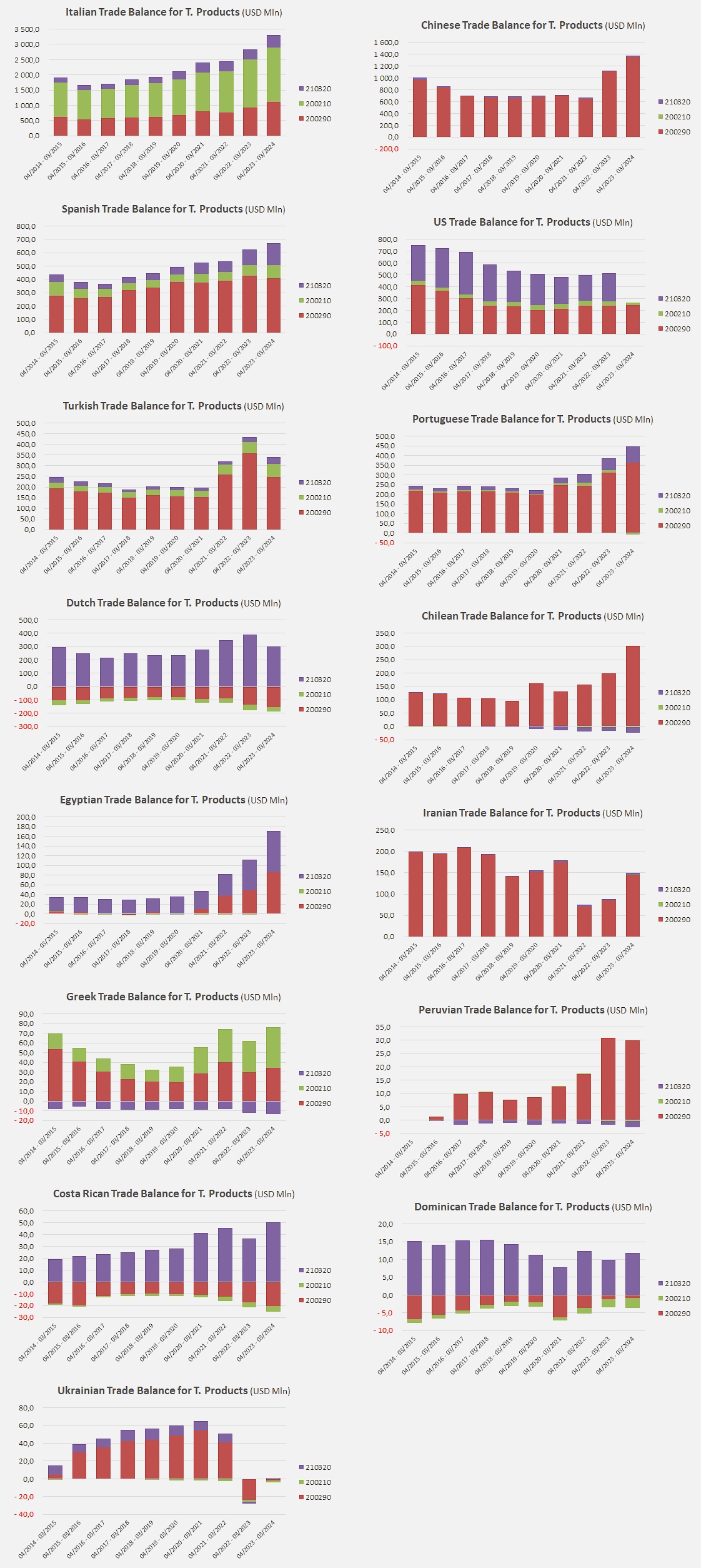
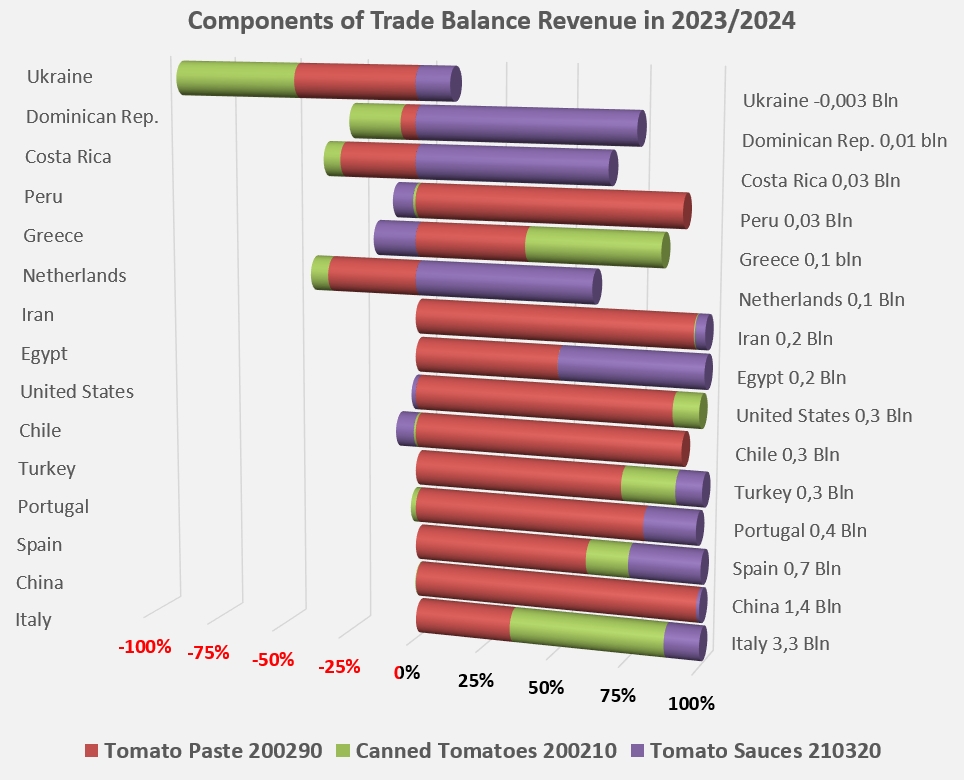
Italy is the world's leading industry in terms of the size of its trade surplus, and also in terms of the diversity of its activity, with a result that is largely based on sales of canned tomatoes (54% of the surplus in value terms over the period April 2023-March 2024), but also on exports of pastes (34% of the surplus) and sauces (12%). Although strongly focused on exports of pastes (61% of the surplus), the Spanish industry also relies on a relative diversity of operations, with 25% of its surplus generated by foreign sales of sauces and 15% by sales of canned tomatoes. In Greece, the approach is similar, with a surplus based on sales of canned tomatoes and pastes, although the balance sheet features the import of sauces.
For most of the other national industries, starting with the largest – the United States and China, surpluses are essentially built on exports of tomato pastes: 99% in China, 92% in the USA, 83% in Portugal, 73% in Türkiye, 100% in Chile and Peru, and 96% in Iran, etc. And finally, others such as the Netherlands, Costa Rica and the Dominican Republic, rely solely on foreign sales of sauces and ketchup.
For most of the other national industries, starting with the largest – the United States and China, surpluses are essentially built on exports of tomato pastes: 99% in China, 92% in the USA, 83% in Portugal, 73% in Türkiye, 100% in Chile and Peru, and 96% in Iran, etc. And finally, others such as the Netherlands, Costa Rica and the Dominican Republic, rely solely on foreign sales of sauces and ketchup.
Some complementary data
The histograms below show the evolution and composition of the trade balances of the fifteen main countries importing tomato products over the last ten years, based on the three main product categories: tomato pastes (HS Codes 200290), canned tomatoes (HS Codes 200210) and tomato sauces and ketchup (HS Codes 210320).
The histograms below show the evolution and composition of the trade balances of the fifteen main countries importing tomato products over the last ten years, based on the three main product categories: tomato pastes (HS Codes 200290), canned tomatoes (HS Codes 200210) and tomato sauces and ketchup (HS Codes 210320).
Source: TDM