News
CRISPR/Cas9 system application in tomato breeding
Resistant breeding and quality improvement in tomato
As per ‘Food and Agricultural Organization’ (FAO), the world population is increasing in an exponential manner and it is estimated that it will reach approx. 9.1 billion by 2050 (United Nations World Population Prospects: FAO, 2019). The food production capacity needs to be increased by at least 70% to feed this huge population. Conventional breeding methods for agronomic crops such as tomato would not be able to keep up with the pace and improved variety of disease-resistant smart crops will be a necessity to address the food security of the world. In this context, next-generation genome editing technology like CRISPR/Cas gains importance.
In recent years, researchers around the globe have been able to identify the presence of two different classes of CRISPR/Cas systems in bacteria and archaea. Remarkable diversity in the domain of genome loci architecture, structure of effector complex, array of protein composition, mechanisms of adaptation along with difference in pre-crRNA processing and interference have led to a vast scope of detailed classification in bacterial and archaeal CRISPR/Cas systems, their intrinsic weapon of adaptive immunity. Two classes: Class 1 and Class 2, several types and subtypes have been identified so far.
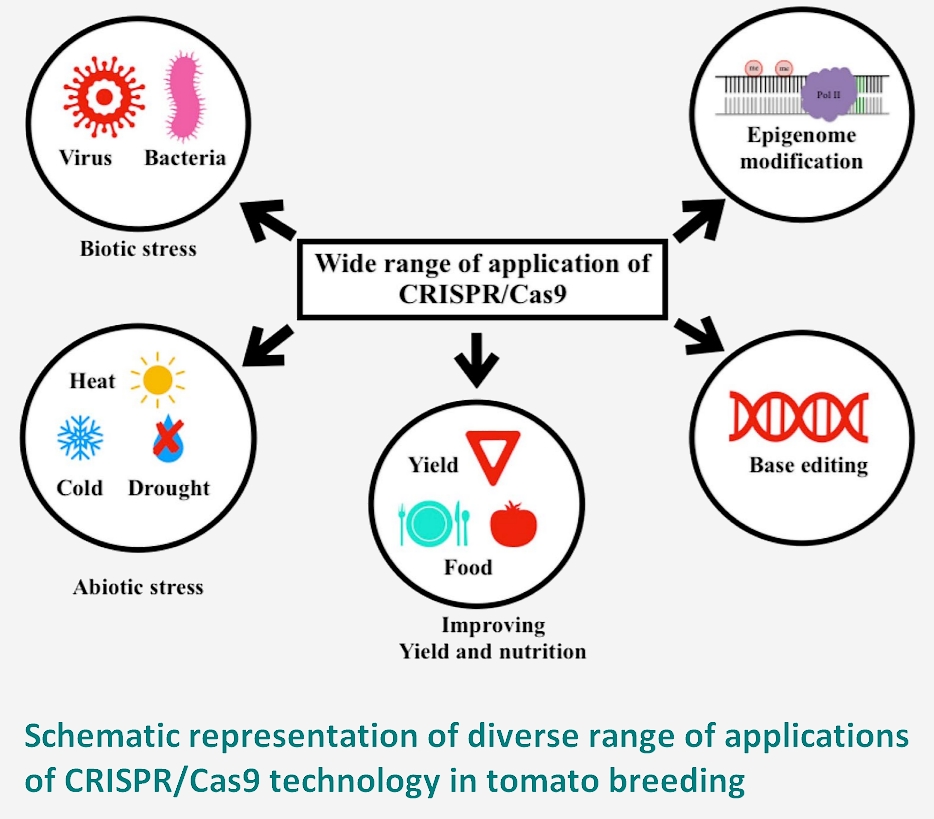
While the evolution of the effector complexes of Class 2 is assigned solely to mobile genetic elements, the origin of Class 1 effector molecules is still in a haze. Majority of the types target DNA except type VI, which have been found to target RNA exclusively. Cas9, the single effector protein, has been the primary focus of CRISPR-mediated genome editing revolution and is an integral part of Class 2 (type II) system. The present review focuses on the different CRISPR types in depth and the application of CRISPR/Cas9 for epigenome modification, targeted base editing and improving traits such as abiotic and biotic stress tolerance, yield and nutritional aspects of tomato breeding.
Genetic diversity is a potential resource for a broad range of genetic research and trait improvement in plants. The gradual evolution in the plant breeding technologies and expansion of its possibilities is much required to cope up with the incessantly increasing needs of man. With the aim of creating new varieties, breeders have developed novel methods to introduce heritable mutations into plant genomes. In the recent past, various mutagens like chemical compounds and irradiation were used to generate large pools of genetic variation in traditional breeding. Like all methods, these too have several drawbacks, such as the non-specific nature of the generated mutations, simultaneous mutation of a large amount of nucleotides followed by deletion, duplication and rearrangement of lengthy genomic fragments, thus making the identification of the mutations a laborious process. Also the random mutagenesis methods usually prove to be less effective to improve traits in polyploid crops, because of their extreme genetic redundancy.
Although traditional breeding allowed the selection of unique crops with improved traits, enriched qualities and extended shelf life coupled with long breeding cycles yet lack of precision in hybridization, high ratio of heterozygosities along with low frequencies of the desirable mutation have led to the development of less/moderate resource-demanding technologies.
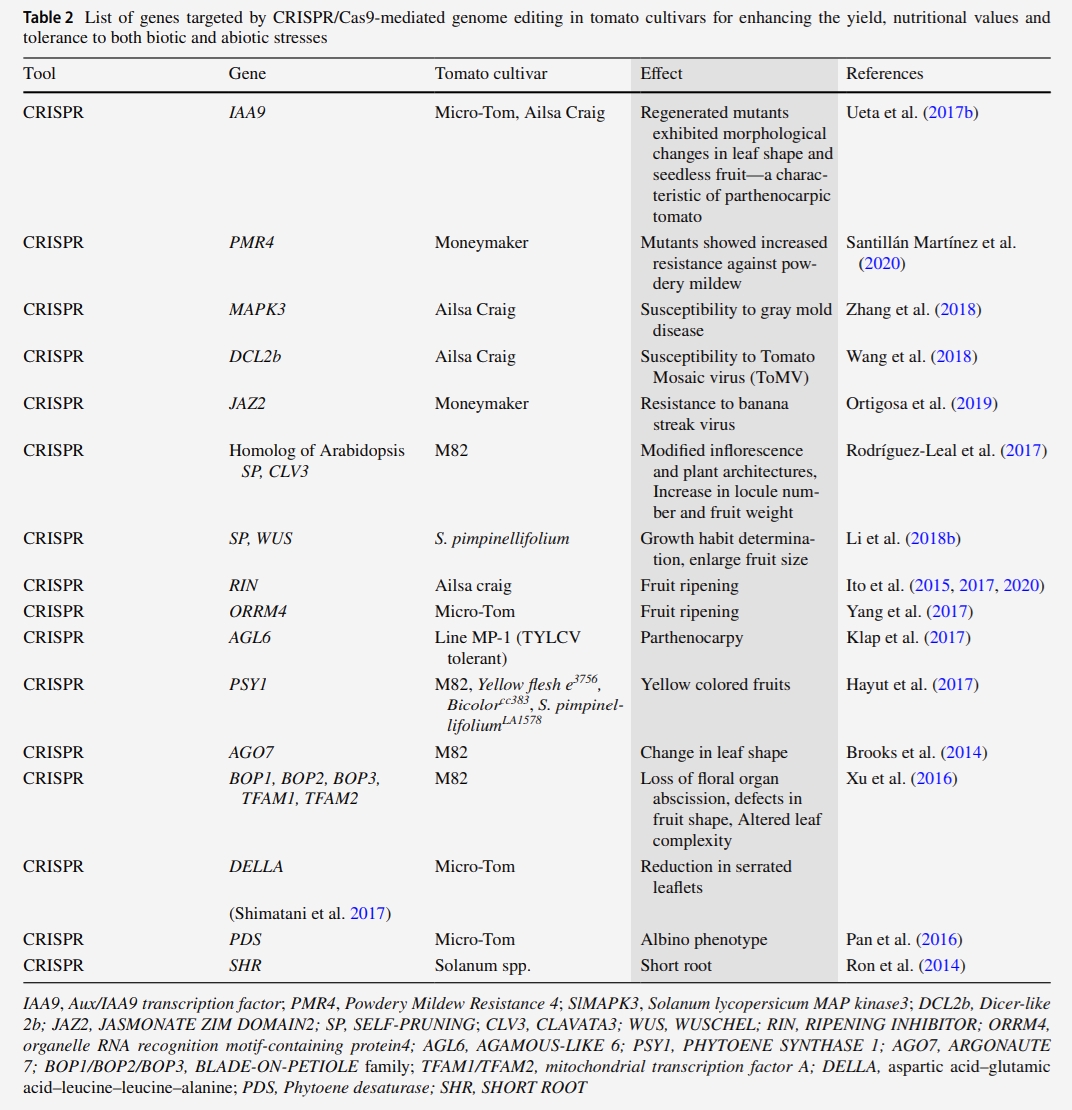
In recent years, the RNA-programmable CRISPR/Cas9 technology of genome editing has caught the eyes of researchers and has traversed a long way in a very short period since it is an uncomplicated and effortless process. The field of biology (animal, plant and microbe) has undergone a massive transformation because of the immense potential of this powerful genome editing tool. It has been proved now and again that CRISPR/Cas9 system of genome editing is the superpower in the domain of plant genome editing, and tomato has proved to be a perfect example of a model plant where CRISPR/Cas system has been an efficient tool in creating new varieties without compromising the plant genome with foreign genes. CRISPR/Cas9 has been used in fleshy fruit model plant ‘tomato’ to enhance several aspects such as yield, nutritional value and resistance or tolerance against biotic or abiotic stress conditions.
A lot of breakthrough research is going on globally to elucidate numerous arcane and outstanding questions of this field. According to the research team, “it appears that CRISPR/Cas system will not be barricaded by genomic complexity, GM controversy, government sanctions, etc. and is here to stay.”
Some complementary data:
Read the complete research at https://www.researchgate.net.
Reference: Chaudhuri, Abira & Halder, Koushik & Datta, Asis. (2022). Classification of CRISPR/Cas system and its application in tomato breeding. Theoretical and Applied Genetics. 3. 10.1007/s00122-021-03984-y.
Sources: hortidaily.com, researchgate.net