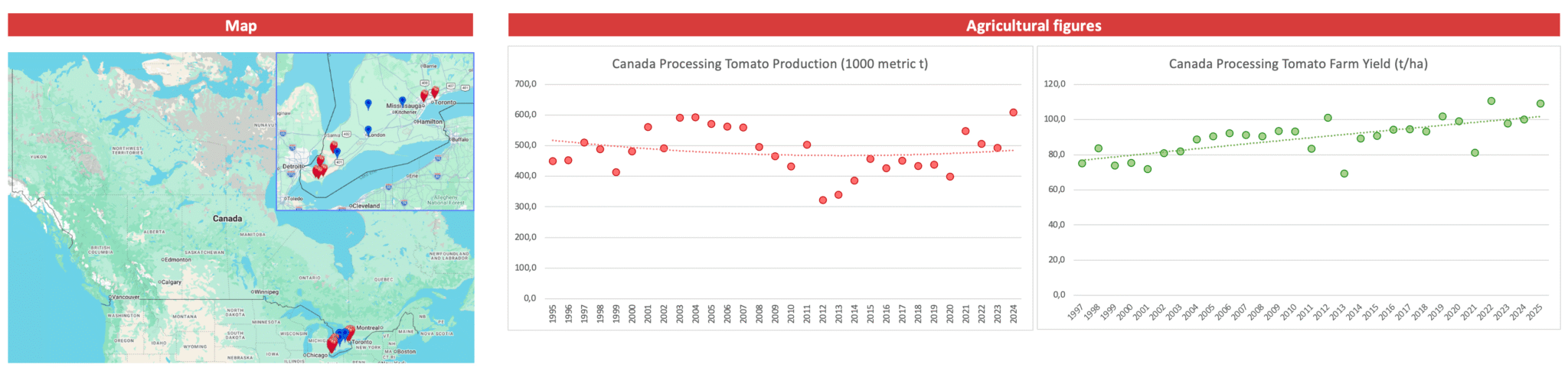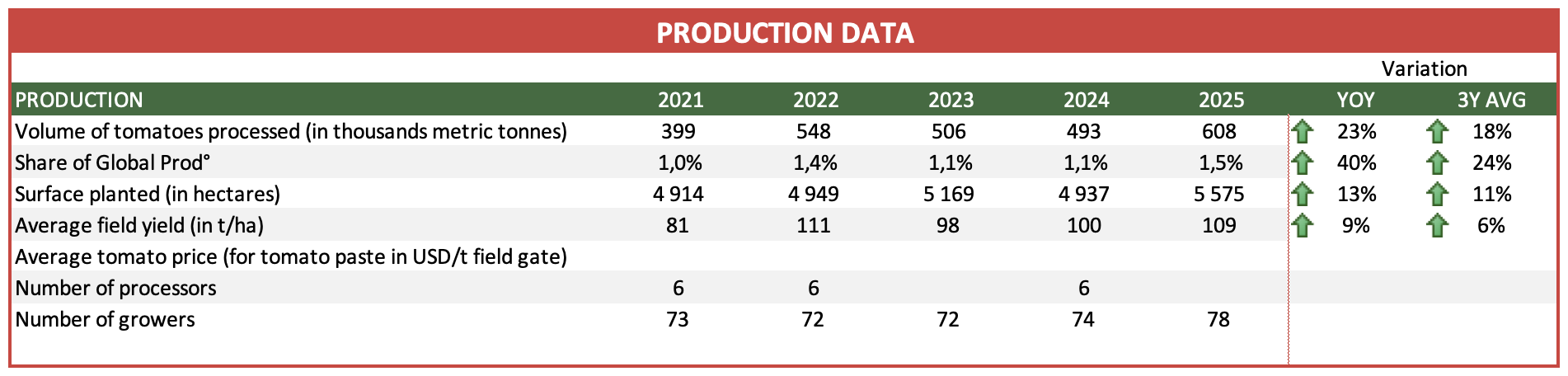
All processing tomatoes in Canada are grown in Southwestern Ontario, primarily within Kent and Essex Counties, where a unique combination of climate and fertile soil creates ideal growing conditions.
In 1988, Ontario had 31,490 acres of processing tomatoes in production. Acreage has since declined due to steady improvements in yield performance and structural changes among processors. All tomato acreage in Ontario is measured by an independent third party, which also provides independent third-party grading for the industry annually.
Because of Ontario’s delicate climate and shorter growing season, tomatoes are not seeded directly into the field. The Ontario industry utilizes 100% transplants for planting. There are close to 9 acres of greenhouses used for transplants producing approximately 125 million tomato seedlings for Ontario growers.
Seedlings are transplanted into fields in early May once the risk of night frost has passed. Early varieties require 90–95 days between transplanting and harvest, while late varieties require 110–125 days. Approximately 50% of the surface is irrigated. Generally spring and summer rains are sufficient to cover water needs, however, drought conditions in some years has resulted in a strong focus on drip irrigation with significant grower investment being made to optimize consistency of raw product supply. Fully mechanized harvesting takes place from early August through mid-October.
About 90-95 days are needed between transplanting and harvest for early varieties and 110-125 days for late varieties. While spring and summer rainfall is generally sufficient to cover water requirements (with roughly 5% of surface area receiving active irrigation), past drought events prompted significant grower investment in drip irrigation systems starting around the 2002 season. Farmers employ a wide range of crop management strategies, including integrated pest management (IPM), crop rotation, cover crops, and drip irrigation to optimize yields and preserve soil quality.
To preserve peak freshness, all tomatoes are processed less than 24 hours after harvest. There are approximately 6 processing plants operating in the region. Neighbors often coordinate planting and harvest schedules to share transport resources, and deliveries are strictly regulated by processors to avoid factory bottlenecks and eliminate waste.
The distribution of the tomato production is usually as follows:
- 60% of tomatoes are made into tomato paste, manufactured during harvest season and reprocessed internally to manufacture ketchup, soups and sauces.
- 20% made into whole peeled tomatoes.
- 20% made into juice from fresh tomatoes.
Ontario Processing Vegetable Growers (OPVG): Established in 1944, OPVG is a producer organization that bargains collectively for prices, terms, and sales conditions on behalf of growers across 12 processing crops, with tomatoes representing the largest volume. Each producer contracts directly with their designated processor for required quantities, varieties, and planting schedules.
OPVG co-funds and coordinates production research. In partnership with processor associations, the industry established the Ontario Tomato Research Institute, which finances targeted research across all aspects of processing tomato production and co-organizes the annual Ontario Processing Vegetable Industry Conference each January.