News
Across the AMITOM and wider global tomato-producing regions, processing for the current Northern Hemisphere season is entering its final stages, with most countries reaching 60% to over 90% completion despite varying yield impacts from localized weather and widespread mite infestations. Some processors in Europe and Asia are facing operational challenges, including elevated defect rates, lower Brix levels, and severe cost inflation—particularly rising energy and transport expenses —while Chinese forecasts have fallen to 5.15 million tonnes due to extreme weather and water restrictions, bringing the world production estimate down to 39.1 million tonnes.
Meanwhile, Southern Hemisphere producers are beginning their new season planting under mixed conditions, benefiting from strong snowpack water reserves in South America but facing delayed field preparations and potential frost risks.
AMITOM COUNTRIES
BULGARIA
The weather is currently favourable (around 30°C) in the main tomato-producing regions (Stara Zagora, Plovdiv area). Some rain is expected in the west in the coming days. Yield is approximately 80% of forecast, about 10% lower than in 2025. Brix is maintained around 5.The harvest is expected to finish around September 20th.
Mite infestations are a continuing problem. The cost of alternative pesticides is very high, making production less profitable. Collective European action — possibly through a tomato industry working group or round table — should be undertaken to present the issue to the EU Commission and seek solutions for effective and affordable mite control.
FRANCE
As of the end of last week, France had processed 108,000 tonnes, representing approximately 83% of the revised forecast of 130,000 to 132,000 tonnes (74% of the initial forecast), representing a reduction of around 12%. Current weather includes light rain and wind, but harvesting has not stopped, with temperatures expected to return above 30°C next week. Brix is approximately 5.08 but the defect rate is 8.3%, which is significant, and may be partially due to a growing problem with aeculops lycopersici mites (previously only seen in greenhouses, now appearing in open fields), compounding the effects of heat waves and sanitary stress. This mirrors issues reported in Italy and Spain via Tomato News and would need to be addressed by governments.
The season expected to conclude around September 25th.
GREECE
The crop is progressing very well. Factories in the south have already closed. Central and northern regions expect to finish by the end of next week. More than 90% has already been processed. The crop turned out better than expected despite some adverse weather at the start of the season, which fortunately did not affect significant areas. Brix is around 5 or slightly above. Quality is very good.
The forecast remains unchanged. Rain is expected next Sunday–Tuesday but is not a concern as the campaign is nearly complete.
HUNGARY
The processing season has progressed steadily over the past few weeks, with generally good fruit quality and favourable soluble solids levels (around 5.4). The harvesting and processing pace has remained consistent, despite the somewhat smaller planted area compared with previous years.
At some processors the processing campaign has now been completed. Across the country, the final phase of the season is currently underway. Following a short interruption in some areas, processing has resumed and the remaining crops are being harvested and delivered at a steady pace. The overall campaign is expected to be completed around mid-September.
Based on the progress so far, the forecast for the total Hungarian processed tomato volume has been revised to approximately 65,000 tonnes.
IRAN
There is no change from the previous report.
ITALY
In the North, the latest OI Nord figures for week 35 show cumulative deliveries of 2,3 million tonnes (payable weight) as of 30 August. The campaign remains the most advanced the North has ever recorded at this date, but the lead over the average is narrowing quickly and we are having a sharp decline in September.
Quality continues to reflect the summer heat. Soluble solids (average at 4.87 °Brix) below and easing further week on week (4.76 in week 35). Defect rate is 4.93% and payment index is 94%.
Organic tomatoes reached about 208,000 tonnes with brix 4.88, about 65% of the contracts, and the harvest is coming quickly to the end.
On the weather, after several weeks running well above the seasonal norm, maximum temperatures remain elevated. The week of 24–30 August brought scattered rain generally light but heavier in the Parma and Ferrara areas, with localised but intense hailstorms on Friday 28 across parts of Emilia-Romagna and the Lombardia with damages on late crop tomatoes. From today (9th September) and in the next days we will receive rain in North and Center Italy halting the harvest for some days.
From a POs survey it has been reported that at the end of August the surface still to be harvested is from 20 to 30%, with possible lower yields on this fraction.
The current working forecast for the North is maintained at around 3.25 million tonnes, with clear downside risk on the late crop.
In the Centre and South, the campaign is progressing, but delivery rates are much slower than expected. Tomatoes are struggling to ripen. Several factories have begun closing after reaching 85–90% of their scheduled targets. By August 30th, 2.06 million tonnes had been processed.
Companies are extremely concerned about rising costs, particularly energy. Natural gas is close to €80/MWh, and electricity and diesel costs are over 100% higher than pre-war levels. Transport costs for fresh tomatoes in the south are a major burden, exceeding €30 per tonne due to the large distances between fields in Puglia and processing factories. Some factories preferred to stop operations rather than run at low capacity with very high costs, given that the market is unlikely to compensate for these costs.
PORTUGAL
After heavy rain two weeks ago that halted operations for approximately four to five days, the following week brought mild/cool temperatures. Last week returned to summer conditions (up to 40°C, stabilizing around 30–32°C). As of Monday 7 September, approximately 63% of the crop had been processed. This is broadly in line with normal progress for this point in the season, accounting for the rain-related delay. Brix levels remain low and are expected to be a characteristic of this season. Quality in new fields being entered is very good. Yield results vary significantly between fields.
The next two weeks are critical. Some fields may continue until the end of September, though quantities will be lower. The forecast remains unchanged; a further update will be provided at the next meeting.
SERBIA
Harvesting is going well, with dry, hot weather, and as of today 62% of the harvest has been done. The last rain was on 2nd July, so it is now the 68th day without rain. The quality of the tomatoes is good with average brix of 5.46, and average colour of 2.1.
The average yield was 75t/ha on early hybrids, and 100t/ha with mid/late hybrids, although some producers hit with hail (even twice) and without water supply, are down to 40t/ha. Altogether the yield will be between 75 and 80t/ha.
The harvest should finish around 1st October.
SPAIN
In Andalucia the last factory will close tomorrow. Yields were below expectations, as already reflected in the previously revised forecast.
In Extremadura a couple of factories will already close this week, and most of the others will close between the 20th and 25th of September. Yields are also there below expectations, for similar reasons documented in recent Tomato News reporting. It is difficult to estimate right now the final production, so far we keep the forecast of 2,6 million tonnes.
TUNISIA
The processing season is nearing the end with only 3 plants still operating with a daily input of 1,200 tonnes. To date 836,000 tonnes have been processed.
TÜRKIYE
The crop in the south finished approximately one to two weeks ago. Other regions are progressing slowly toward the end. Factories are still operating at roughly 80–90% capacity, with no sharp decline yet. Quality of incoming raw material remains surprisingly good — tomatoes are red and fruits are firm. At least 15 more days of production are expected, with volumes slowly reducing. The weather forecast is mild, which helps tomatoes remain in the fields, and no rain is currently expected.
The forecast maintained at the previously reduced level of 2.2 million tonnes.
UKRAINE
To date approximately 30% of tomatoes have been processed. Field yields are in line or slightly above expectations and factory yields are good. This year quality is perfect (far above historical average for early tomatoes). Some rains did cause some interruptions, but the biggest interruptions are linked to the Russian attacks on Ukrainian civilians.
If mid season varieties perform similar to early season, the forecast of 550,000 tonnes will definitely be reached.
OTHER NORTHERN HEMISPHERE COUNTRIES
CALIFORNIA
The estimate is to process 808,630 metric tonnes (891,362 short tons) this week. At the end of this week (week ending 12th September) we will have processed 6,887,889 metric tonnes (7,592,598 short tons). Overall, the crop continues to perform well at this time.
One processor has completed harvest at the time of this publication. Over the next few weeks more will begin to complete their harvests and we will finish in the third week of October. Yields continue to be performing at or slightly above contracted levels.
CANADA
Harvest is moving along and is 40% complete. Crop quality is good overall, with decent colour and solids. Over the past week, warm late-summer conditions helped push maturity along, with temperatures reaching around 30°C. Although severe weather hit Wheatley on September 3rd with an EF1 tornado and heavy downbursts, local field operations managed to weather the storm well and are continuing to make good progress.
CHINA
As of September 7, the harvest has entered the late stage in China. The forecast is about 5.15 million tonnes, a drop of 700,000 tonnes from 5.85 million tonnes,with further reductions possible later in the season.
Three major factors contribute to the forecast reduction: First, Xinjiang experienced strong El Niño weather during flowering, fruit‑setting and fruit‑enlargement in June and July. Second, water restriction policies led to water shortages during key growth stages. Third, Inner Mongolia region was hit by two episodes of heavy rainfall and one hailstorm during the harvest period.
JAPAN
Since August, Japan has experienced continuous heavy rainfall across the country. As a result, production volume is expected to decrease slightly from 24,000 tonnes to 23,000 tonnes.
SOUTHERN HEMISPHERE COUNTRIES
ARGENTINA
The very affordable Chilean paste prices are a huge problem for the local industry. The current estimate is for only around 4.700 hectares to be planted which could produce about 370.000 tonnes at an average yield of 80 t/ha (down from 5,120 hectares and 431,000 tonnes in 2026). A more precise forecast will be available at the end of September.
Transplanting started during the first week of September (week 36), with hopes of starting the harvest before Christmas, as has been successful in the past few years. There have, however, been isolated frosts in in the earliest transplant areas in San Juan, and more are expected over the next few days, so some delays are likely.
El Niño is a concern. It was an extraordinary winter in terms of snowfall, with snow accumulation above the historical average. This has helped us move out of the critical situation regarding water reserves. However, the atmospheric patterns associated with El Niño are still keeping average temperatures lower than usual and increasing the risk of frost and these conditions should persist for another two to three weeks. There is evidence that the local government is investing in flood damage prevention and the news warns of a stormy season. If it’s true that it will be stormy, production can be much lower because summer storms tend to bring hail.
AUSTRALIA
The forecast for the coming season is to plant 1,155 hectares for an expected production of a 142,000 tonnes. Planting is expected to start on 24th September.
Field preparations have been delayed in some areas due to persistent wet weather during winter.
CHILE
Based on information shared at between all three processors, the planted area for the 2026/27 season is expected to decrease by approximately 10% compared to last season, bringing the total to roughly 12,500–13,000 hectares.
Transplanting in the fields began this week, under normal spring weather conditions: average daytime temperatures ranging between 18°C and 22°C, with nighttime lows not dropping below 2–5°C. The mountain range currently holds abundant snow following a winter with above-average rainfall, so water availability for the entire production season is expected to be secured, with no supply concerns.
SOUTH AFRICA
As of today ,100,000 tonnes have been processed and the season should end within 6 weeks projecting towards a 125 000-tonne harvest.
Current world production estimate
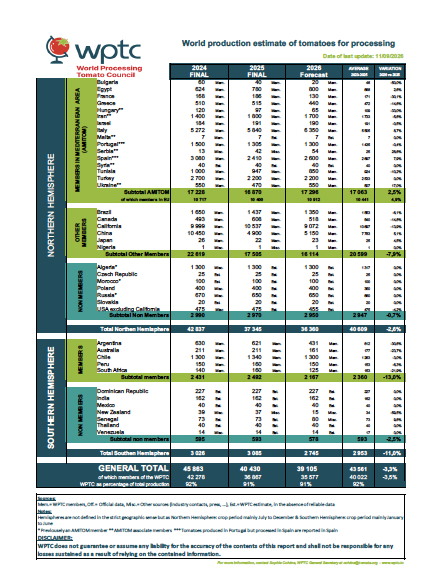
From the information provided by WPTC members, the world production estimate for 2026 currently stands at 39.1 million metric tonnes, a reduction largely due to the revised Chinese forecast. This is 3.3% less than the 40.4 million tonnes processed in 2025.
Attachment: WPTC World production estimate as of 11 September 2026