News
Review: Mechanized Production of Processing Tomatoes
The School of Agricultural Engineering at Jiangsu University has published a comprehensive review entitled “Toward Sustainable Mechanized Production of Processing Tomatoes: Crop–Machine Interactions, Operational Trade-Offs, and Pathways for Intelligent Control.” in the scientific publication Agriculture.
The paper reviews the mechanized production of processing tomatoes, emphasizing the complex interactions between crop traits, agronomic practices, and machinery. It analyzes how these interactions affect operational performance, sustainability, and the potential for intelligent, feedback-driven control systems.
The review is structured around four main questions:
- How do crop traits and agronomic conditions affect mechanization?
- What are the key operational trade-offs in mechanized tomato production?
- How advanced are sensing, automation, and closed-loop control technologies?
- How does cross-stage coordination impact yield, quality, resource use, and sustainability?
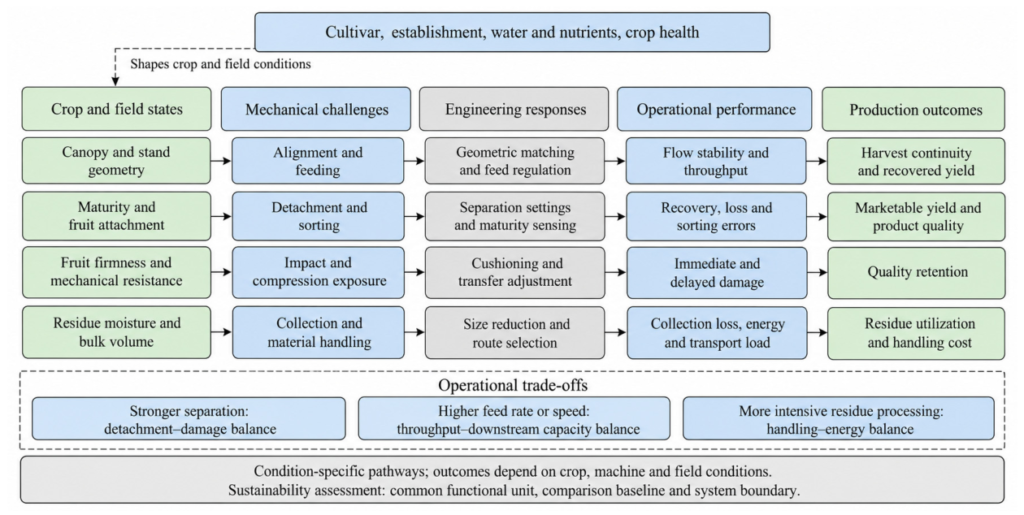
Crop–Machine Interactions
- Plant Morphology: The architecture and maturity synchronization of processing tomato plants are crucial for efficient mechanization. Traits like canopy structure, fruit attachment, and stand geometry influence machine trafficability, feeding stability, and fruit separation.
- Physicomechanical Properties: Fruit firmness, puncture resistance, and detachment force are key for minimizing damage during harvesting and handling. Machine settings must be calibrated to these properties to reduce losses and maintain quality.
- Agronomic Factors: Cultivar selection, planting density, irrigation, and nutrient management all impact the uniformity and maturity of the crop, which in turn affects mechanized operations. Disease and abiotic stress can disrupt feeding and increase losses.
Mechanized Operations Across the Production Chain
- Tillage and Planting: Conservation tillage and mechanized transplanting are evaluated for their effects on crop establishment, resource use, and operational efficiency. Tray-cell geometry, seedling robustness, and root-ball integrity are important for successful mechanical transplanting.
- Field Management: Mechanical weeding, precision irrigation, and fertigation are discussed, with emphasis on integrating sensing and automation to optimize resource use and crop health.
- Harvesting: The review details the challenges of low-damage, high-efficiency harvesting, including cutting, feeding, fruit–vine separation, cleaning, sorting, and collection. Operational trade-offs include balancing throughput with fruit damage, impurity removal, and energy use.
- Postharvest Residue Management: Mechanized systems for vine residue discharge, chopping, collection, and valorization (e.g., composting, anaerobic digestion) are analyzed. The choice of technology depends on the intended end use and sustainability goals.
Technological Progress and Intelligent Control
- Sensing and Automation: Advances in machine vision, maturity detection, and quality assessment are enabling more precise and adaptive operations. However, most systems are still at the prototype or component-testing stage, with limited whole-machine field validation.
- Closed-Loop Control: The integration of sensing, decision-making, actuation, and feedback is identified as a key pathway for future intelligent mechanization. Coordinated control across stages (from agronomy to harvest and residue management) is necessary for optimizing yield, quality, and sustainability.
Sustainability and System-Level Integration
- Resource Efficiency: Mechanized systems can improve water and input efficiency, reduce labor, and enhance residue recovery. However, sustainability benefits must be assessed using consistent boundaries and functional units (e.g., per hectare, per tonne of marketable yield).
- Trade-Offs: Operational changes (e.g., increasing speed, cleaning intensity) often involve trade-offs between capacity, quality, energy use, and losses. These must be measured and balanced according to local conditions and system objectives.
The review concludes that sustainable mechanization of processing tomato production relies on close coordination between agronomy and engineering. It demonstrates that equipment performance depends not only on isolated mechanical settings, but also on the dynamic interaction between crop traits (architecture, maturity, mechanical resistance) and operational field constraints. To overcome historical trade-offs among field capacity, harvest losses, and fruit damage, the development of intelligent, closed-loop systems and predictive sensors represents the path forward. Finally, integrating residue management into a circular economy framework and rigorously evaluating overall environmental impacts will ensure the long-term economic and ecological viability of the sector.
Reference: Zhang, L.; Qian, Y.; Tang, R.; Cao, J.; Zhang, Y.; Tang, Z. Toward Sustainable Mechanized Production of Processing Tomatoes: Crop–Machine Interactions, Operational Trade-Offs, and Pathways for Intelligent Control. Agriculture 2026, 16, 2257.
Full text: https://doi.org/10.3390/agriculture16202257