News
Decoding Tomato DNA: how a new genetic map helps grow better fruit
For a long time, scientists studying tomatoes have relied on a single standard reference map of the genome. Think of it like using a single, basic map of a country; it gets you around, but it misses all the hidden backroads, new neighborhoods, and unique shortcuts. Because wild tomatoes (Solanum pimpinellifolium) and modern cultivated tomatoes (Solanum lycopersicum) have distinct differences, looking at just one standard map means researchers often miss complex genetic variations that control how a plant grows, develops, and defends itself.
To solve this problem, a team of researchers from China Agricultural University, the Agricultural Genomics Institute at Shenzhen of the Chinese Academy of Agricultural Sciences, Henan University, and Huazhong Agricultural University created a brand-new type of map called a graph-based pangenome, nicknamed MiniTG1.0. Instead of a flat, single line, this tool acts like a multi-layered map that captures all the small tweaks and major structural changes found by crossing a large modern cultivated tomato with a wild, small-fruited relative.
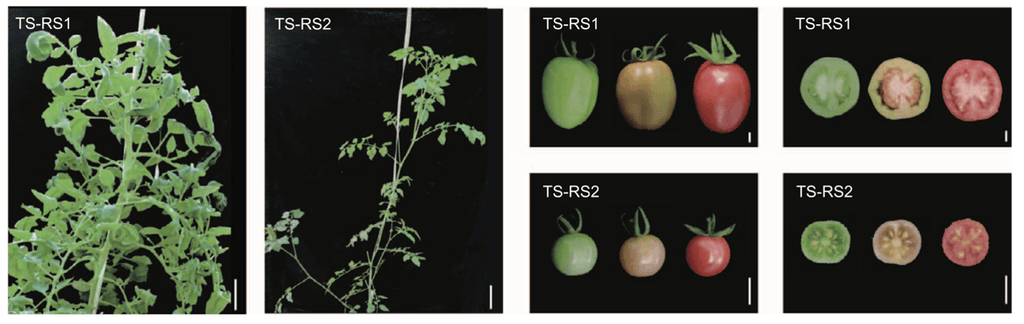
Whole plants (scale bars: 5 cm) and fruits (scale bars: 1 cm) of S. lycopersicum (TS -RS1) and S. pimpinellifolium
(TS -RS2).
By studying a family of 230 hybrid plants bred from these two parents, the researchers tracked how specific genetic traits get passed down. This advanced map captured significantly more of the plants’ inherited traits than traditional methods ever could. It successfully pinpointed the exact genetic hotspots responsible for plant hairiness and growth patterns, while also discovering a completely new gene region tied to fruit weight, called fw6.4. Within this region, a gene named SIILL6 acts like a natural brake on fruit size by controlling how much plant cells expand. By understanding this gene, breeders can better figure out how to modify and optimize fruit size.
The researchers also mapped out the chemical makeup of the fruit during ripening, identifying over 1,200 different compounds. Many of these chemicals belong to a family that helps give tomatoes their flavor and natural protection against disease. A standout discovery here was a gene called SICGT, which acts as a switch controlling chlorogenic acid—a powerful antioxidant that helps the plant fight off fungal infections. When the team used gene editing to turn off this gene, the tomatoes produced more of this protective acid and showed much better resistance against gray mold caused by pathogenic fungi.
Ultimately, this research connects the dots between a plant’s raw DNA and its physical traits. By pinpointing the exact genes that control size and disease resistance without ruining fruit quality, this work gives agricultural breeders powerful new tools to grow healthier, stronger, and more bountiful crops.
Source: Horticulture Research
https://doi.org/10.1093/hr/uhag147