News
The latest WPTC crop update indicates that processing tomato harvests across major producing regions are experiencing mixed outcomes, heavily influenced by extreme weather, market adjustments, and shifting yield expectations. Continuous heatwaves, sunburn, and localized rainstorms have impaired yields and Brix levels across Southern and Western Europe, leading to reduced production forecasts in France, Spain and Türkiye, with some uncertainties in many other countries. Outside the AMITOM region, in California the harvest is progressing well and expected to yield slightly more than the May USDA forecast.
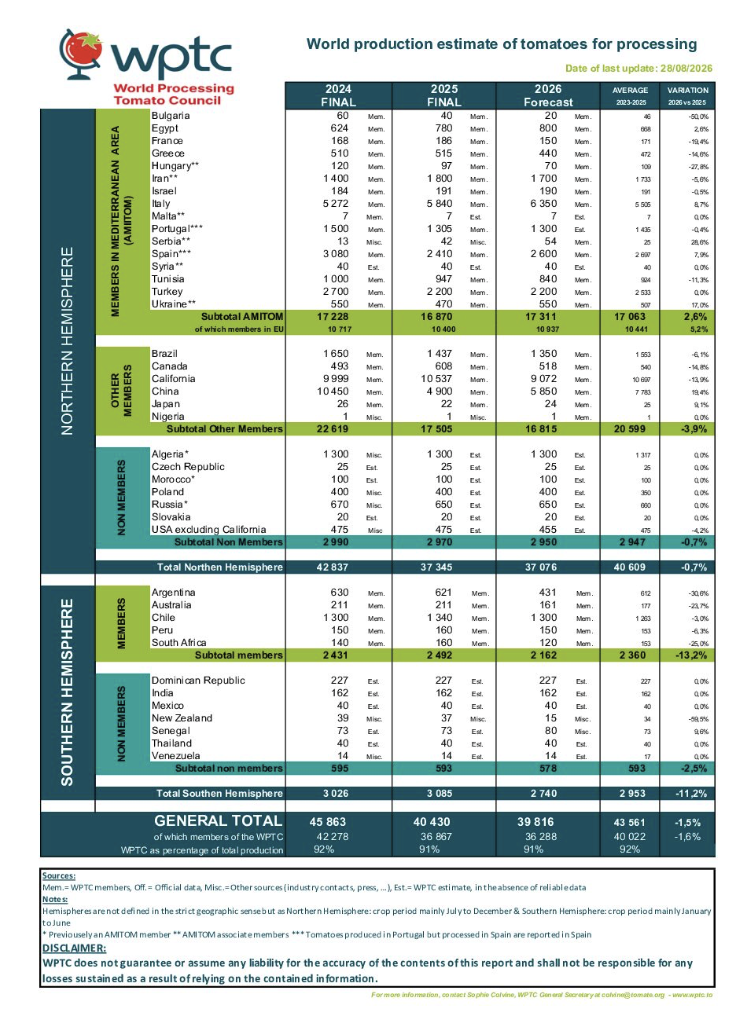
Pending information on the progress of the 2026 crop in China, the world production estimate now stands at 39.8 million tonnes, 1.5% lower than the 40.3 million tonnes processed in 2025.
AMITOM COUNTRIES
BULGARIA
No major new developments; the unusual August conditions with heatwaves and strong winds continue to be abnormal for Bulgaria. Issues include low colour, low yields (approximately 10% below normal). Another heatwave is expected in the coming days.
EGYPT
Assessments conducted over the past 15–20 days with agricultural associations and growing communities revealed that supplied quantities are not matching expectations. Approximately 5–7% less acreage has been planted for the summer crop, as some growers shifted to other crops due to increased costs of fertilization, pest control, and energy. Brix average is approximately 4.9.
Ongoing assessments of quantities and planted areas are continuing; updated figures are expected by the first 10 days of September.
FRANCE
At the end of week 34 (23 August), 80,000 tonnes had been processed, 55% of the expected total which is reduced to 145,000 to 150,000 tonnes due to the successive heatwaves affecting the mid to late season tomatoes: blossom end-rot, sunburnt and floral abortion are reducing yields, especially in the southern fields of the south-east region (Camargue area) than in the Drôme region. Average brix is 5.06 and defect rates of 8%. Temperatures are now down, with no more heatwaves expected, and the recent rains which have not affected the harvest.
GREECE
Temperatures are relatively high (35–37°C) but not classified as heat waves; conditions are uncomfortable for people but not damaging for tomatoes.
In the south, 80% of the surfaces have now been harvested and the season should end by 10 September.
In the centre, 70% of surfaces harvested and the end expected around 15 or 20 September.
Yields average 90 to 95 t/ha and fruit quality is good with brix around 5, a bit lower than in 2025.
The forecast remains unchanged.
HUNGARY
The processing season started on 17 August. As mentioned in our previous updates, the unusually cool nights during certain periods slowed down the ripening process, and fruit maturity developed somewhat more slowly than initially expected. Since 23 August, however, the pace of processing has increased, and harvesting is progressing steadily.
At present, approximately 25% of the expected crop has been harvested and delivered for processing.
The overall situation remains positive, with the season now moving forward at a faster pace.
IRAN
Harvesting of the new tomato crop has now started in northern and western regions of Iran, and tomato processing factories are currently operating and processing the new crop.
At this stage, it remains difficult to provide an accurate estimate of the final crop volume, as harvesting is still in its early stages and yields are being affected by weather conditions. For the time being, we maintain our previous forecast of approximately 1.7 million metric tonnes of processing tomatoes for the 2026 crop.
Weather conditions continue to be an important factor affecting the progress of harvesting. High temperatures and recent heat waves have created additional pressure on the crop and are influencing both harvesting schedules and tomato quality in some areas.
There are also reports of sunburn damage on tomatoes in western Iran, although the overall impact on production and final yields is still difficult to quantify. Further information will become available as harvesting progresses and more fields are assessed.
Processing factories across the main production areas are now active, with factories processing significant volumes of fresh tomatoes.
An important development this season is that factories are processing more tomatoes than in previous years. This appears to be partly related to the current economic situation in Iran and reduced consumer purchasing power. With weaker domestic purchasing power and challenging economic conditions, a larger proportion of the tomato crop is being directed toward industrial processing rather than the fresh market.
This increased processing activity could provide additional availability of tomato paste and other processed tomato products during the season.
ITALY
In the North, the last OI Pomodoro release state that as of the end of week 33 (16 August), 1.76 million tonnes had been processed with an average brix of 4.9 (below the 2025 average), a defect rate of 4.8%; and a 95% payment index. Week 33 saw the highest weekly input for the last five years, and thus marked the peak of the production while volume started slowing down during week 34 which also saw a reduced brix of 4.83.
It rained between 20 and 50 mm across tomato-growing areas (Piacenza to Ferrara) over the last weekend, causing a temporary harvest stoppage; harvesting restarted on Monday.
POs report a very early crop and early harvest, even for late-transplanted fields so the campaign is expected to finish by mid-September at the latest, with a reduced flow of tomatoes from end of August onwards. The forecast remains 3.25 million tonnes.
In the Centre and South, the campaign is wrapping up in Caserta (Campania) while it is in full swing in Puglia. Quality is good, but Brix levels are lower than usual.
Agricultural yields remain normal for now, but there are significant concerns regarding the late harvest due to the July heat wave. It is still too early to quantify the impact of the heat wave on the late crop.
The season in the south will be longer due to delayed transplanting caused by heavy rains in Puglia in April. There is an uneven ripening issue — the first line of tomatoes is ripening while the last line is still arriving, creating a harvesting dilemma similar to last year in some areas. The yield harvested will be less than the yield in the field, but given current market conditions, this is not expected to be a major problem. No heavy rain is forecasted in the short term, but some websites are predicting a very difficult September (though long-term forecasts are not fully reliable).
The forecast remains 3.1 million tonnes for the Centre and South, so the total for Italy remains 6.35 million tonnes.
PORTUGAL
Portugal is experiencing very unusual August weather with heavy rain and thunderstorms since Sunday; some areas received 8–12 mm of rain. Some factories stopped operations on Monday as growers could not access fields; some factories attempted to continue working very slowly. Heavy storms again on the current day (morning/evening) have made field work impossible; harvesting is not possible today. Tomorrow, some showers are still expected but after Friday, conditions are expected to normalize, with harvesting resuming on Friday or Saturday. Fields that were ready for harvest need to be processed quickly once the sun returns.
Late September fields still need to be evaluated; there were already question marks about yields from those late fields.
Brix levels are the lowest seen in 25 years — below 5 on average (usual average is 5.2), attributed to the mild spring and weather conditions. Colour quality remains very good, which is typical for Portugal.
As of Monday, approximately 40% of processing had been completed.
Overall, the season is not expected to exceed the estimated volume and may be slightly lower, though it is too early to confirm.
SERBIA
Harvesting is progressing without problems and 40% of the surface has been harvested to date. On the remaining 60%, we expect much better colour of tomatoes 2,1 – 2,2 vs 1,9 – 2 and yield more than 95 t/ha vs 80 t/ha now.
In the future, we will focus on more heat resistant varieties.
SPAIN
In Andalusia two factories have already closed, and the rest will still work at least some days of September. Yields are generally 5 to 15% lower than expected.
In Extremadura, 55 to 60% of the volume has been delivered already. Medium and late tomatoes have been affected by heat waves and mite attacks, resulting in lower yields. Light rains occurred last Monday with no significant impact so far.
It is still difficult to give an accurate forecast, but the revised maximum forecast is 2.6 million tonnes, and it may be lower.
Some rain is forecasted for today and tomorrow in Extremadura, but it is not expected to be too heavy.
TUNISIA
As of 23 August, 807,000 tonnes have been processed. At present only 5 factories are still open with a daily input of 3,400 tonnes of fresh tomatoes.
TURKIYE
The harvest in the south, where lower surfaces than usual were planted this year, is now finished, while the other regions (Balıkesir, Bursa, Manisa) are all at peak harvest simultaneously, which is unusual as they are typically staggered. All factories are processing from their own local supply; no inter-regional tomato transport is occurring. Another ten days of peak are expected.
Turkiye has not experienced the same extreme high temperatures as other regions, so the impact on the late crop is still unknown. Clear skies are forecasted for the near future. Brix is between 4.8 and 5 depending on the area/factory, which is considered average to slightly high for Turkey.
The forecast is reduced to 2.2 million tonnes due to forecast lower yields in the later crop and partially due to tomatoes being left in the field due to oversupply during the peak of the crop.
UKRAINE
Everything is ok. The forecast remains the same. Early tomatoes are good from any side.
OTHER WPTC COUNTRIES
CALIFORNIA
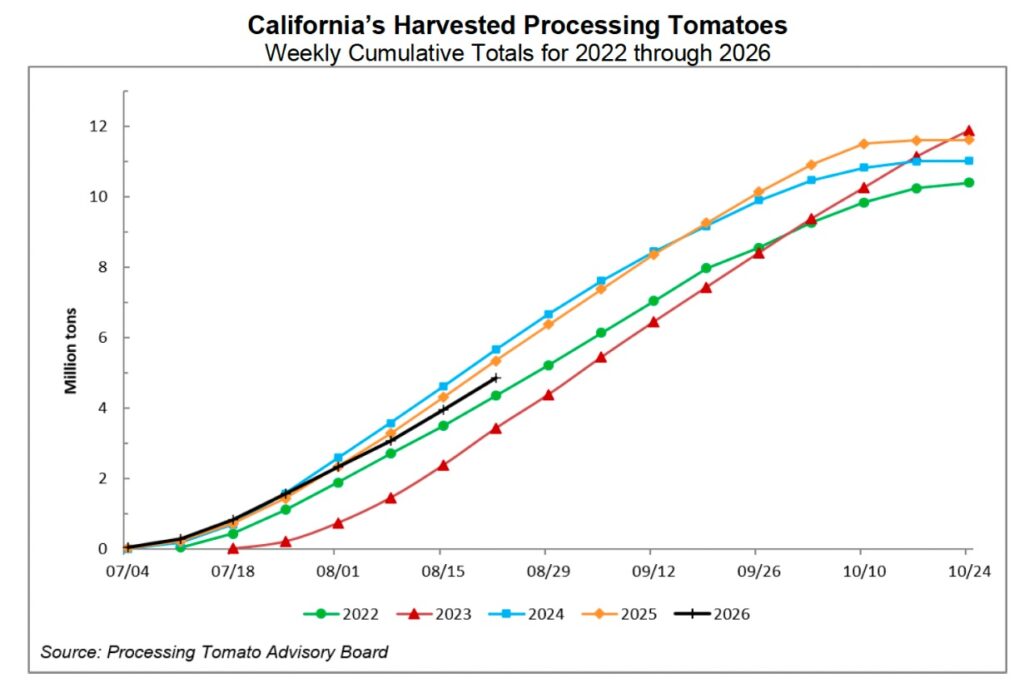
According to the USDA report released on 28 August (see 2026 California Processing Tomato Report), contracted production for California processing tomatoes is forecast at 10.0 million tons (9,072 million metric tonnes), averaging 54.9 tons per acre. The current production forecast is 10 percent below last year’s contracted production of 11.1 million tons (9.97 million metric tonnes), and 1 percent above the May forecast. The projected harvested acreage of tomatoes grown under contract is 182,000 acres (73,500 hectares), down 4 percent from 2025.
Variable weather patterns throughout the spring and summer affected the uniformity of crop development. This marks the third consecutive year of declining contracted acreage as the industry works to balance inventory levels with market demand.
The processing tomato harvest began in the last week of June, nearly a week earlier than usual, and is expected to conclude before the end of October. Yields are reported to be above average, though they are not expected to reach the record highs achieved in 2025.
The Processing Tomato Advisory Board published shipments through August 22, 2026, showing a 9 percent decrease compared to this time last year.
CANADA
Harvest began on August 14, with most processors starting during the week of August 17.
To date, the crop looks good, with good colour and solids. While some fields experienced slightly delayed maturity due to the cooler weather over the past couple of weeks, harvest is progressing well overall.
At this point, it is anticipated that contracted volumes will be achieved, with the potential to finish slightly above contract.
JAPAN
No changes to report.
NIGERIA
Harvesting commenced in the first week of February 2026, with fields harvested in batches according to maturity, reaching peak harvest in the third week. The harvest season spanned approximately five weeks.
Weather conditions remained relatively consistent throughout the harvest period, with average morning temperatures of approximately 28°C and midday temperatures of 37°C. Relative humidity ranged between 25% and 41% during both periods.
During the reporting period, the factory received and processed approximately 1,642.75 metric tonnes of fresh tomatoes from the farming team, producing 267.7 metric tonnes of tomato concentrate at 27°Brix. The raw material recorded an average starting Brix of 4.4, with a favorable color value of 1.8.
Approximately 29.25 hectares were planted with high-quality hybrid tomato varieties, producing 1,813.65 metric tonnes at an average yield of 60.5 t/ha. This represents a 51% increase over the projected yield target.
A reliable water source from a nearby dam provided consistent irrigation throughout the production cycle, supporting crop development through full maturity and harvest.
Source: WPTC