News
Spain’s Tomato Mite Outbreak
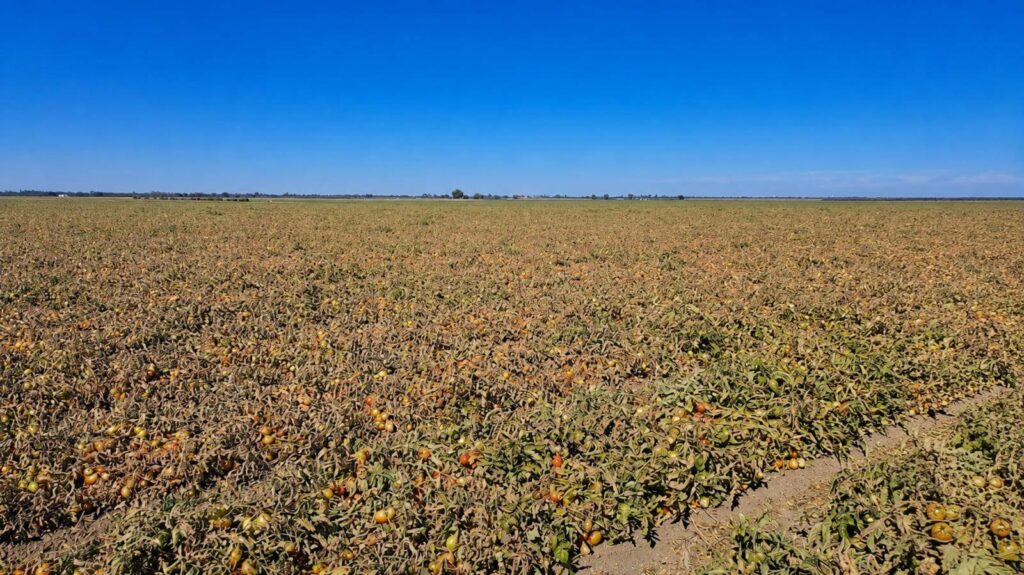
Spain’s processing tomato industry, heavily centered in Extremadura—which generates nearly three-quarters of the nation’s crop—is confronting a crisis this season. High temperatures and low humidity have fueled a massive outbreak of the tomato russet mite, locally known as Vasates. The microscopic pest sucks plant cells and causes vines to dry out prematurely, leaving up to an important amount of Extremadura’s 20,700 planted hectares affected and projecting yield losses of up to 30%. While climate conditions enabled the outbreak, industry leaders agree that the severity of the damage stems directly from a sudden regulatory shift: the prohibition of Movento, a spirotetramat-based insecticide that growers previously relied on as a single-application safeguard.
The absence of an effective control measure has severely disrupted field operations and damaged fruit quality. According to the Agronomy Manager at CONESA, the incidence of Vasates has increased dramatically compared with previous seasons, largely due to the ban on Movento. This regulatory change has not only heightened mite pressure but has also “favoured the resurgence of pests that had previously been well controlled and had very little impact on the crop, such as green aphids and whitefly.” In severely infested fields, plants dried out before reaching optimum maturity, forcing growers to harvest 10 to 15 days earlier than the natural cycle. While early tomato crops largely escaped damage, mid-season and late crops suffered far more severely as peak pest pressure collided with summer heat.
Beyond physical crop damage, Spanish growers face skyrocketing input costs for inferior results. To replace a single pass of Movento—which previously cost approximately €70–80 per hectare—growers have been forced to apply at least three authorized alternative treatments costing between €100 and €170 per hectare each, alongside multiple sulfur dusting applications at €30 per pass. As the CONESA Agronomy Manager noted, producers are carrying out “many more treatments with products that have low efficacy and very limited persistence, while at the same time involving a very high economic cost.” Though factory data is still being finalized, conservative estimates point to at least a 10% reduction in expected regional production, with local cooperatives in heavily hit zones like the Vegas del Guadiana anticipating real losses of 25% to 30%.
The operational crisis is further compounded by what local producers view as a severe regulatory disadvantage within the European Union. While the Spanish Ministry of Agriculture has refused to re-authorize the active ingredient, neighboring countries have taken a different approach. Industry association AGRUCON expressed strong frustration over the policy disconnect, stating that “it is highly disappointing and hard to understand that the Spanish administration has not authorized the use of the only product that allows effective control of mites in tomato, whereas main EU competitor countries, such as Italy and Portugal, have indeed authorized it.” Spanish producers now face a distinct competitive disadvantage, absorbing significantly higher treatment costs and lower overall yields while competing in the same European market against producers equipped with effective pest control tools.
Sources: RTVE, CONESA, AGRUCON