News
California: Morning Star Company explores AI options
The Morning Star Company explores AI options to improve yields, profitability
A leader in the tomato processing industry, The Morning Star Company is looking at new AI agriculture technologies in extensive field settings. The processor extends this knowledge to their tomato farmers to improve yields and overall profitability, as well as positively contribute on the long-term sustainability of our natural resources.
Currently, Gradient Crop Yield Solutions (a Morning Star agriculture business entity), is working on smart irrigations technologies in processing tomatoes. “This year, we are partnering with farmers to expanding our knowledge in other agricultural industries such almonds, pistachios, wine grapes, citrus and dates,” says Saul Alarcon, Agronomist at Morning Star.
Artificial intelligence will play a critical role in the future integration of infrared technology (IR) and environmental data, Alarcon says. “Mathematical algorithms will eventually help us to automate irrigation systems using plant water stress index responses from daily atmospheric water demands. The standard practice currently is to have a program that uses weather and/or soil moisture sensor data to determine irrigation scheduling.”
 However, Morning Star found through field research that precise irrigation decisions can be fine-tuned by collecting daily vital environmental stress signals from the plant. “This process can detect stress much faster than the methods mentioned previously (almost real-time) thus aiding in the rapid detection and prevention of unpredictable yield limiting factors before we can visually detect it,” Alarcon explains.
Gradient is also partnering with other companies that utilize technologies that lead themselves to AI benefits. The company uses the CERES Imaging Water Stress tool, which helps growers to detect crop anomalies such as water stress, irrigation efficiency issues, disease and insect problems. Detection of crop yield limiting factors before they are noticeable to the naked eye is very useful to farmers. “Aerial crop images provide a wider perspective of our production systems through the visualization of plant vigor maps (NDVI), thermal and other crops stress algorithms,” Alarcon says.
Morning Star is also teaming up with ESCARDA Technologies, based in Berlin, Germany, which specializes in laser-based weeding. Laser-based weeding shows great potential as a non-herbicide solution to weed control that uses multi-spectral sensors and state of the art computer vision algorithms (AI) to detect and classify all plants on the field. Alarcon says that after identifying the weed plants, a laser beam will be used to eliminate or seriously damage the weeds. In this way, value crops can grow without the competition from noxious weeds and have higher yields because all available nutrients do not have to be shared.
 AI could help us to estimate harvest times while predicting yields more accurately. For example, says Alarcon, preliminary data has shown that when growers have low plant water stress index levels (PWSI) the possibility to have above average yields increases significantly. He says that PWSI information therefore could be used in the future to estimate yields thus aiding in the prediction of possible crop shortages. Similarly, the smart integration of aerial images might help in the planning of harvest schedules that could assist in the effective coordination of a continuous and steady stream of incoming fruit for factories.
“AI could also aid in the improvement of the quality and nutritional value of fruit such as natural tomato soluble solids (brix). By using smart technologies growers might be able to manage pre-harvest irrigation, to gradually regulate plant stress to a desirable point where fruit can increase brix levels without the negative impact of yield loss,” Alarcon says. At a more regional level, AI can be useful in the generation of economic models using field and environmental data to predict yields projections and estimate future commodity prices, he adds.
Preliminary data shows that yields have had a steady improvement with growers that have actively adopted them. Optimization of irrigation management practices can help them get better production while optimizing water usage (and cost).
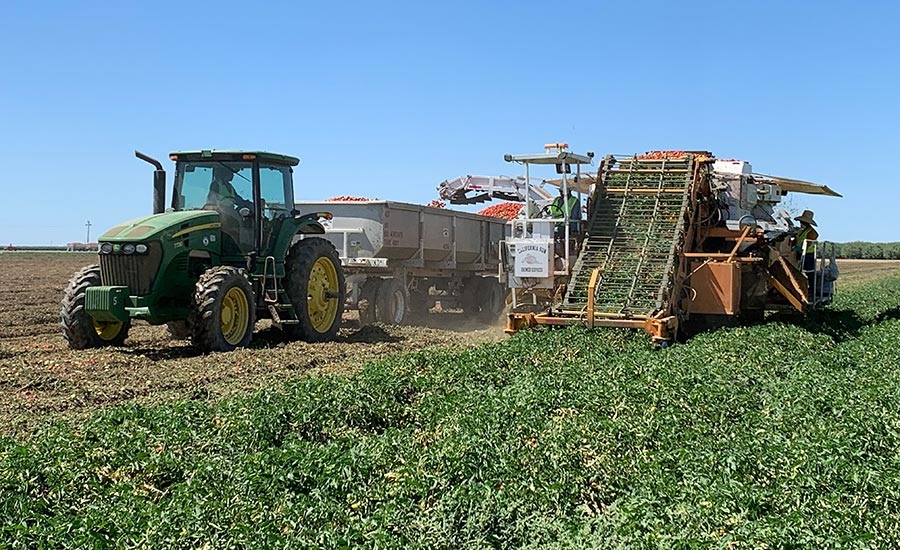
AI will help to solve several issues during the various stages of the supply chain. “For example, in some places where labor is scarce or weather conditions are extreme, AI models will be essential to develop autonomous planters, weeders, harvesters and even driver-less grain combines,” says Alarcon. “At the tomato processing facility levels, yard automation will be a standard soon, where autonomous shuttles will efficiently move loaded trailers to fruit dumping areas.”
Source: foodengineeringmag.com