News
Worldwide water scarcity by 2040
The seasons go by one after another, each with its share of climatic incidents, rarely beneficial for crops, most often harmful – sometimes downright catastrophic – and always impossible to predict. But it has been noted in recent years that the severity and frequency of these events (late frosts or unseasonal heatwaves, heavy or violent weather conditions, prolonged drought, etc.) have increased, while at the same time, the effects of climate change have manifested themselves in fairly heterogeneous ways.
The World Resources Institute is an American think tank founded in 1982, politically independent and specialized in environmental issues. It is made up of about a hundred scientists, economists, political and financial experts and analysts. The WRI is dedicated to finding practical ways to reconcile economic development with environmental protection.
The World Resources Institute is an American think tank founded in 1982, politically independent and specialized in environmental issues. It is made up of about a hundred scientists, economists, political and financial experts and analysts. The WRI is dedicated to finding practical ways to reconcile economic development with environmental protection.
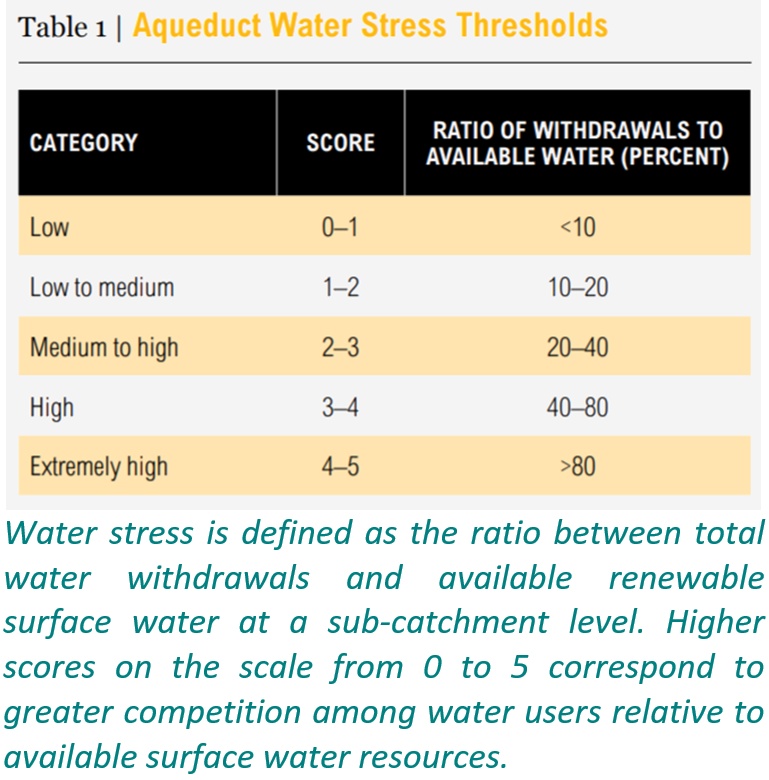 In a report that already dates back to June 2015, WRI experts built country-level water stress projections which are intended to provide useful information about potential future water situations that can help drive improved water management at the international level. Scores are determined for scenarios that are considered optimistic, pessimistic, or neither (business-as-usual), for each of the 167 countries studied, briefly describing potential water-related issues expected for 2020, 2030 and 2040. They are available for global stress levels as well as for industrial, agricultural and domestic contexts.
The following figures give a schematic overview of the expected levels of water scarcity for agricultural areas in the 40 or so countries that are being monitored by the WPTC. Although the accuracy of the data provided is not sufficient to determine the possible conditions of irrigation access, for example, in California and Indiana, hypotheses from the experts confirm the agricultural issues related to the availability of water resources over the next twenty years and give their measurable dimensions. As stated by the report's authors, the scores are in no way predictions. It is important to note, however, that the areas most exposed to increasing water risk are also those that today feature the largest areas of industrial tomato crops and are currently home to the most powerful processing industries.
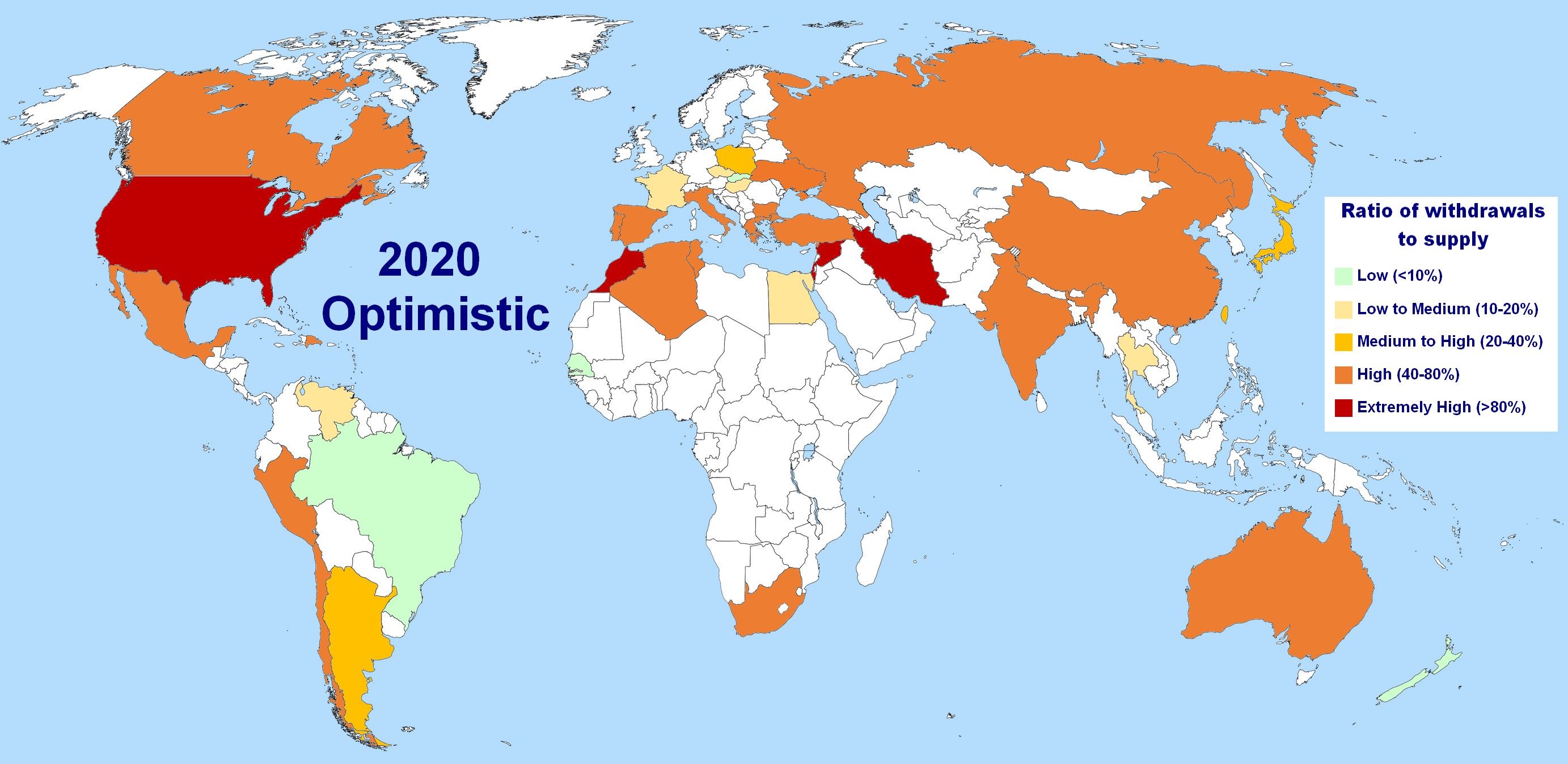
Country-Level Water Stress in 2020 under the Optimistic Scenario
The World Resources Institute forecasts that the world’s demand for water is likely to surge in the next few decades. Rapidly growing populations will drive increased consumption by people, farms and companies.
It is not clear where all that water will come from. Climate change is expected to make some areas drier and others wetter. As precipitation extremes increase in some regions, affected communities face greater threats from droughts and floods.
It is not clear where all that water will come from. Climate change is expected to make some areas drier and others wetter. As precipitation extremes increase in some regions, affected communities face greater threats from droughts and floods.

Country-Level Water Stress in 2030 under the Business-as-usual Scenario

Country-Level Water Stress in 2040 under the Pessimistic Scenario
Some complementary data:
These global country-level projections are best suited to making comparisons among countries for the same year, as well as among decades and scenarios for the same region. As with Aqueduct’s previous projections and country rankings, these country-level future scenarios might not be as accurate as those using higher resolution data or more localized scenarios. These indicators also should not be seen as predictions, but rather as potential outcomes under specific climate and socio-economic trajectories, which are subject to uncertainties. Nor do the indicators attempt to account for existing governance and investment in the water sector.
http://www.wri.org/resources/data-sets/aqueduct-projectedwater-stress-country-rankings.
Technical note: https://wriorg.s3.amazonaws.com/s3fs-public/aqueduct-water-stress-country-rankings-technical-note.pdf
For further information: https://www.wri.org/
These global country-level projections are best suited to making comparisons among countries for the same year, as well as among decades and scenarios for the same region. As with Aqueduct’s previous projections and country rankings, these country-level future scenarios might not be as accurate as those using higher resolution data or more localized scenarios. These indicators also should not be seen as predictions, but rather as potential outcomes under specific climate and socio-economic trajectories, which are subject to uncertainties. Nor do the indicators attempt to account for existing governance and investment in the water sector.
The full results of all scenarios are available at:
http://www.wri.org/resources/data-sets/aqueduct-projectedwater-stress-country-rankings.
Technical note: https://wriorg.s3.amazonaws.com/s3fs-public/aqueduct-water-stress-country-rankings-technical-note.pdf
For further information: https://www.wri.org/
Table of stress scores for the 40 countries followed by the WPTC

Sources: wri.org, freshplaza.com
A session will be devoted to this topic of climate change and water availability and how it could affect the tomato processing industry during the next decades during the 14th World Processing Tomato Congress in San Juan in March 2020.
Full report: