News
Tomato pomace as a renewable resource for bioplastic production
Research: turning to tomatoes for bioplastics
Bioplastics from tomato skin that decompose within a month
Tomatoes and tomato products are unanimously recognized for their protective properties against a large number of cardiovascular or degenerative diseases. Could the tomato also be made into bioplastics? This is what José Alejandro Heredia has been investigating for the past years in Spain. Researchers at the La Mayora Subtropical and Mediterranean Hortofruticulture Institute have developed bioplastics from tomato by-products that have similar properties to commercial packaging plastics, but that decompose in one month in the sea. That is a much shorter time than the 450 years it takes for petroleum-derived plastics to degrade.
Tomato pomace is the resulting by-product after tomato fruit processing to prepare sauces, ketchups, juices, gazpachos, purees, concentrates, etc. It is composed of peels (almost half), seeds (approximately 40%), and a residual fibrous material. These residues represent approximately 2-3% of the fresh weight processed. In Spain, it is estimated that about 60,000 metric tonnes per year are generated.
Nowadays, this low-cost by-product (whose elimination is valued at € 4 per ton) is wasted or, to a much lesser extent, used for animal feed or to extract substances with a certain added value such as lycopene (a natural pigment with antioxidant properties) or pectins (polysaccharides that are used as thickeners and gelling agents in prepared dishes and medicines). Unfortunately, in many countries the burning of this type of waste is still allowed, contributing to CO2 emissions and, therefore, global warming.
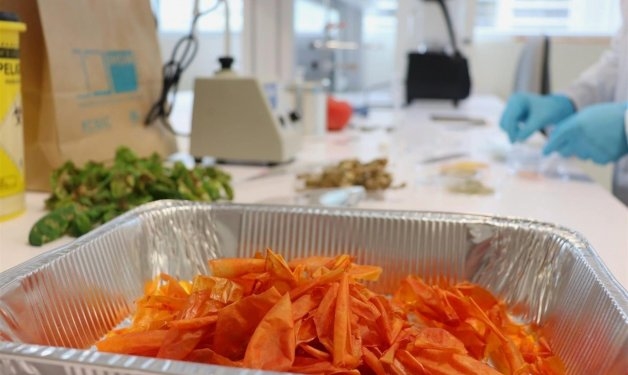 The researchers extracted cellulose from the tomato leaves, stems, and skin that are discarded in the canning industry after making tomato paste, sauce or ketchup. Researchers used these remains to create a robust and transparent film or plastic wrap that can have multiple applications, stated Institute of Subtropical and Mediterranean Horticulture (IHSM) researcher, Jose Alejandro Heredia, who works with the cellulose obtained from these remains to create a material capable of being modified with antibacterial bioactive substances and antioxidants that have properties for food packaging and that, in addition, would degrade in a minimum time compared to plastic containers.
José Alejandro Heredia is currently working on his project titled “Circular bioeconomy for food packaging: use of waste from the tomato canning industry”. In a context of circular bioeconomy, tomato processing waste represents an abundant and renewable resource of raw materials to manufacture, in a sustainable and efficient way, different products that can be incorporated back into the manufacture and consumption cycle. In particular, our research team works with the plant cuticle, i.e. the outermost membrane that covers the plant epidermis. As an interface between the plant and the environment, cuticles prevent massive water loss, regulate gas exchange, defend against pathogens, and protect against mechanical damage and severe changes in relative humidity, intensity, and light quality (for example, harmful UV radiation) and temperature. These characteristics make the cuticle an ideal system to be mimicked and used as a material in different industrial applications such as food packaging. Regarding its composition, the plant cuticle is made up mainly of cutin (a polyhydroxylated long-chain polyester) and polysaccharides from the epidermal cell wall, in addition to small fractions of waxes and phenolic compounds. Recently, cutin has been considered a potential substitute for conventional petroleum-derived plastics in specific uses as part of a broader strategy to reduce plastic waste in the sea, according to the United Nations.
The research aims to provide sustainable and economically viable solutions to the massive use of petroleum-derived plastics in food packaging by manufacturing multifunctional bioplastics from under-utilized and non-commercial agricultural waste. Therefore, the project plans to lead to a global reduction in plastics used in food activities. In particular, the residues resulting from the industrial processing of the tomato fruit will be used as bio-renewable raw material, in combination with other materials such as paper, to manufacture products of biological origin and are likewise biodegradable using ecological technologies and that are also easily scalable for large production volumes.
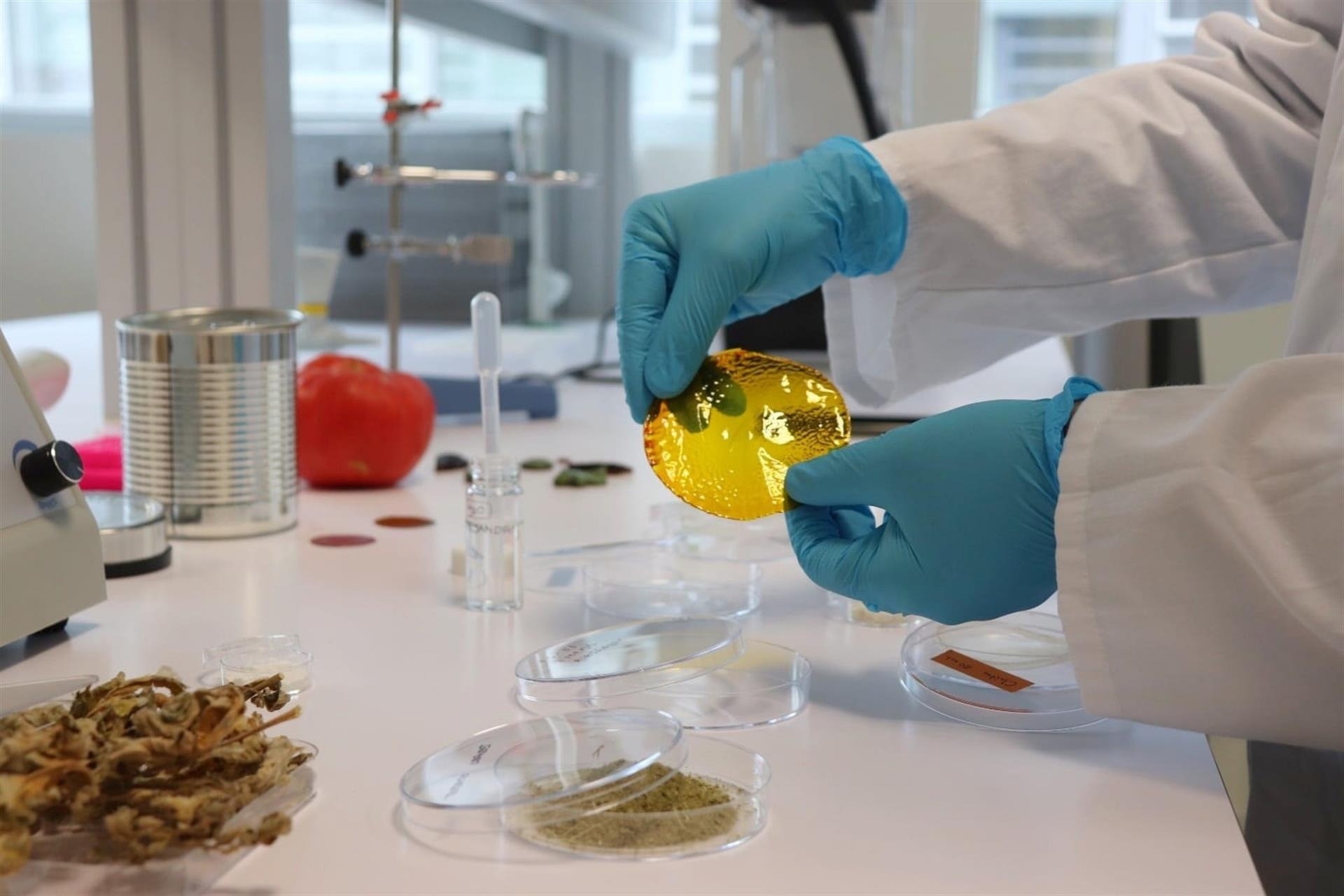 These products will offer the same benefits as those made with petroleum-derived plastics, but will be biodegraded into non-toxic substances, thus avoiding the problem of collection and disposal after use. The physical properties of these products will be designed to be equivalent to those of common plastics through environmentally friendly chemical modifications. Finally, the environmental and economic sustainability of bioplastics production will be evaluated by determining the environmental impact through life cycle analysis and production costs, respectively.
Sustainable smart plastics
These bioplastics can be hydrophobic, fluorescent, pearlescent, or have different colors and shades, depending on light exposure. In addition, these bioplastics can also be used to make 'Smart packaging'. Once they are used to protect food and the plastic is losing its initial color, it means that the plastic has absorbed water, is starting to lose its structure, and is beginning to lose antioxidant properties.

Figure 1. Diagram of the production of cutin-based bioplastics. Unsaturated and polyhydroxylated fatty acids are obtained by basic hydrolysis of tomato pomace. Several scalable technologies and specific reaction conditions can be applied to produce different bioplastics based on tomato pomace.
“Our investigations – José Alejandro Heredia explains – have consisted of isolating cutin monomers from the tomato pomace and re-polymerizing them for the manufacture of bioplastics using green processes, as explained in Figure 1. In addition to cutin monomers from peels, unsaturated fatty acids from seeds are also extracted. In general, these cutin-inspired bioplastics are hydrophobic, waterproof, ductile, insoluble, infusible, completely biodegradable by fungi and other microorganisms, and harmless to humans. Adding other components with very interesting properties, food packaging films, can lacquers, Wi-Fi antennas, T-shirts that produce electricity, and other products can be fabricated. How far can these bioplastics made from tomato pomace go?”
Using such a sustainable protocol, the material can also be used to coat the interior of a can. The researcher ensures that once this process has been carried out, it is “as good” as the current commercial oil derivatives, since they make the metal “resist corrosion very well and do not migrate towards the food”.
However, the researcher said, this new plastic will not be used by the sector for a long time, because the plastics industry needs to be able to use the same machinery for this change to be economically viable. A revolution for the environment and food sustainability is necessary first.
Sources: José Alejandro Heredia, efeagro.com, hortidaily.com, biomarketinsights.com, freshplaza.fr
Some additional information:
Research team consists of scientists from the Institute of Subtropical and Mediterranean Horticulture (IHSM) "La Mayora" and the Institute of Materials Science of Seville (ICMS). Currently, the research is funded by the Spanish “Ministerio de Ciencia, Innovación y Universidades” projects RTI2018-096896-J-I00/AEI/10.13039/501100011033 (cofinanced by the European Regional Development Fund, ERDF) and RYC2018-025079-I/AEI/10.13039/501100011033 (cofinanced by the European Social Fund, ESF) as well as by the PIE project 202040E003 funded by CSIC.
 See also: https://www.ihsm.uma-csic.es/proyectos/161
José Jesús Benítez1, Susana Guzmán-Puyol2, Antonio Heredia2, José Alejandro Heredia-Guerrero2.
1 Instituto de Ciencia de Materiales de Sevilla, Centro Mixto CSIC-Universidad de Sevilla. Americo Vespucio 49, Isla de la Cartuja, 41092 Sevilla, Spain.
2 Instituto de Hortofruticultura Subtropical y Mediterránea “La Mayora”, Universidad de Málaga-Consejo Superior de Investigaciones Científicas (IHSM, UMA-CSIC), Bulevar Louis Pasteur, 49, 29010 Málaga, Spain.