News
Tomato doubled haploid plant production
In plant breeding, the addition of desired properties to stable varieties is very labor-intensive and time-consuming, especially with slow growing species. Therefore techniques that speed up the breeding process are highly valued. As the gametes, the reproductive cells, only contain half of the genetic material (chromosomes) of the parent plant, they are excellent for the production of new plants with a pure genetic background (homozygotes). The doubled haploid technique is a method of varietal selection that consists in collecting haploid cells from these gametes in order to provoke a doubling of their chromosome store and obtain a stable line within only two generations. With traditional methods, it takes 6 to 8 generations of self-fertilization and more than 10 years to obtain a variety that has fixed major characteristics (which can nonetheless be unstable).
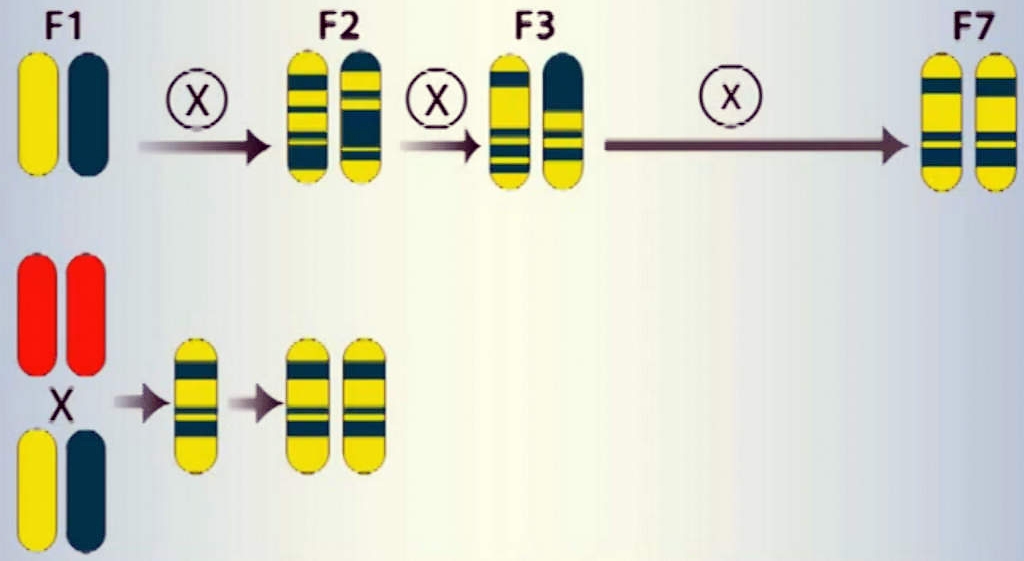 At the top, conventional crossing techniques require 7 generations to obtain what is rarely a strictly homozygous hybrid. At the bottom, the haploid generated by an inductor makes it possible to obtain a homozygous doubled haploid hybrid from the second generation.
Most often, an in vitro cultivation stage is necessary in order to regenerate a complete plant, as the rate of natural mutation from haploid (sterile) to diploid (fertile) is only 1 to 10%, depending on the variety. By careful treatment of isolated reproductive cells and the application of different stress and growth conditions, these cells can double their genetic material and can be stimulated to divide and form multicellular structures, embryos and plants. For all species and often also for every variety, optimal conditions for the generation of doubled haploid must be selected and implemented.
The strong point is the phasing approach combined with practical experience in donor plant selection and treatment selection. Fytagoras, a company active in research projects involving horticulture and seed technology, has implemented a three-step program. In the first phase, the quality, vitality and responsiveness of the cells are determined. In the following phase, a basic protocol development is carried out, while in the third phase the protocol is optimized for efficiency.
Doubled haploid technology is used by numerous breeders all over the world. In a single cycle, 100% homozygous plants can be produced in tissue culture. In comparison, traditional back-crossing takes several generations, and even then plants are still not 100% homozygous. Using doubled haploid technology, the breeding progress is accelerated enormously. Furthermore, the generation of homozygous parent lines enables seed production of identical and homogenous elite offspring (F1 hybrids). The elite offspring cannot be further propagated by seed without losing the elite characteristics. This offers hybrid variety protection because the parents of the elite hybrids belong exclusively to the owner.
For tomato, in contrast to several other crops, such technology has not been made available yet. Application in the tomato industry would mean that new varieties could be released much faster on the market and customer demand could be anticipated more effectively.
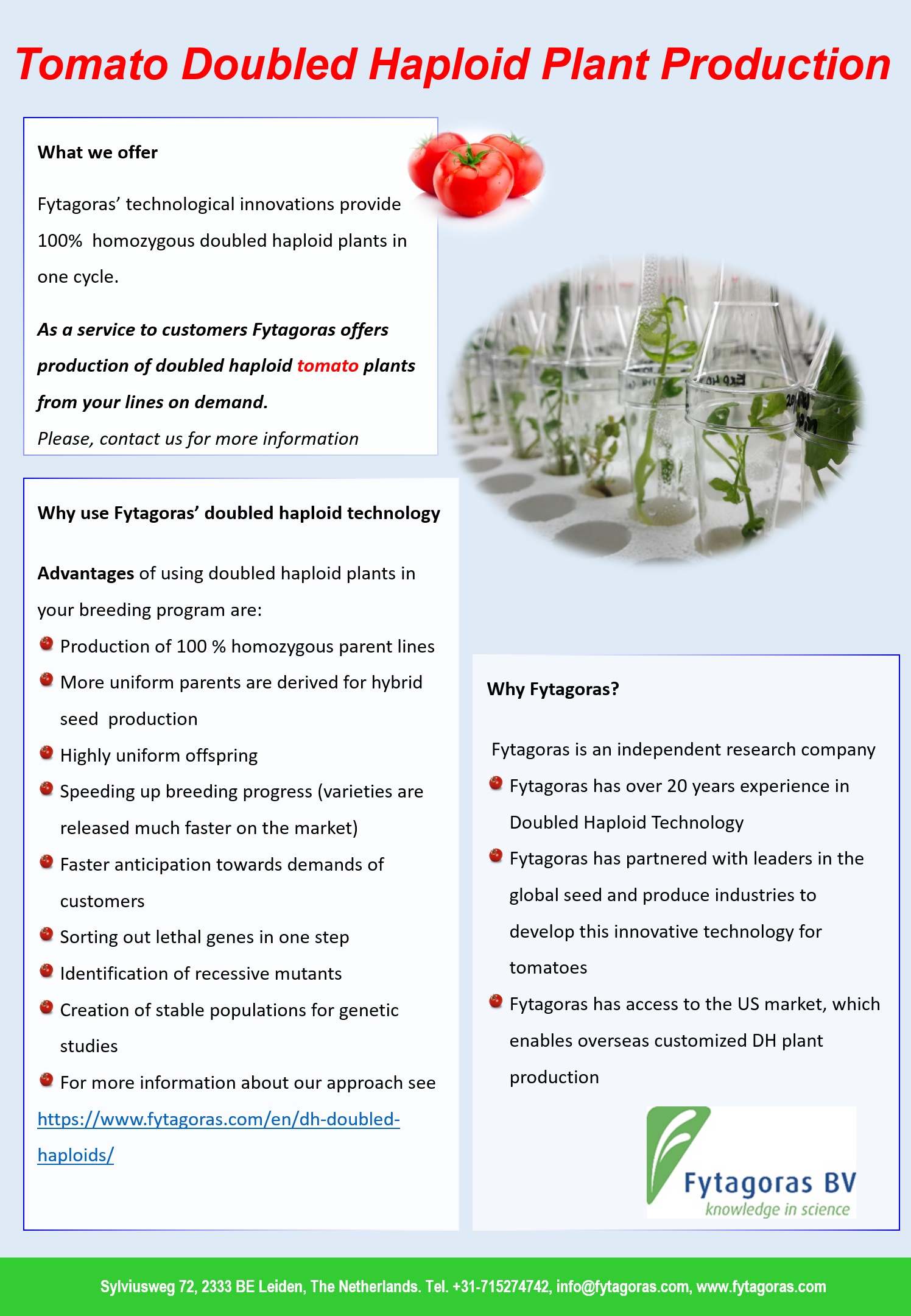
 As a service to customers, Fytagoras offers production of doubled haploid tomato plants from existing customer-owned lines on demand. The success of this approach has been proven for a wide variety of crops. Fytagoras in Leiden has many years of experience and a great track record in the development of protocols for the production of doubled haploid plants from many crops and varieties. The company has partnered with leaders in the global seed and produce industries to develop this innovative technology for tomatoes.
For further details:
Dr. W.L. Holtman, Commercial manager: wessel.holtman@fytagoras.com
Dr. W.L. Holtman, Commercial manager: wessel.holtman@fytagoras.com
Source: Fytagoras, planet-vie.ens.fr
Some complementary information: