News
Research, Portugal: Throwing tomatoes at bacteria
In a cover article, an ITQB NOVA team (Instituto de Tecnologia Química e Biológica António Xavier da Universidade Nova de Lisboa ITQB Nova) shows strides in the usage of discarded tomato peel to develop antimicrobial mixtures.
In recent years, agro-industrial residues have been explored for the development of bioplastics, food supplements, and other applications. In Europe, nearly 10 million tonnes of tomato fruit were processed in 2020, generating half a million tonnes of tomato pomace (residues of peels, stems and seeds).
 In an article published on the cover of ACS Sustainable Chemistry and Engineering, a team of ITQB NOVA and INRAE (France) scientists showed that it is possible to extract bactericidal mixtures from tomato peels in a short and sustainable process.
Fruit peel is the armour of fruits, acting as a barrier against outer damage, pathogen invasion and preventing water loss. The cuticle is the outermost part of the fruit peel and is mainly comprised of cutin. This polymer (a network of molecules), highly abundant in nature, provides antimicrobial properties to the peel. Due to its easily removable cuticle, the tomato is a key model for studies on cutin.
Portugal is the third biggest processor of tomatoes in Europe and the resulting pomace is usually destined for animal feeding. In this article, a team of scientists led by ITQB NOVA’s PI Cristina Silva Pereira focused on further exploring the potential of tomato pomace as a source of antimicrobial mixtures extracted from cutin, through a fast, simple and sustainable method.
Depending on the processing and cultivation methods, pomaces’ composition can vary significantly (different amounts of seeds, peels and stems). The team studied the extraction process from two tomato pomaces, produced in two different countries. They used a liquid extractant, which allows the recovery of cutin with minor alterations and washes out the remaining components. In addition, this extractant is biodegradable, biocompatible, and can be recycled and reused.
The researchers showed that the extracts could be processed to obtain mixtures with antimicrobial activity against pathogenic bacteria. Both mixtures showed effectiveness against Staphylococcus aureus and Escherichia coli. However, there were some differences in effectiveness against E. coli, depending on the composition of the pomace.
Abstract
Agro-industrial residues comprise a rich diversity of plant polymers and bioactive compounds, constituting promising sources for the development of materials, including bioplastics, and food supplements, among other applications. In particular, the polyester cutin is abundant in fruit peel, a plentiful constituent of pomace agro-industrial residues. The potential of diverse fruit pomaces as a source for the development of cutin-derived materials/products has been extensively sought out. This study expands the established knowledge: it sets proof of concept for the production of antimicrobial oligomers from cutin-rich materials isolated in a single step from tomato pomaces generated by two remote agro-industries. Specifically, it first analyzed how the chemical signature (nuclear magnetic resonance (NMR) and gas chromatography–mass spectrometry (GC–MS)) of a pomace (and of its major constituents) mirrors that of the corresponding cutin-rich material isolated using an ionic liquid extractant.
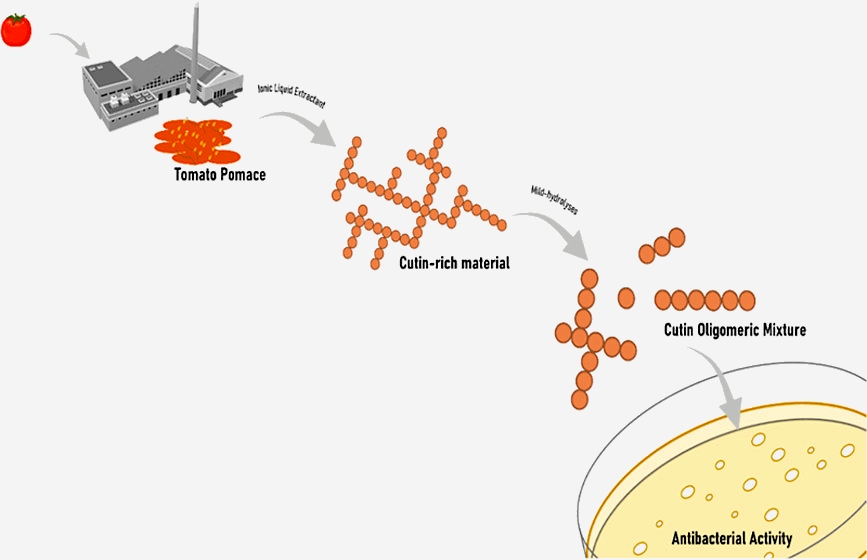
The cutin-rich materials were then deconstructed (using mild hydrolyses), and the resultant mixtures were chemically characterized and screened for bactericidal activity against Escherichia coli and Staphylococcus aureus. The presence of esterified structures, linear and/or branched, likely comprising dioic acids as a major building block (but not exclusively) is a prerequisite for activity against E. coli but not against S. aureus that was susceptible to monomers as well. Further studies are required to optimize the production of broad bactericidal oligomers from any cutin-rich pomace source, moving ahead toward their circular usage.
“Many studies have explored the potential of tomato peels as a source of cutin”, says Rita Escórcio, who has been studying the process during her PhD. “However, they rely on long processes with multiple steps. We have just provided proof of concept that it is possible to use tomato pomace to extract cutin in a fast, simple and green method. The extracts can then be processed to obtain mixtures with antimicrobial properties.” In the future, these mixtures can be used to provide antimicrobial properties to biomaterials.
“This is an important contribution to the future of circular usage of fruit pomace”, adds Cristina Silva Pereira, head of the in the Applied and Environmental Mycology lab, where Rita is developing her work. “Further studies are needed to optimize the production of broader bactericidal mixtures from any cutin-rich source. In the future, the goal is to translate this process to the industrial scale and search for methods to make it even greener”.
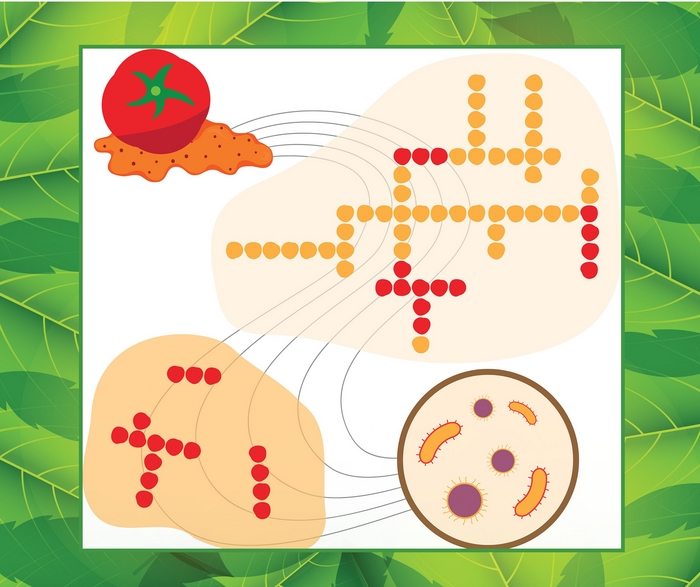 Some complementary data
Original paper
ACS Sustainable Chemistry and Engineering
“Finding a Needle in a Haystack: Producing Antimicrobial Cutin – Derived Oligomers from Tomato Pomace”
Rita Escórcio, Artur Bento, Ana S. Tomé, Vanessa G. Correia, Ru?ben Rodrigues, Carlos J. S. Moreira, Didier Marion, Bénédicte Bakan, and Cristina Silva Pereira
(
On the IQTB website:
https://www.itqb.unl.pt/news/throwing-tomatoes-at-bacteriaSource: eurekalert.org