News
Research: A review on microbial role on plant stress
Tomato cultivation faces formidable challenges from both biotic and abiotic stressors, necessitating innovative and sustainable strategies to ensure crop resilience and yield stability. A comprehensive review published in May 2025 in the international Journal of Experimental Botany delves into the evolving landscape of employing microbial consortia as a dynamic tool for the integrated management of biotic and abiotic stresses in tomato plants.
The microbial consortium, comprising an intricate network of bacteria, fungi, and other beneficial microorganisms, plays a pivotal role in promoting plant health and bolstering defense mechanisms. Against biotic stressors, the consortium exhibits multifaceted actions, including the suppression of pathogenic organisms through antagonistic interactions and the induction of systemic resistance in tomato plants.
On the abiotic front, the microbial consortium enhances nutrient availability, optimizes water retention, and ameliorates soil structure, thus mitigating the adverse effects of factors such as drought, salinity, and nutrient imbalances.
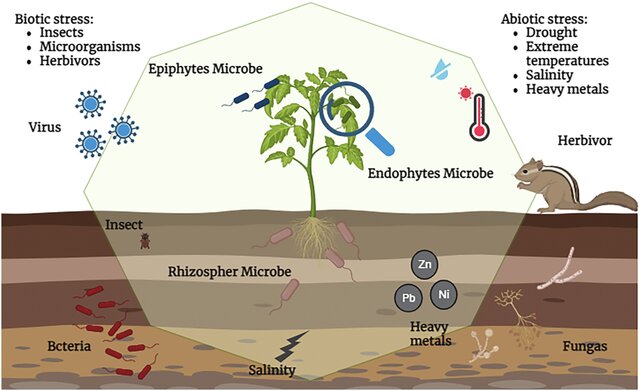
Tomato plant under different stresses and its association with Plant Growth Promoting Microorganisms (copyrignt: article authors)
This review synthesizes current research findings, highlighting the diverse mechanisms through which microbial consortia positively influence the physiological and molecular responses of tomato plants to stress. Furthermore, it explores the adaptability of microbial consortia to various agroecosystems, offering a versatile and sustainable approach to stress management. As a promising avenue for eco-friendly agriculture, the utilization of microbial consortia in tomato cultivation emerges not only as a tool for stress mitigation but also as a transformative strategy to foster long-term sustainability, reduce reliance on synthetic inputs, and enhance overall crop productivity in the face of changing environmental conditions.
Reference: Benaissa, O., Taoussi, M., Legrifi, I., Belabess, Z., Lazraq, A. et al. (2025). Strengthening Tomato Resilience: Harnessing Microbial Consortia to Overcome Biotic and Abiotic Stress. Phyton-International Journal of Experimental Botany, 94(5), 1453–1495.
Full text at: https://doi.org/10.32604/phyton.2025.064598