News
An extended season, but objectives exceeded for French processing tomatoes
Adapted with authorization from an article by Emmanuel Delarue originally published in the weekly French magazine “L’Agriculteur Provencal” on 21 November 2025.
Despite a sluggish start in the spring and a harvest campaign severely affected by intense heat, the French processing tomato sector achieved one of its best recent years in 2025, pushing its industrial capacity to the very limit.
The 2025 industrial tomato campaign in France can be summarized as paradoxical, unpredictable, yet ultimately satisfactory. Following a 2024 marked by mixed fortunes, French producers (grouped into four Producer Organizations) and the ten processors not only met their goals but exceeded contracted volumes by 6% (and 4% for organic alone). This performance is rare enough to be highlighted.
Sluggish Spring Leads to Early Rush
The season began with some anxiety. Typically, preparation for the earliest plantings takes place between mid- and late-March. However, in 2025, rain and cool temperatures complicated soil work, leading to early concerns among processors.
Paradoxically, subsequent extreme weather ultimately accelerated the season. Heat stress in late June/early July and again in the first half of August dramatically sped up the vegetative cycles, boosted maturity, and led to unprecedented early harvesting. As a result, the campaign kicked off on July 15th in the South-East (Hérault and Gard regions)—one of the earliest start dates in recent history.
“When the climate cooperates, all is well. But the system can quickly seize up,” notes Robert Giovinazzo, director of Sonito, underscoring the fragility of a sector where everything—planting, delivery, and industrial scheduling—is tightly synchronized.
Significant Yield Increases Boost Production
Field results were reassuring, with good and sometimes excellent yields. Consolidated figures show France hitting an average of 76.9 tonnes per hectare (t/ha), a 14% increase. Conventional farming reached 78.7 t/ha (+10%), and organic saw a notable jump to 66 t/ha after several subdued years.
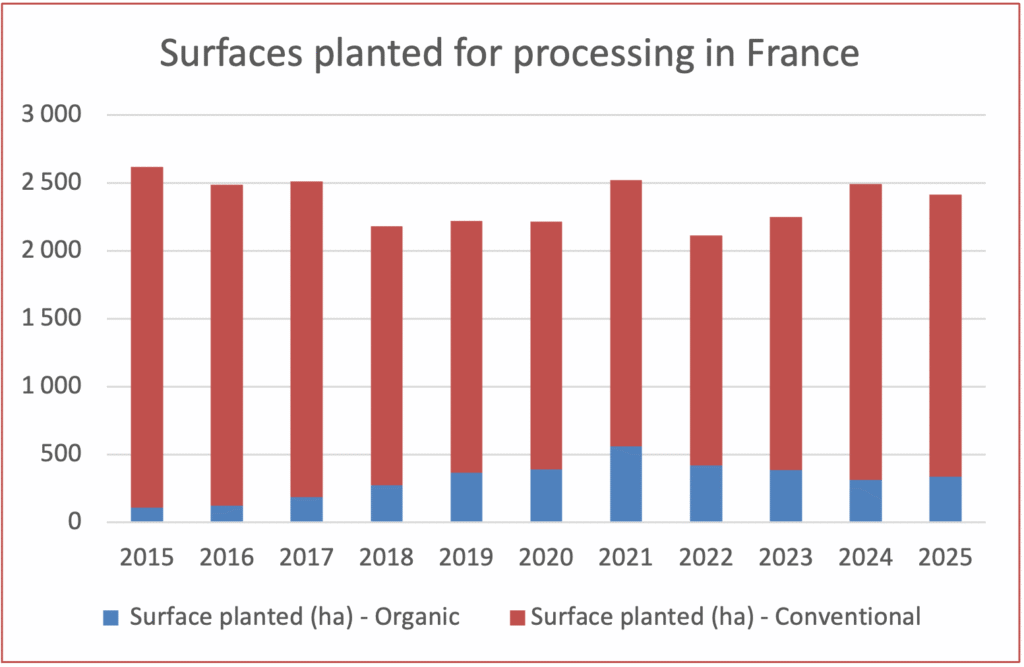
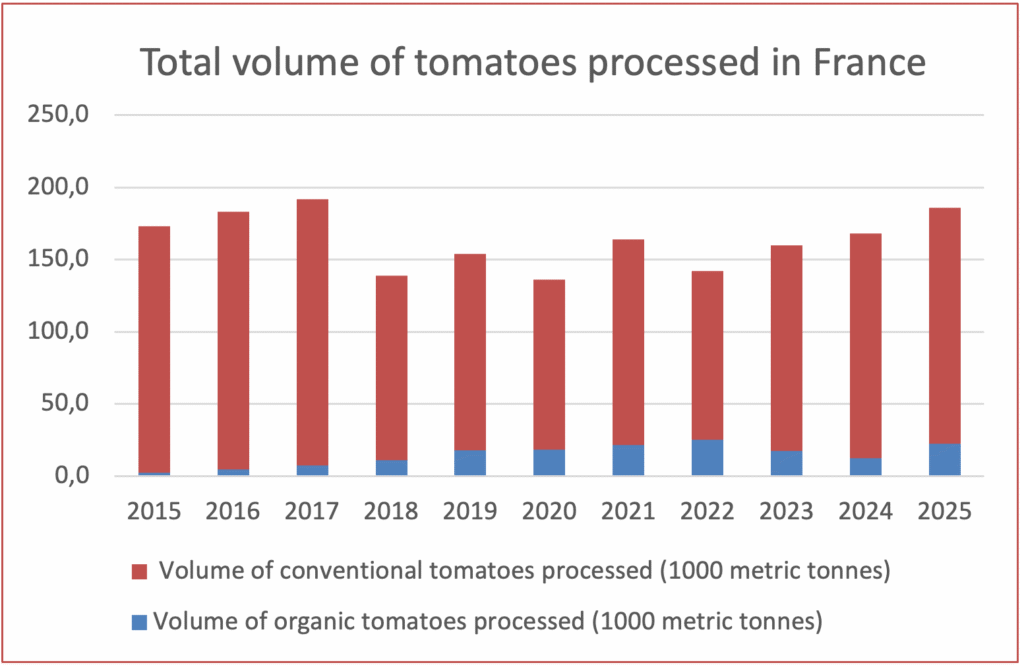
These strong performances resulted in 185,878 tonnes delivered against 175,280 tonnes contracted, representing a 106% execution rate. Organic production, in particular, exceeded commitments by 4%. This success is even more remarkable considering a slight decrease in overall planted area to 2,416 hectares (3% less than in 2024). However, the organic area grew to 338 ha (+7%), a trend expected to continue as processors anticipate maintaining demand in 2026, potentially pushing organic area back up to 400 ha.
Industry Strains Under Early, Rapid Influx
While the fields operated at full capacity, the processing plants neared saturation. The rapid influx of volumes driven by accelerated maturity severely disrupted the tight industrial planning.
“Factory operating margins are very narrow, and the weather can quickly complicate everything,” explains Robert Giovinazzo.
The structural complexity of managing deliveries is amplified by varying daily production rates depending on whether the output is simple concentrate, double concentrate, or lower-concentration products. Consequently, some over-ripe tomatoes were left in the field—a surprising outcome for an otherwise successful season. The early start also meant a very late finish, ending on October 20th—a harvest period spanning over three and a half months. This “extended season,” as the Sonito director described it, brought its own set of logistical challenges.
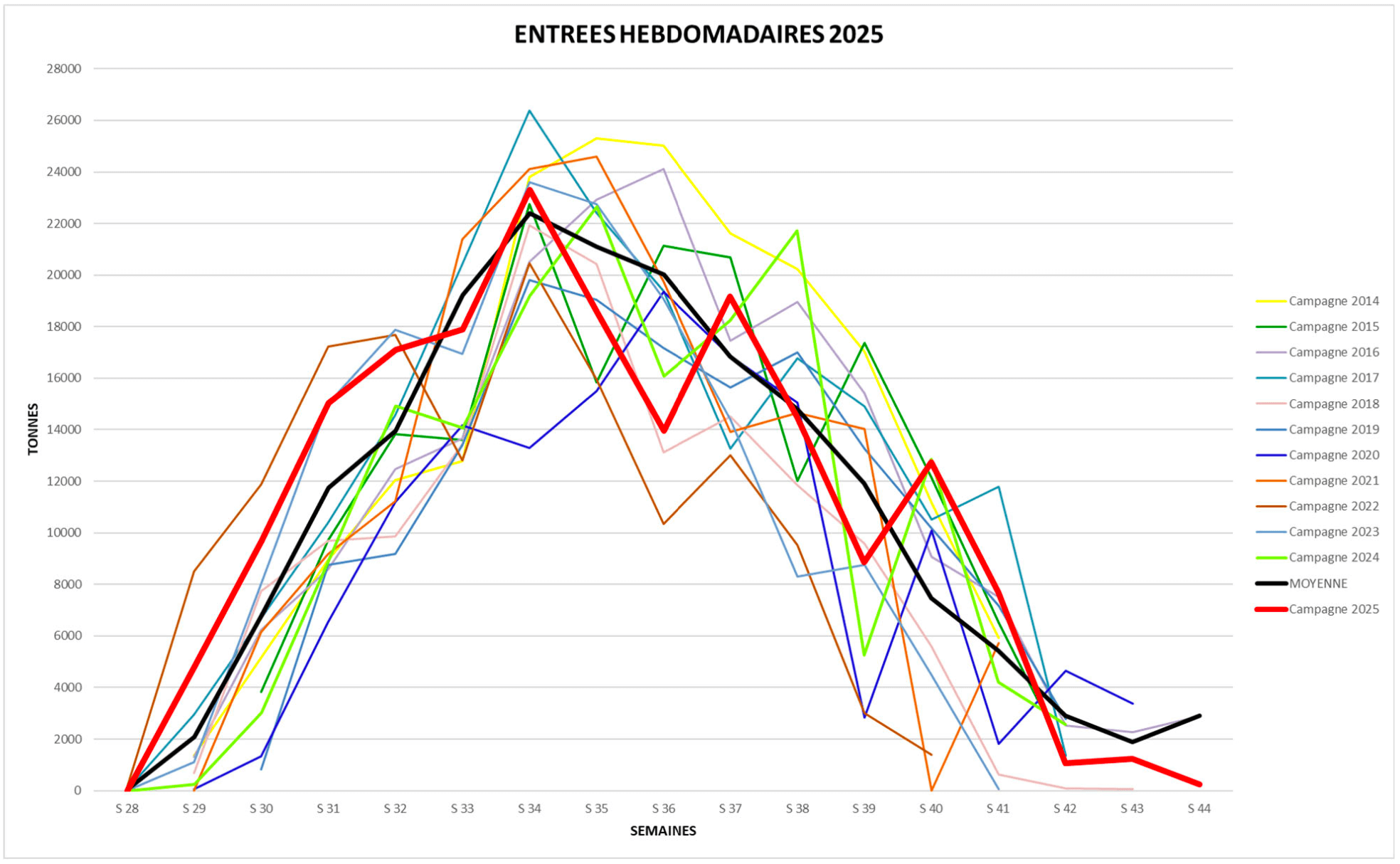
Image: Weekly loads for the last 11 years, with 2025 in red
Plant Health: An Unexpectedly Calm Year
In contrast to previous campaigns plagued by destructive cutworms, 2025 was surprisingly peaceful. There were no cutworms, few diseases, and, exceptionally, no mildew, even in the Southwest basin. The only concerns were increasingly prevalent mites, which accelerated plant desiccation and rapid maturation, and late June plantings, which suffered severely from the heatwave, leading to difficult starts and shifted cycles. Overall, however, the favorable health situation offered a welcome respite to a sector often under strain.
Reaching the Industrial Ceiling and Future Ambitions
With nearly 186,000 tonnes produced, 2025 ranks among the top tomato campaigns of the last decade. Crucially, this volume aligns “clearly with the current capacity of tools in France,” indicating they are hitting the industrial ceiling. This has spurred discussions about developing new processing infrastructure. The sector is dynamic, showing renewed interest in preserved tomatoes, requests for increased acreage, and development in new areas in the South-East, like the Durance Valley and Drôme.
The ‘Syamm’ project (Systèmes agricoles multiperformants méditerranéens, formerly called ‘Tommates’), led in partnership with the interprofessional organization, aims to increase volumes across a wider territory, diversify crop rotations, and integrate processing crops to supply future methanizers. This structural project is supported by government initiatives like France Relance, France 2030, and the food industry support plan. A territorial demonstrator, led by the Paca Regional Chamber of Agriculture and involving twenty partners, is set to be submitted on December 10th.
France: A Small, Agile Player in a Volatile Market
Globally, 2025 saw production retreat to 40 million tonnes, down from the record 45.8 million tonnes in 2024, yet global consumption remains high at 40 million tonnes. In this unstable international context, France, the “small player” in processing, leverages its focus on quality. Global prices for concentrate have fallen from their 2023 highs but remain attractive. While proposed US taxes on European exports could penalize countries like Italy, France’s premium positioning may allow it to continue navigating the market successfully.
A Clear-Eyed View of the Future
The 2025 season will be remembered as a fragile success, achieved despite climatic challenges and industrial inflexibility. The short-term priority is clear: increase processing capacity to support acreage growth and consolidate a strategic position in a tumultuous global market. From the Sud region—the sector’s heart (producing 85% of the national volume)—to the emerging basins of Drôme and Durance, the potential is evident. The challenge is to modernize infrastructure to turn every ripe tomato into added value.
2025 demonstrated that a strong, coordinated French sector can not only hold its own but, with the right investments, could soon surpass its current standing.