News
France remained a major importer in 2024
For almost a decade, the French processing tomato sector has been experiencing a resurgence made possible by the installation and development of new processing facilities. Currently, this growth is simply keeping pace with increasing demand, meaning that reliance on imports remains a significant characteristic of the French tomato products market.
The trade statistics published in the country profile on our website clearly illustrate this imbalance: with average annual exports of tomato paste (HS code 200290) remaining virtually unchanged at less than 12,000 tonnes (t) and imports exceeding 127,000 t (a slight decrease) over the past five years, France ranks seventeenth among paste exporting countries, far behind the global and European leaders in the sector, but also behind some non-tomato-producing and non-processing countries such as Austria, the Netherlands, and Germany. France’s share of the global market over the past five years has amounted to just over 0.3% of exported quantities, while French purchases of paste from foreign sources have represented nearly 5% of the global volume.
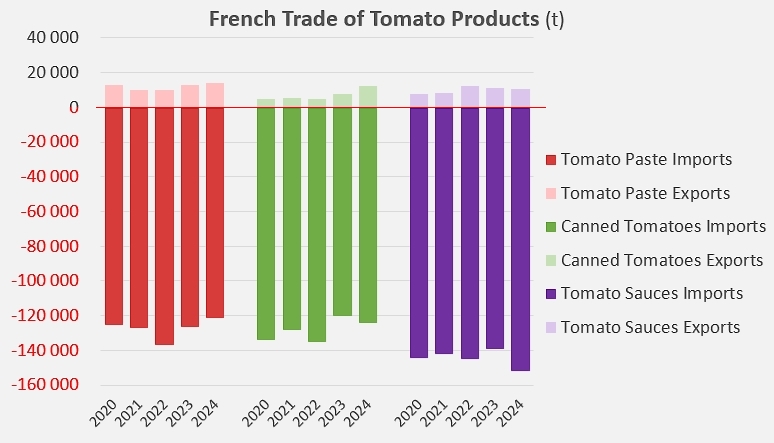
Similar findings apply to other product categories: France, the world’s twelfth largest exporter and third largest importer of canned tomatoes (HS codes 200210), with less than 7,000 tons exported (up) and 128,000 tons imported (down) on average over the last five years, accounted for 0.35% of global sales (12th place) and nearly 8% of total purchases (3rd place) during the period under review.
The sauces sector also suffers from a chronic deficit: from 2020 to 2024, the average annual export sales of tomato sauces and ketchup (HS codes 210320) amounted to just under 9,900 tons (up), while export purchases exceeded 144,000 tons (also up). These results place France twenty-fourth among sauce exporting countries, with just over 0.6% of total global exports, and third among importing countries, with nearly 10% of global exports.
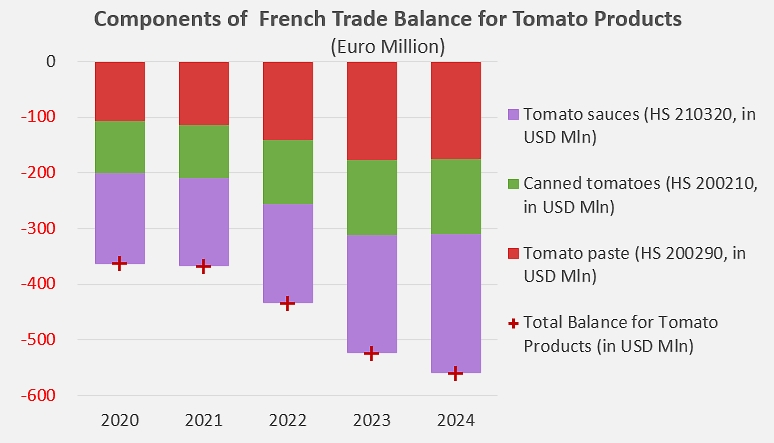
Despite slight improvements in volume for tomato paste and canned products, France’s trade balance for tomato products continues to show a significant deficit: in 2024, net French expenditure amounted to over €560 million (US$606 million). Imports of sauces and ketchup constitute the largest expenditure item, representing nearly 45% of the total bill, or approximately €251 million (US$271 million) in 2024; canned tomato supplies accounted for slightly more than a quarter of French expenditure last year, at €135 million (US$146 million). Purchases of tomato paste cost just over €174 million (nearly US$189 million) and accounted for a third of French spending.
Whether imports or exports, the French trade sector is extremely dependent on the European and Mediterranean regions. For tomato paste, half a dozen countries (Italy, Spain, Portugal, Germany, Turkey, Tunisia, and Egypt) supply the vast majority (97%) of French inputs. Canned tomato paste purchases are made from the same sources (Italy, Spain, Germany, Turkey, Tunisia, and Morocco), which account for 98% of French purchases. Sauces of foreign origin are primarily Spanish or Italian and, to a much lesser extent, German, Belgian, Dutch, British, or Turkish.
French exports of tomato paste are mainly destined for the United Kingdom and the Netherlands, and to a lesser extent, for the Spanish, German, British, and Italian markets. The main buyers of canned French tomatoes are the Dutch, Belgians, and Poles, while tomato sauces are most often destined for the Spanish, Belgian, and Romanian markets.
In total, French imports of tomato products amounted to 397,200 tons in 2024, a very slight decrease (-0.6%) compared to the three previous years; however, exports totaled 36,500 tons, 35% more than the average over the previous three years.
In 2024, purchases of tomato paste decreased by 9,000 tons (-7%) compared to 2023, and purchases of canned tomatoes by 3,350 tons (-3%), while imports of tomato sauces increased by 9,800 tons (+7%).
Exports of tomato paste rose by 3,200 tons (+29%), and those of canned tomatoes by 6,400 tons (+112%). Exports of sauces remained virtually unchanged (-86 tonnes, -1%).
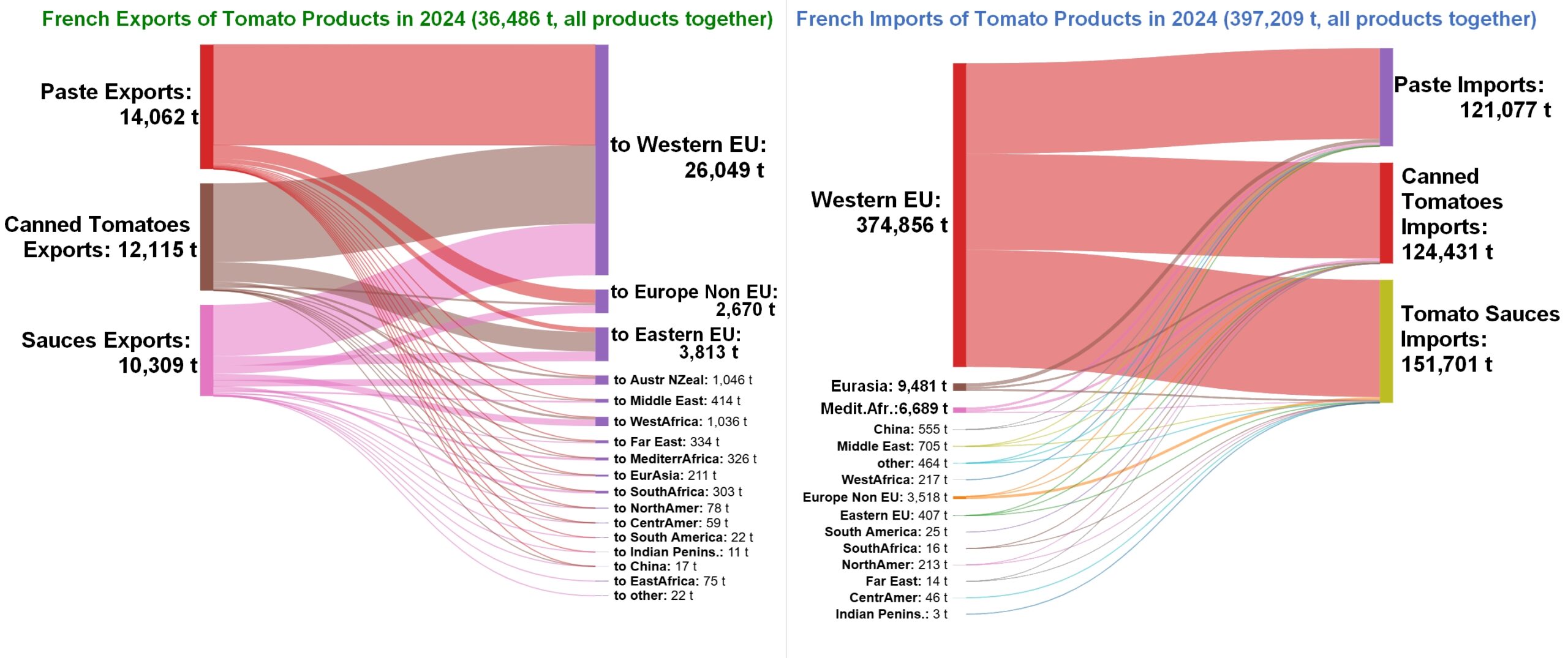
Detailed French exports and imports by country of origin and destination are available upon request from the Tomato News Team.
Some complementary data: Evolution of quantities processed by the French sector since 1989.
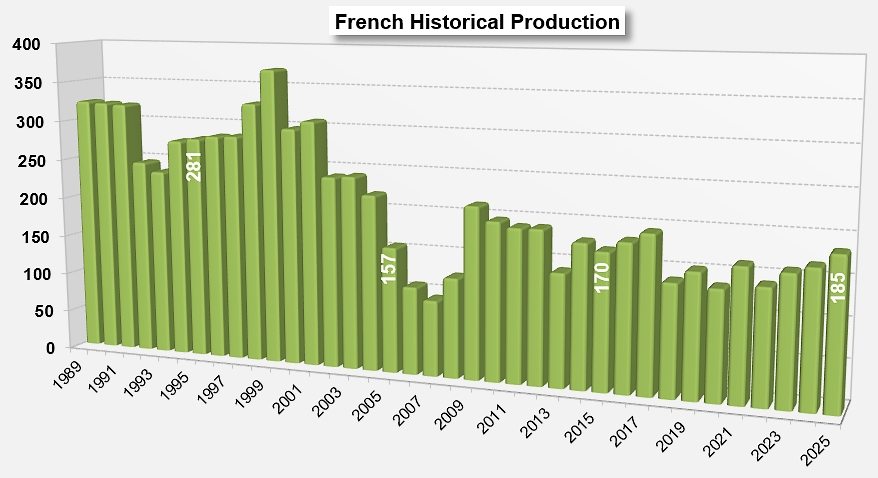
Sources: Trade Data Monitor, WPTC