News
Decoding the Tomato Network
For decades, agricultural science has been on a quest for the “miracle gene”—that single piece of DNA that could suddenly make a crop drought-resistant or double its yield. However, a groundbreaking study published in Plant Communications suggests we’ve been looking at the problem through the wrong lens. Researchers from the Institute for Integrative Systems Biology (I2SysBio) in Spain and the Phytolearning Millennium Nucleus in Chile have discovered that tomatoes don’t rely on solo genes; they rely on a sophisticated “internal language” of communication.
The study, led by Dr. Tomás Matus, Dr. Elena Vidal, and Dr. José Miguel Álvarez, reveals that the tomato species Solanum lycopersicum operates through complex interaction networks rather than isolated commands. By analyzing over 10,000 gene expression data sets, the team mapped how different organs—roots, leaves, flowers, and fruits—talk to one another. Elena Vidal explains that the team finally managed to “understand who gives the orders, who responds, and how that conversation changes between a root, a leaf or a fruit.”
This “conversation” isn’t just biological noise; it is a highly organized strategy for survival. When a tomato plant faces environmental stress, it doesn’t just react in one area. Instead, the plant reorganizes its internal networks, shifting regulatory priorities to ensure it can survive water shortages while still producing viable fruit. This research marks a definitive paradigm shift because modifying a single gene can have a knock-on effect throughout the entire network. Success in future agriculture will likely come from understanding the complete system rather than searching for a single “miracle” fix.
The study found that the tomato’s communication isn’t strictly hierarchical; depending on the stressor, such as a heatwave or drought, different parts of the plant take the initiative to send signals to the rest of the organism. This decentralized leadership allows the plant to coordinate its parts to survive and grow in the best possible way. To help identify these “coordinator genes,” the team created a functional map of the tomato’s metabolism, identifying the most influential nodes that manage water stress and fruit development.
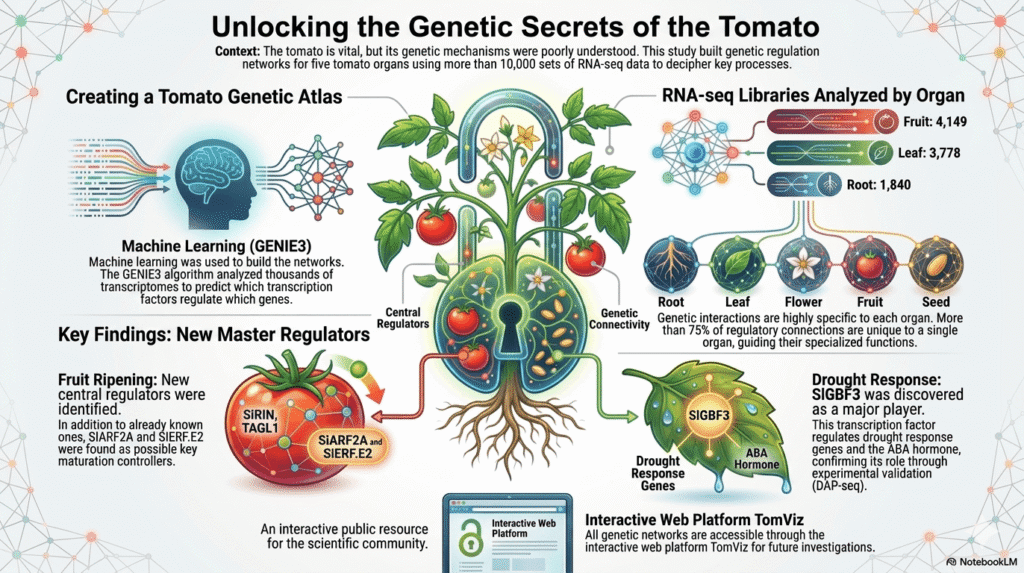
This image was translated from Spanish to English with AI
In a move to accelerate global climate adaptation, the research team has also launched TomViz, an interactive web platform. Integrated into the PlantaeViz environment, this tool allows the global scientific community to explore these gene regulatory networks in a simple, visual way. Whether a researcher is in Chile, Spain, or elsewhere, they can use TomViz to identify gene connections and design smarter genetic enhancement strategies based on complete networks.
As climate change redraws the map of global agriculture, this study provides a more realistic framework for the future. By understanding the “internal language” of tomatoes, scientists can now select varieties with the most efficient communication strategies. As Dr. Matus puts it, “Where crops face increasingly extreme conditions, understanding these networks can help us anticipate and select varieties with more efficient resilience strategies, rather than focusing on a single ‘miracle gene.’ It is a more realistic and modern way of understanding plant biology in the face of climate change.”
Sources: i2sysbio, Tele Cinco, LinkedIn
Reference: Fernández J.D., et al. (2025). Organ-level gene-regulatory networks inferred from transcriptomic data reveal context-specific regulation and highlight novel regulators of ripening and ABA-mediated responses in tomato. Plant Communications.
DOI: 10.1016/j.xplc.2025.101499