During the last 5 years the Spanish production has averaged 2.8 million tonnes, which is about 25% of the volume processed within the EU. Production has however fluctuated between 2.1 and 3.2 million metric tonnes, depending on changes in the market situation but also water availability. After a period of growth in capacity, in recent years we have seen a concentration of the industry in the hand of fewer large companies.
Processing tomatoes are mainly grown in three main regions where the factories are located: about 70% of the tonnage in Extremadura (irrigated by the Guadiana River), about 20% % in Andalusia, and 7% in the Ebro Valley (Navarra, Rioja and Aragon), and the rest in other areas like Toledo, Ciudad Real, Murcia, etc. Some small volumes are also grown in Portugal and processed in Extremadura. Spain as a whole has a long processing season: it starts in the first weeks of July in Andalucía (south) and finishes end of October/early November in the Ebro Valley (North).
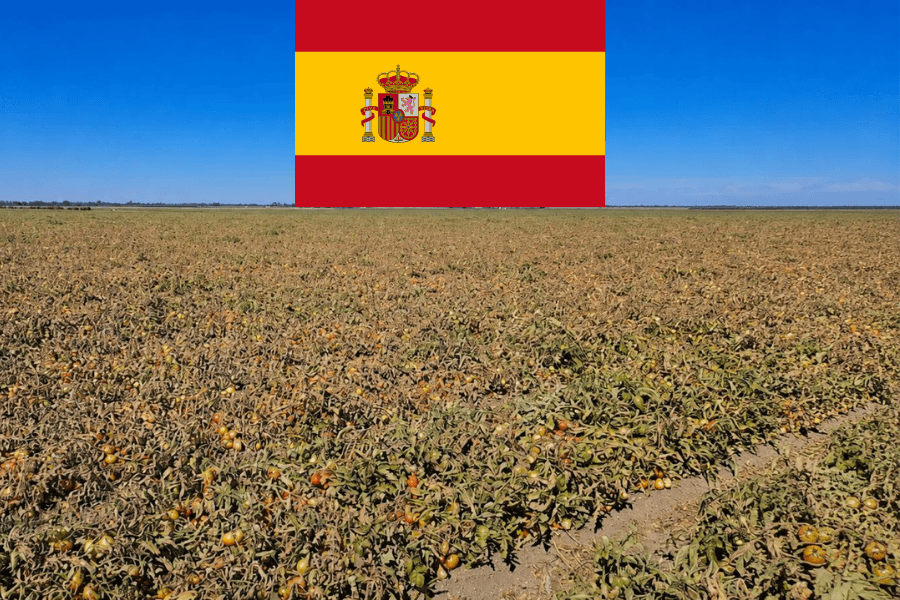
The largest producing region of Extremadura benefits from good silty soils with varying sand content and favourable weather conditions with little risk of frost in the planting period although high temperatures in July can lead to some risk of blossom drop. With a good water holding capacity of about 8,000 hm3, no serious drought has been suffered since 1995, and most of the fields use surface or subsurface drip irrigation. Average yields have been increasing and now average more than 90 t/ha. There are several large factories producing mainly tomato paste but also diced tomatoes and sauces. Extremadura is also the world largest manufacturer of tomato powder. Cooperatives process about 35% of the total production in the region.
South of Extremadura, a new area of production was developed in the early 1990’s, around Lebrija in Andalusia, near Seville, and more factories were installed during the 2010s. There growers using drip irrigation obtain yields exceeding 105 t/ha on average. The region, however, experiences issues with drought some years, and it particularly affected the 2022 and 2023 seasons when production was sharply reduced with some factories remaining closed, but production regained volume in 2024 as water availability improved. Tomato paste is the main production in this region.
In the Ebro Valley in the north of the country, the harvest generally begins in the second week of August due to the risk of late frost in April, and if the fall is dry, it can continue until the end of October or early in November. The soils here are silty and 100% of the fields use drip irrigation with a size of the lots is relatively bigger than in Extremadura. Average yields are about 80-85 t/ha. Many processing firms in the region have specialized their operations around whole peeled tomatoes, but also in the production of “tomate frito”, a Spanish speciality.
More than 75% of the Spanish production is exported, with the EU being the main destination market, with exports of bulk tomato paste representing about 60% of the total volume.
Spanish tomato processors are represented within AMITOM and WPTC by AGRUCON.


(click on any of the images to expand it)