News
Climate change and its effects on Europe, the USA and Latin America
2022 WPTC congress
From the presentation given by Fernando Santibáñez Quezada, Professor at the Universidad de Chile, during the 14th World Processing Tomato Congress (March 2022, held online from San Juan, Argentina).
 This is an opportunity to talk about climate change, an important phenomenon affecting world agriculture.
I would like to start with an update about what is going on in terms of the weather worldwide, so that we can then think through what these changes may mean for tomato production in America and Europe. There is no doubt that climate change is a global phenomenon with anthropic components that are very important. We cannot evade the responsibility that we have as human beings in the alterations to the climate that are being observed worldwide. These will leave biological traces, some of which are permanent, even if we are able to control climate change. We will probably be able to do this in the end, but not before 100 years, and over that century, the footprint we are going to leave could be permanent. Agriculture will certainly be affected by climate change throughout the world, and we must absolutely work preemptively on the potential effects of climate change so as to adapt agricultural technology, land management, and production strategies that will allow us to minimize the negative effects of these shifts.
 In order to contextualize the problem that we are facing, we must remember that planet earth is constantly receiving solar energy that it transforms into heat. That heat is reemitted through infrared energy sent through space in the same quantity as the radiation received. In that way, the earth has all the mechanisms it needs to preserve a balance that allows it to have a stable temperature. But in recent years, after the industrial revolution, the huge emissions of CO2 that have been sent into the atmosphere have meant that incoming radiation is much higher than outgoing radiation. So some of the solar energy is being retained by the atmosphere and that is why it is warming up. This is causing a distortion in all kinds of areas of life on earth, including agriculture, but natural ecosystems also are being impacted by this phenomenon. We have changed the rules and the conditions of the climate scenario in which different species have lived for thousands of years. This means more kinetic energy is being retained in the atmosphere. Temperatures are therefore more unstable. So we should expect more extreme climatic events, and from a human perspective, we face increased climate risks because we observe more unusual events more frequently. From the agricultural point of view, we will have to imagine a more hazardous form of agriculture, able to face more extreme events, which will in turn most likely mean less crop productivity for some key crops that feed humankind. So the task that we have is to prepare ourselves to face these challenges…
…because this is a challenge that will be with us for 100 or 150 years. We will have a higher air-humidity level because more water will be evaporated from oceans. We will have more intense rainfall, more intense winds, more intense drought and with more extreme temperatures. These will be the key features that accompany this global change.
 Evidence for this is demonstrated in the recent history of weather. Until the 1940s, weather was quite stable, but in the decades between the 1940s and the 1970s, we started to record warmer years. We began to have years where the weather was unbalanced. So the first signs were there: we had 20 years of signals and after the 1980s, we had scientific evidence, with temperature anomalies that are consistently in the positive values. Every year is warmer than the previous one.
So this is a phenomenon that no doubt is taking place at a scientific level. It is a phenomenon in progress: the history of the last 2000 years is showing us that the highest temperatures correspond to the most recent years. This means that there has been an increase in temperatures that corresponds to a phenomenon affecting nature.
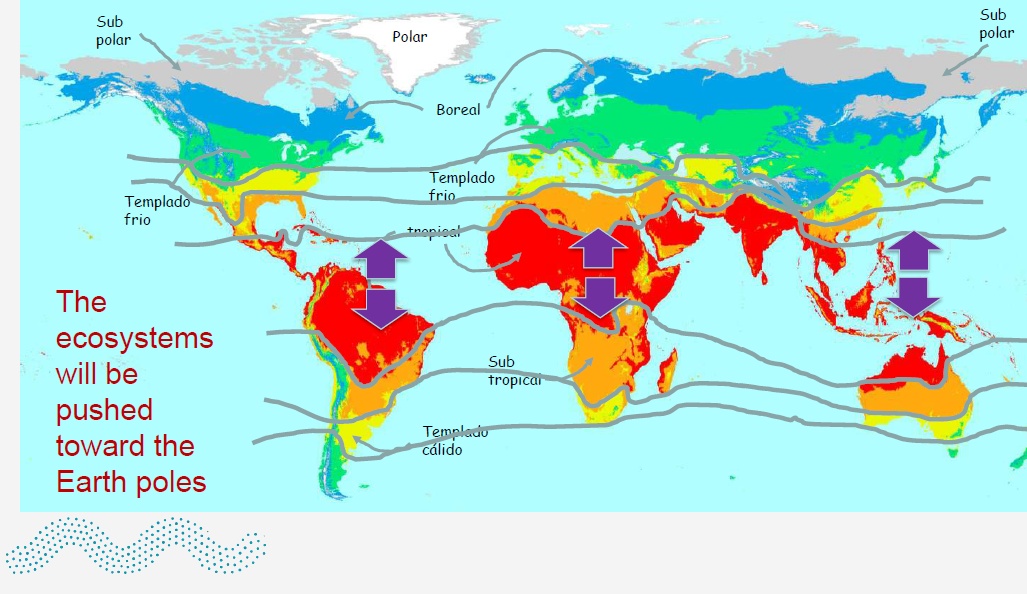
What are the consequences of this on the planet’s biology? It means that there will be a higher concentration of caloric energy in the tropical regions, in the terrestrial equatorial areas. The atmosphere is going to be expanded and it will push all the regions of life on the planet towards the poles. There will be a mobilization of the climate toward the poles that will leave many chains of life or many ecosystems – including the agricultural ecosystem – to cope with different weather conditions than those that have prevailed throughout many centuries, forcing them to adapt to new conditions. This means that agriculture that took place near to the equator will be displaced toward the poles following the course of climate change.
It does not mean that we are going to cease cultivating the areas close to the equator, but it means that we will have to adapt to more hazardous weather conditions. On the other hand, every country will have the task of creating new agricultural areas in latitudes that are further away from the equator. Agriculture will migrate to an extent, following the climate that will be moving towards the poles.
Generally speaking, we can say that climate change is going to warm up and aridize the weather in different parts of the planet. A rise in temperature can affect the growth rates, survival and reproduction of biological species. The growth rate of many species will be affected, as will their reproductive capacity. Once again we are going to face new biological threats because of inter-species competition. Some bugs or insects will move towards areas where they were not found before, finding new hosts that will transform into new agricultural tags.
It does not mean that we are going to cease cultivating the areas close to the equator, but it means that we will have to adapt to more hazardous weather conditions. On the other hand, every country will have the task of creating new agricultural areas in latitudes that are further away from the equator. Agriculture will migrate to an extent, following the climate that will be moving towards the poles.
Generally speaking, we can say that climate change is going to warm up and aridize the weather in different parts of the planet. A rise in temperature can affect the growth rates, survival and reproduction of biological species. The growth rate of many species will be affected, as will their reproductive capacity. Once again we are going to face new biological threats because of inter-species competition. Some bugs or insects will move towards areas where they were not found before, finding new hosts that will transform into new agricultural tags.
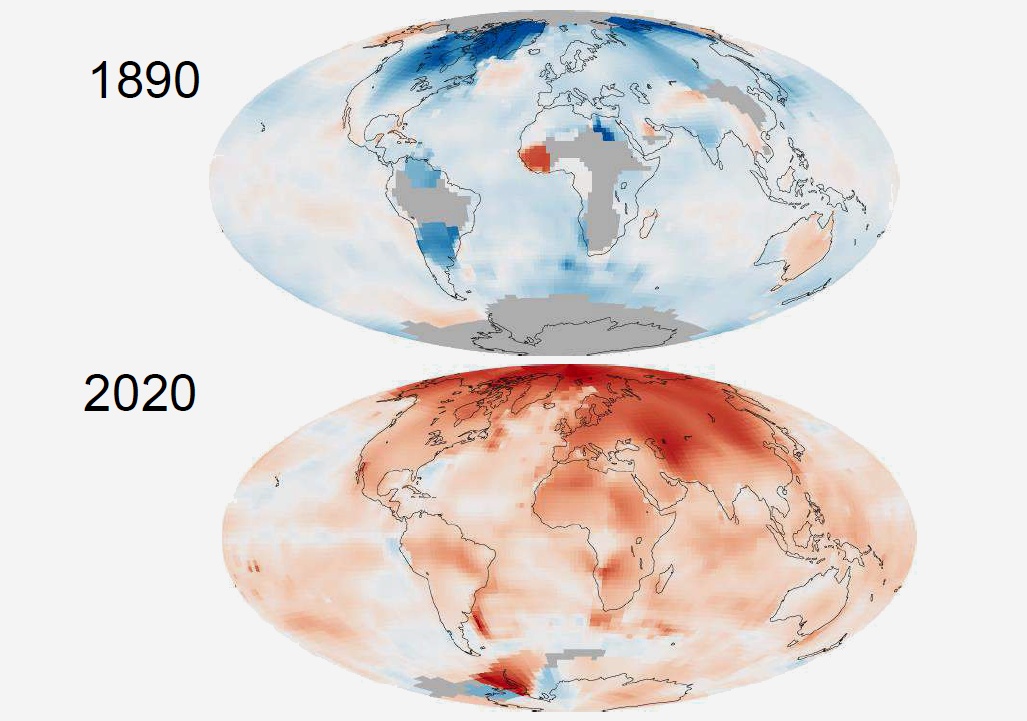
This diagram shows how the world situation was in the 1890s, with temperatures that were colder than the average of the century that came afterwards – the blue indicates temperatures colder than the average of the following century, while the colors that are reddish or orangish are above the average of the same century. In 2020, we ended up with a planet that was warmer than the planet that we had in the previous century. Yet we had started with a planet that was colder, overall, than what we had in the century that followed.
We now have a planet that is warmer, with an agricultural system that needs colder conditions. The same is happening with rainfall and water supplies. There are many important agricultural areas of the planet that are shifting towards more arid conditions, like the US, Latin America, a big part of Brazil, a large part of Australia (almost completely), a large part of Africa and a large part of Asia. This presents a big challenge – we need more water for better agriculture, but water seems constantly scarcer, and we are going in the opposite direction.
The dilemma of tomato cultivation facing climate change
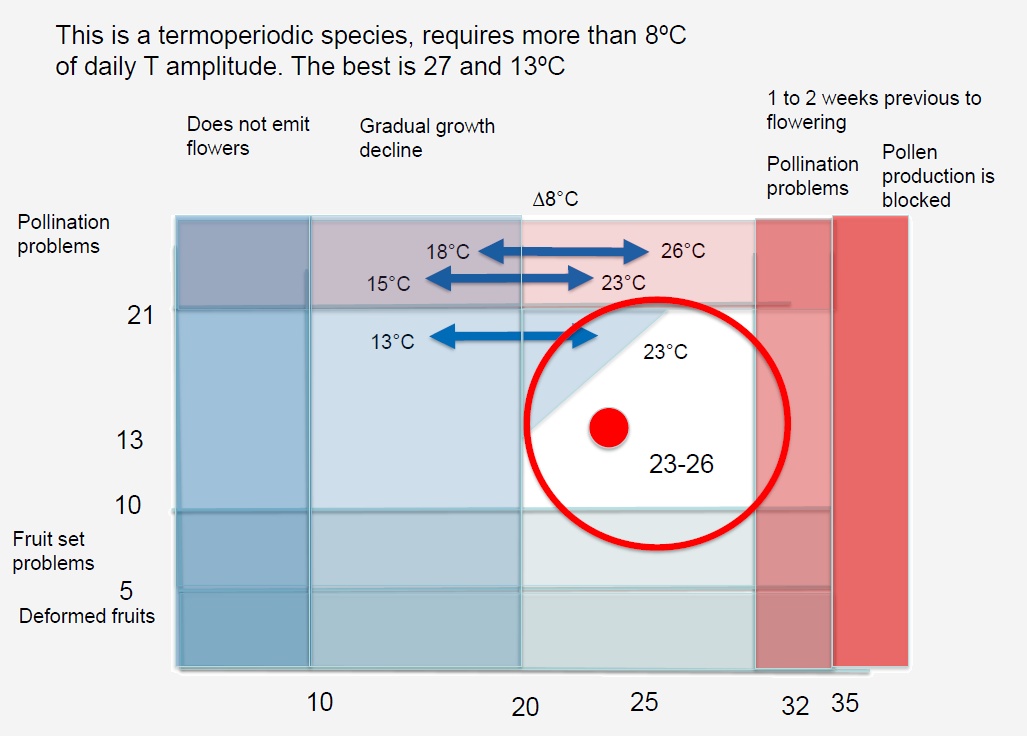
We know that the tomato comes from the western coast of South America. Historically, we know that it comes from maritime weather – colder weather coming off the Pacific Ocean. This is not a species that can bear high extremes of temperatures – either cold or hot. In general, it needs eight degrees of temperature range daily – if we have 26°C during the day, it can accept up to 18°C minimum temperature at night. If the temperature is 23°C in the day, it needs 13°C during the night. These are the proper conditions for its growth. But if we look at the graph, we can see that if tomatoes are planted in areas where temperatures do not reach 10°C, they simply do not bloom. Between 10°C and 20°C, growth declines. Between 28°C and 30°C, pollination starts to face problems, especially one or two weeks before flowering. Finally, when temperatures exceed 35°C, the production of pollen is blocked.
Looking at minimum temperatures, if we have very low temperatures around 5°C, the fruit tend to be deformed because of physiological problems at the embryo level. Between 5° and 10°C, we encounter problems with fruit set, with many blossoms that go through pollination but do not set. If minimum temperatures are very high, we also have pollination problems. So we have a window, combining the effects of minimum and maximum temperatures, that is shown in white in the graph, between 23°C and 26°C, where conditions seem to be optimal. In general, the most productive areas have maximum temperatures of 25°C and minimum ones around 13°C or 14°C.
Because of its origin, tomato is a species that has very restrictive growth conditions. Among the effects of high temperatures, the pollen tube experiences growth problems when temperatures exceed 28°C. Pollen fertility and ovule viability also decrease, as there is embryo abortion and stigma dehydration. Even the flowers get dry – so there is an increase of the parthenocarpy that results in small fruits or the risk of fruit falling.
High temperatures also have an effect on the plant itself. The thermostability of the cell membranes is affected, as are the ionic and water flows, and growth is retarded. In this case, photosynthesis is reduced because of the reduction or blocking of mitochondrial electron transport. Cellular homeostasis – that is to say the balance between water and ions – tends to vary and makes it difficult for the cell to reproduce. If plants suffer high temperatures, the tissues are affected because they dehydrate and the stomata are closed, with dehydration also of the chloroplasts. So high temperatures produce multi-systemic failure in the plant, potentially leading to death.
Low temperatures also have bad effects when they descend below 10°C. They affect thermostability and can produce deformed fruits and cause blossom drop. Photosynthesis is also reduced, and hollow fruit can be produced due to these failures.
We know that tomato is a thermal-periodic crop – that is to say it needs a temperature difference between day and night. If the low temperatures are over 18°C, the products of the photosynthesis go to the apex of the plant, causing it to grow high or really tall, but failing to produce fruit. On the other hand, if minimum temperatures fall lower, carbohydrates cannot allocate and they stay in the leaves, creating a specific abscisic acid and therefore causing a blockage of Rubisco activity, or photosynthesis, and the plant stops production. The ideal is to have minimal temperatures of 18°C that facilitate the translocation of fruit because they bypass the apex extremes and help create photosynthesis products that are transported to the fruits.
Low temperatures also have bad effects when they descend below 10°C. They affect thermostability and can produce deformed fruits and cause blossom drop. Photosynthesis is also reduced, and hollow fruit can be produced due to these failures.
We know that tomato is a thermal-periodic crop – that is to say it needs a temperature difference between day and night. If the low temperatures are over 18°C, the products of the photosynthesis go to the apex of the plant, causing it to grow high or really tall, but failing to produce fruit. On the other hand, if minimum temperatures fall lower, carbohydrates cannot allocate and they stay in the leaves, creating a specific abscisic acid and therefore causing a blockage of Rubisco activity, or photosynthesis, and the plant stops production. The ideal is to have minimal temperatures of 18°C that facilitate the translocation of fruit because they bypass the apex extremes and help create photosynthesis products that are transported to the fruits.
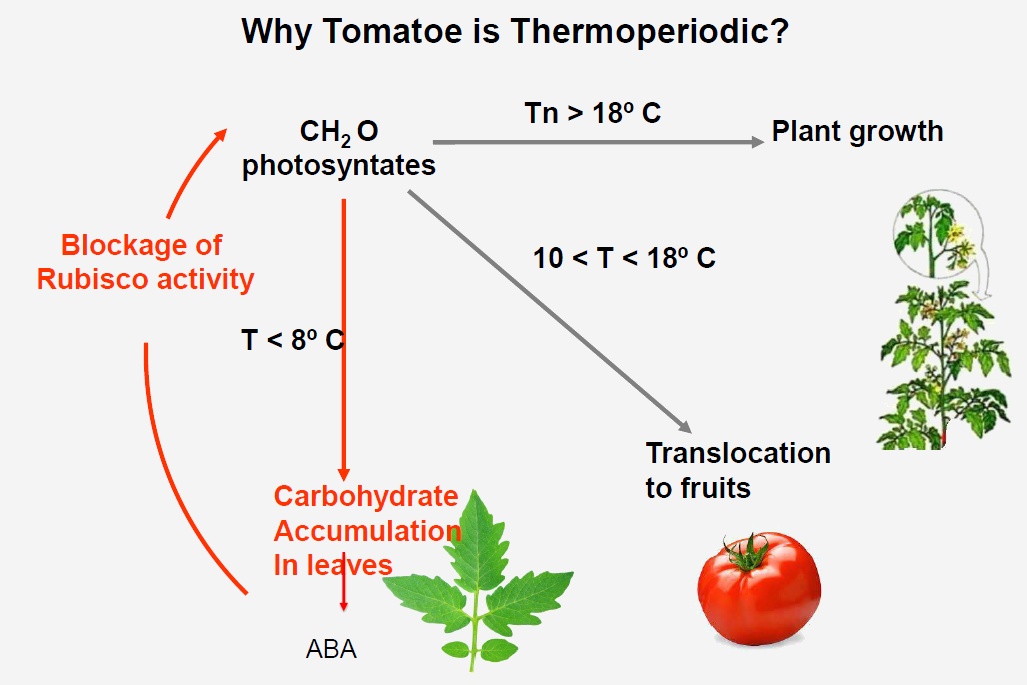
When daytime temperatures go over 38°C, the stomata are closed, interrupting photosynthesis and therefore decreasing productivity and yield. Solar energy is lost because stomata are closed, and the plants cannot carry out photosynthesis. So the useful period is in the morning and in the afternoon. The ideal is when the temperature is near 25°C all day, as this is good for the plant, with conditions that allow it to carry out photosynthesis.
So, how do tomato crops face climate change in America and Europe?
What would these changes look like on this continent? During hot days, it is really important to know what is going to happen with tomatoes because over 25°C, we know we are going to have a problem. Currently, we are exceeding the 30°C level, so we see yearly average temperatures going over the thermal stress level.
So, how do tomato crops face climate change in America and Europe?
What would these changes look like on this continent? During hot days, it is really important to know what is going to happen with tomatoes because over 25°C, we know we are going to have a problem. Currently, we are exceeding the 30°C level, so we see yearly average temperatures going over the thermal stress level.
So how will this situation evolve between now and 2050, and by 2070?
In this diagram, we observe the warming we expect on the continent, with strong heat in Mesoamerica and in North America and in the southern part of South America, even though it is less warm there than in the northern part of North America. The weather is going to be extremely hot in parts of Brazil and in most of Mesoamerica or Central America, with conditions improving slightly in Patagonia and in the southern part of Argentina.
The other factor is water – evapotranspiration less the water rainfall. It is recording deficits, with negative values of course, in the western part of the United States, in Mexico, in parts of Central America, and in the south and eastern cones of Brazil. But these diagrams show what we expect in the future – for 2050 and then for 2070.
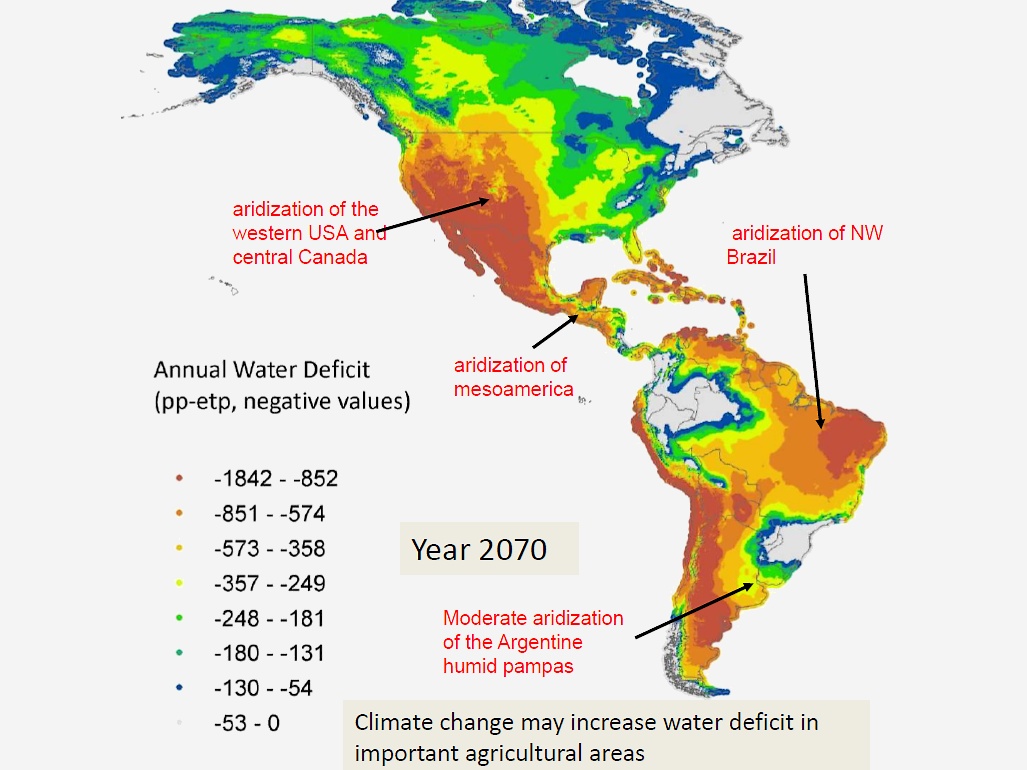
It is expected that there will be a net expansion of aridity on the continent – to the poles – and an aridisation in the western part of USA, most of Mexico, basically all of Central America, from the north-eastern part of Brazil to the central part of it, and a moderate aridisation in the humid pampas of Argentina, regardless of the heavy rainfall, because it is going to rain more but differently. There will be more intense and concentrated rainfall, which is going to make the water less useful, and the increase of evapotranspiration is not going to be balanced out by the lack of water. This is a paradox that will be observed in many parts of the world. So even where rainfall is going to increase in the future, there is also going to be an increase in the aridity of some areas, specially agricultural areas.
The minimum temperatures in the coldest months of the year will also be different. For example, in North America, there will be a backward trend, with more favorable conditions in the south of Canada or even in the northern part of the USA. In South America, the winters will be hotter, especially in the part of Brazil near Paraguay, as well as the north of Argentina.
The Pacific Coast of America will stay colder due to the Andes and also the Pacific Ocean. But we could record thermal stress in Central America, in the south of the USA, in Brazil and the north of Argentina, and an improvement in areas of Patagonia and also in parts of the Andes chain.
Rainfall is going to increase in North America and parts of Canada – however Canada could become slightly more arid due to evapotranspiration rates that will increase strongly.
The minimum temperatures in the coldest months of the year will also be different. For example, in North America, there will be a backward trend, with more favorable conditions in the south of Canada or even in the northern part of the USA. In South America, the winters will be hotter, especially in the part of Brazil near Paraguay, as well as the north of Argentina.
The Pacific Coast of America will stay colder due to the Andes and also the Pacific Ocean. But we could record thermal stress in Central America, in the south of the USA, in Brazil and the north of Argentina, and an improvement in areas of Patagonia and also in parts of the Andes chain.
Rainfall is going to increase in North America and parts of Canada – however Canada could become slightly more arid due to evapotranspiration rates that will increase strongly.
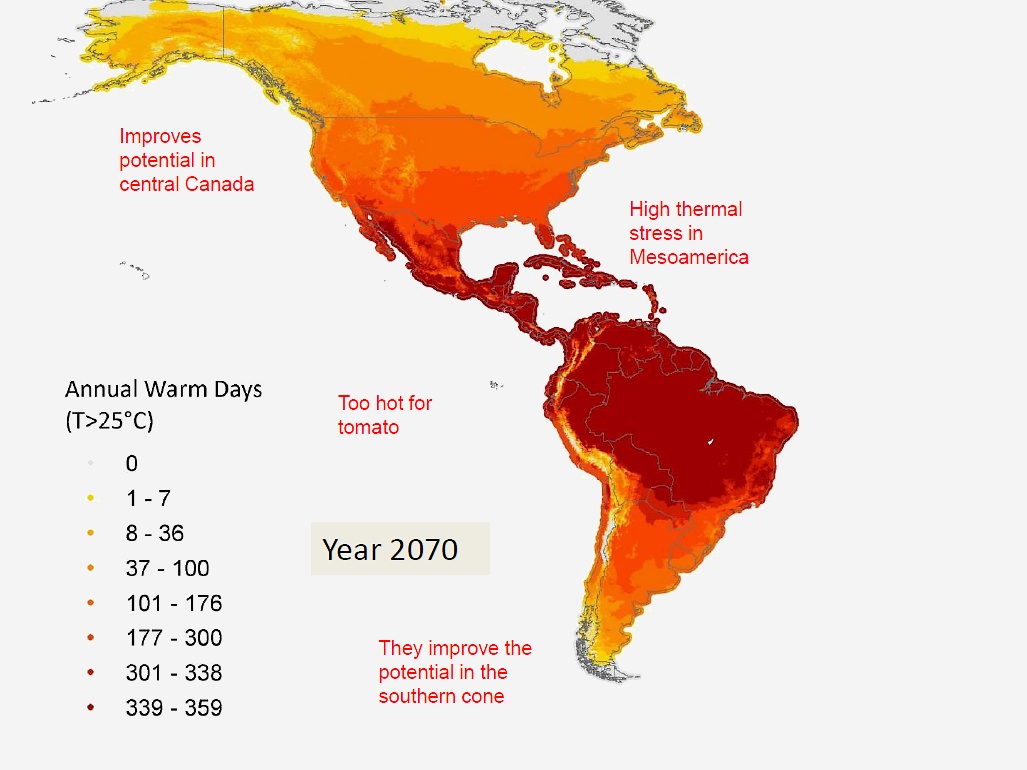
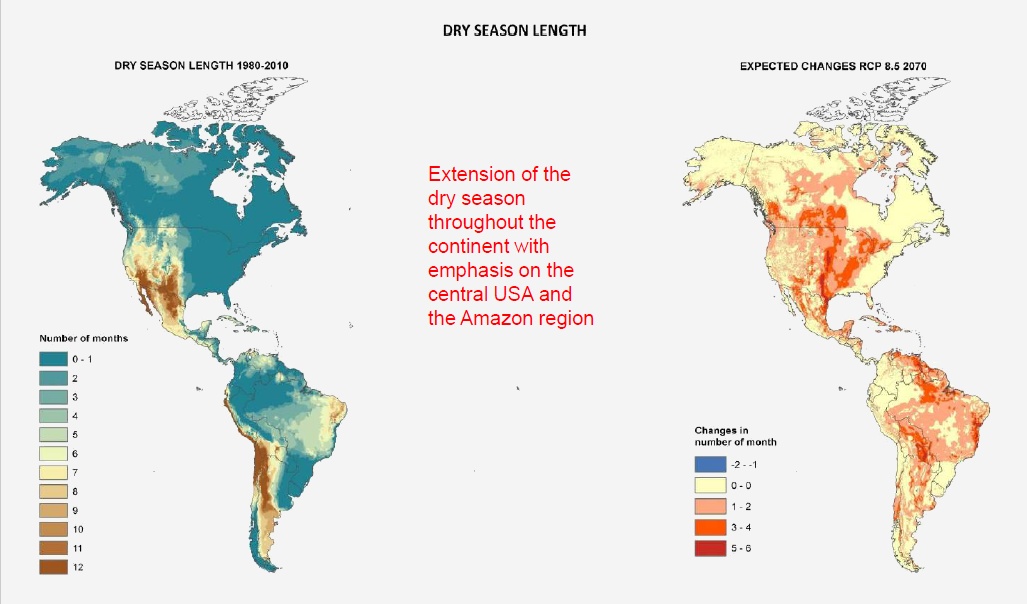
Hot days will also be a threat for tomatoes. Frost will reduce, which will be a favorable factor in some areas, and an excess of runoff water will increase in parts of Canada and the USA. Rain events will be more intense and less frequent, producing more runoff water. They will decrease in the Andean Basin, so it is foreseen that more of the Andean Basin’s waterways will decrease their flows – specially the Amazon River. A considerable decrease of water is expected, meaning that all the rivers that are born in the Amazon Basin will just diminish their flow. The water deficit will be aggravated all over the continent because only the evapotranspiration rate is due to increase.
Also, the dry season will extend by one or two months compared to what it is today, which will affect irrigation.
How will these changes affect tomato production?
We need to use crop models. We have correlated production with these impacts. We are not going to enter into the detail of this evolution, but we will see the results of it.
The current productivity of tomatoes is shown in this diagram. These are the most productive tomato-growing areas on the continent, showing improvement in the south of Canada and some deterioration in Central America, improvement in Patagonia and some deterioration in the eastern and southern parts of Brazil and Uruguay.
Water consumption is due to increase over most of the continent, so in the future, we will need more water in order to produce one tonne of tomato because there will be an increase in the evaporation rate.
Roughly speaking, we will have to move transplanting dates to months of the year when the temperatures are not so risky. Growers will need to shift operations to the cooler seasons. The expected changes are generally negative: only one part of Canada (the southern part) is expected to undergo positive changes, and this is a challenge for us, as we need to adapt production technology.
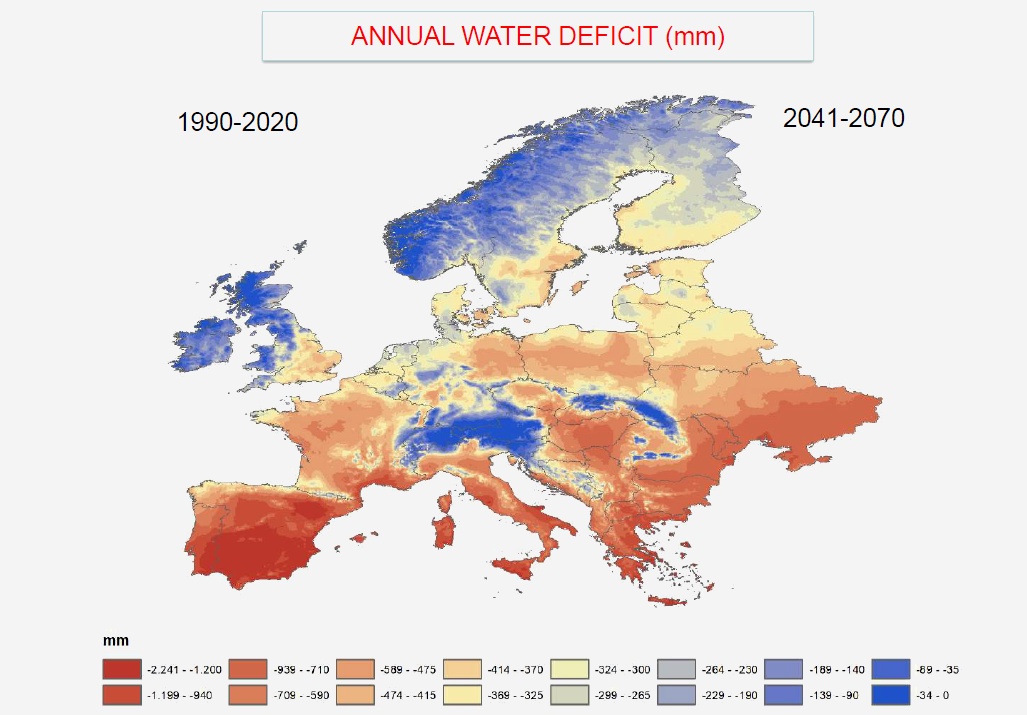
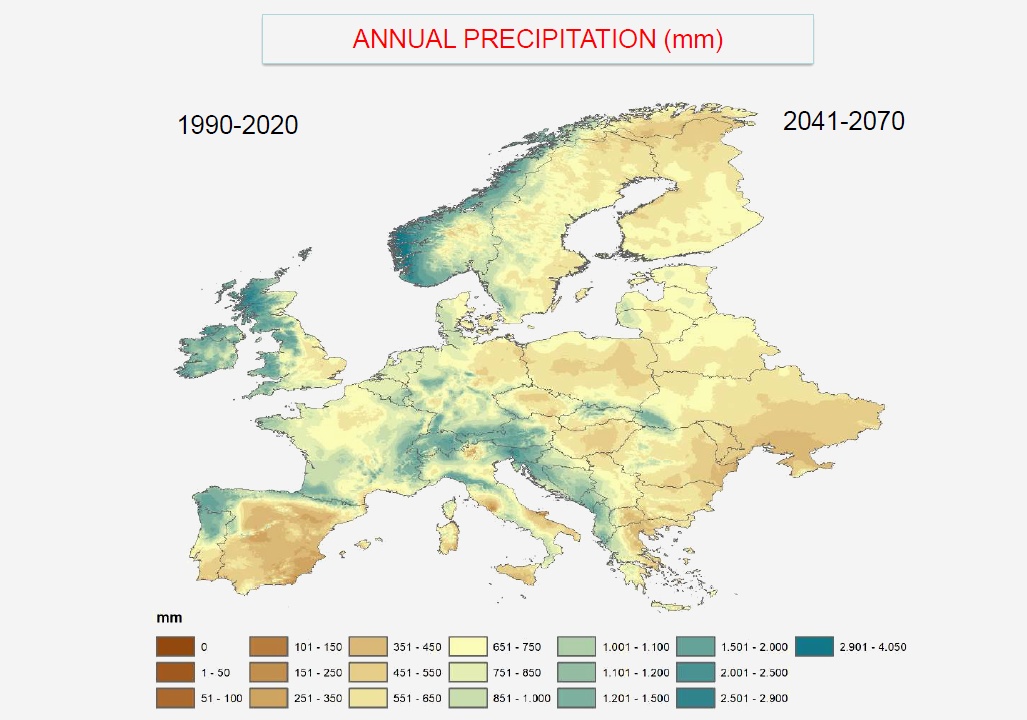
As for Europe – I am not going to enter into detail because we have not modeled this yet – we can see how the continent is going to change in this diagram, with the historical average temperatures, the hottest temperatures, and prospects for the situation between now and 2070.
As for Europe – I am not going to enter into detail because we have not modeled this yet – we can see how the continent is going to change in this diagram, with the historical average temperatures, the hottest temperatures, and prospects for the situation between now and 2070.
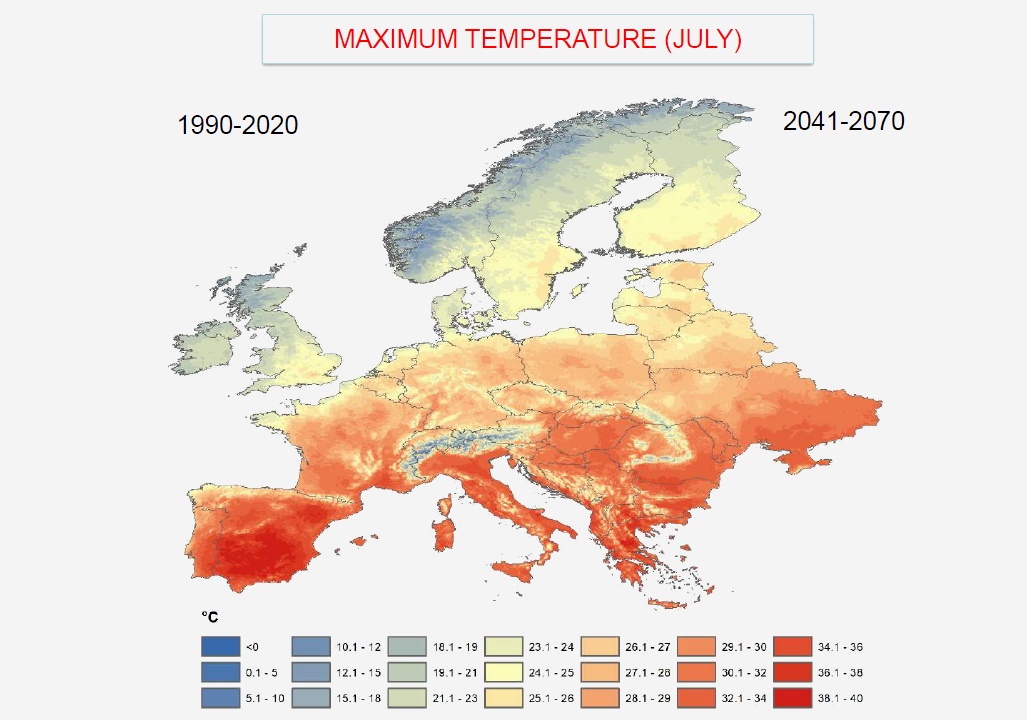
Temperatures are going to be progressively higher, and winters are going to warm up also, so the process is similar to the Americas. We are going to have a more tropical Europe and the water deficit will lead to a slightly drier Europe – but it is not going to affect crops as much as in America. Annual precipitations are going to decrease – but this is not too risky for operators.
So for a synthetic approach to how tomato crops are going to be affected from the genetic improvement point of view, we need to improve resistance to thermal stress, tolerance to coldness, tolerance to frost, tolerance to dehydration, and provide greater hardiness of the blossoms against thermal stress.
As for cropping systems, we need to look for new areas with a less extreme climate and milder winters – this is an essential condition we will have to explore. This will require moving cultivation operations to cooler seasons of the year in order to re-establish planting periods that avoid thermal stress. Also, thermal stress control systems will have to be implemented, like protective meshes, trees that can protect crops from sun and wind, etc. It is imperative that operators effect changes to the water economy; we have heard different speakers describe the problem of water, irrigation management, soil management, and evaporation reduction, and these aspects will be crucial points of the cultivation of processing tomatoes in the years to come.
Sources: World Processing Tomato Congress (whova.com)
Video is available at:
https://www.youtube.com/watch?v=65ZBmlNLvZo&t=2062s