News
Italy: Emilia-Romagna strives to save water
Tests carried out by the CER (Canal Emiliano Romagnolo) as part of the "Positive" project show that it is possible to save up to 200 cubic meters (m3) of water per hectare per year.
A system that saves up to 200 m3 of irrigation water for each hectare of processing tomatoes : this is the result of the project called Positive (Protocolli Operativi Scalabili per l'Agricoltura di Precisione or Scalable Operating Protocols for Precision Agriculture) led by the University of Parma, whose public presentation in early December involved many partners and universities under the supervision of the CIDEA (Interdepartmental Center for Energy and the Environment). It allowed participants to discover the most advanced frontiers in the field of water saving in agriculture, thanks to scientific research and the technology applied to precision irrigation.
 The meeting was an opportunity for CER Director of Agronomic Research and Development Stefano Anconelli to present the results of the agronomic studies carried out in the Acqua Campus laboratories. Information processed in the form of images is becoming increasingly relevant because it is important today to be able to integrate satellite data with data that is obtained directly from the estimation of water availability of the "intelligent" system Irriframe of the Consorzi di Bonifica (Land reclamation consortia) associated with the ANBI (Associazione Nazionale Bonifiche Irrigazioni or National Association for the Improvement of Irrigation).
The use of detailed images of the condition and strength of plant growth now makes it possible to obtain increasingly targeted irrigation advice based on the actual development and maturity stage of the crop. If growers are well informed, they may have adequate variable-flow irrigation technology thanks to this scenario, which is already an improvement over the recent past. They can then obtain a very precise evaluation in real time of the quantity of water that can be brought to each plot of land, according to the progress of crop development and consumption, without wasting a single drop of water.
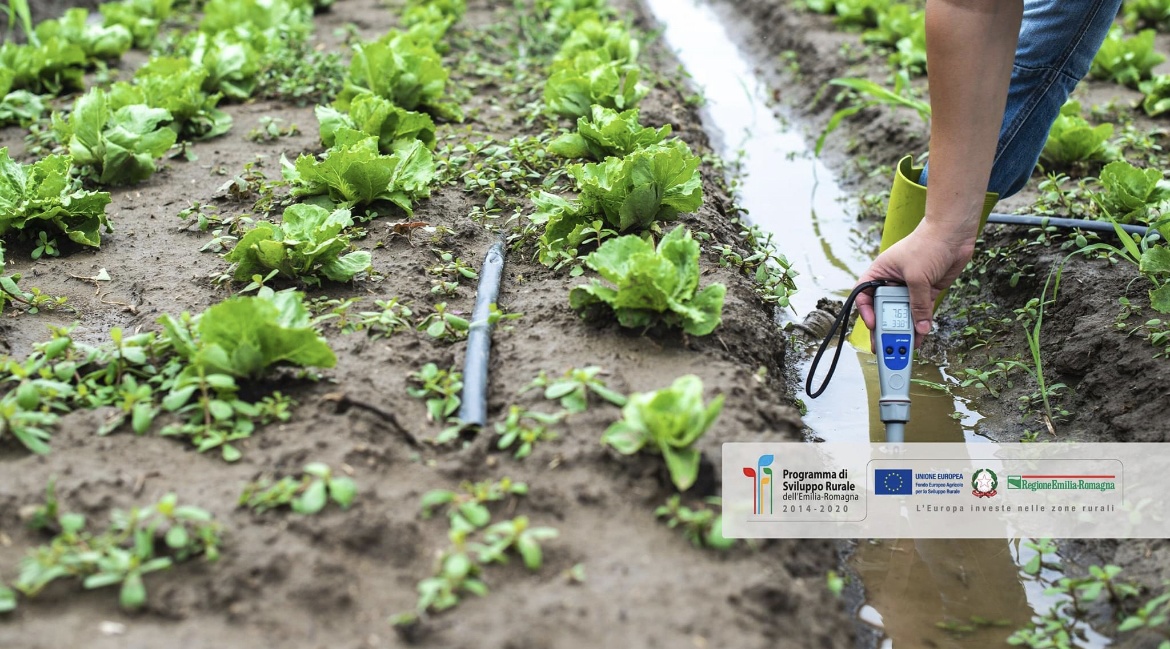 In addition to the improved crop management and reduced water and energy consumption provided by the "Positive" project, the results of the procedures carried out allow growers to create their own irrigation database, associated with specific crops and seasonal yields.
"The persistent drought in many regional drylands during the year," commented Nicola Dalmonte, President of the Second Degree Consortium for the Emiliano Romagnolo Canal, "is providing a significant boost to the technical and scientific research of our laboratories and consolidating effective collaborations with universities and various stakeholders. Research is leading to the use of the most sophisticated and innovative systems to save resources, with territorial repercussions that, obviously, progress significantly with each passing season."
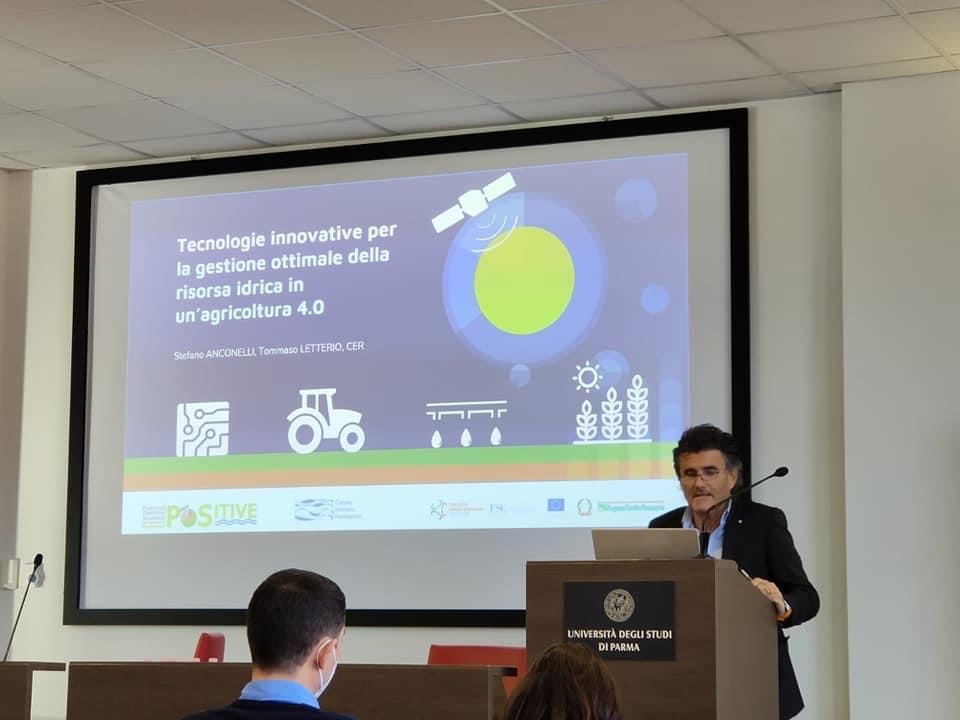 "This system," underlined Stefano Anconelli, Director of research and agronomic development of the Emiliano Romagnolo Canal, "allows the saving of up to 150-200 m3 for each hectare considered. A simulation based on 2020 data, considering only the Emilia-Romagna maize and tomato growing areas of about 110,000 hectares, estimates the possible water saving at about 20 million m3 per year."
Some additional information
For more information on the Positive project
http://www.progettopositive.it/nqcontent.cfm?a_id=19537&tt=t_bt_app1_www
on the Land Reclamation Consortia
https://ambiente.regione.emilia-romagna.it/it/suolo-bacino/argomenti/bonifica-idraulica-e-irrigazione
on the National Association for the Improvement of Irrigation
https://www.anbi.it/?lang=en
and on Irriframe
https://www.irriframe.it/Irriframe
Sources: freshplaza.it, parmadaily.it