News
Chinese pastes: is the Middle East the new driver for exports?
The Middle Eastern market, buoyed by the recent development of Iraqi imports, took first place among Chinese foreign sales partners, ahead of West Africa, the historical base of Chinese foreign trade.
In China, the last two marketing years (see related articles below) have been marked by impressive growth in the export volumes of tomato products. According to figures published by the official customs service, Chinese operators exported almost 1.2 million tonnes of products under HS codes 200290 (tomato pastes), 8% more than in the previous marketing year (2022/2023) and 28% more than in the previous three marketing years (2020/2021 – 2022/2023).
The value of Chinese goods exported in 2023/2024 (USD 1.38 billion) increased by 16% compared to the previous year (USD 1.2 billion) and by 59% compared to the average of the previous three years (USD 0.86 billion).

Compared with the period 2020/2021 – 2022/2023, the other major exporting countries have recorded variable results, with a significant rise in US activity and notable declines in the foreign sales of Spanish, Turkish and Portuguese pastes. Italian and Iranian results were not available at the time of writing.
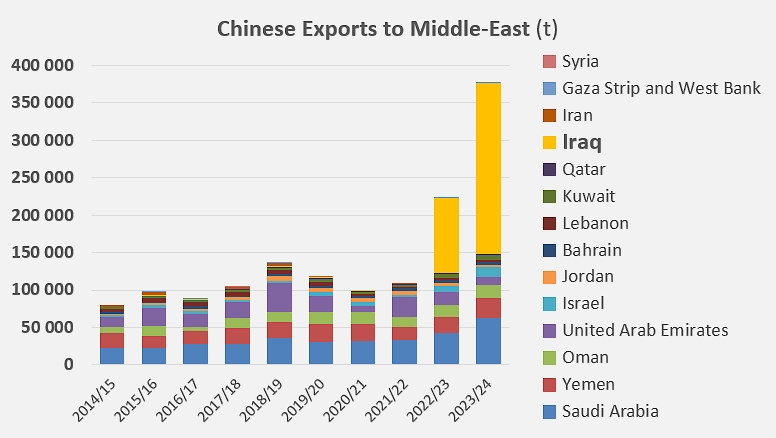
The main driving force behind the sudden increase in foreign sales of Chinese tomato products over the past two years has been the explosion of demand in the Middle East region. Annual quantities delivered to this region by Chinese operators, which were recorded at approximately 100,000 to 110,000 tonnes between 2014 and 2022, exploded to over 220,000 tonnes in 2022/2023 and over 370,000 tonnes in 2023/2024. The value of products delivered to these markets (USD 435 million in 2023/2024) has been multiplied by 3 compared to the 2020/2021 – 2022/2023 period (USD 140 million).
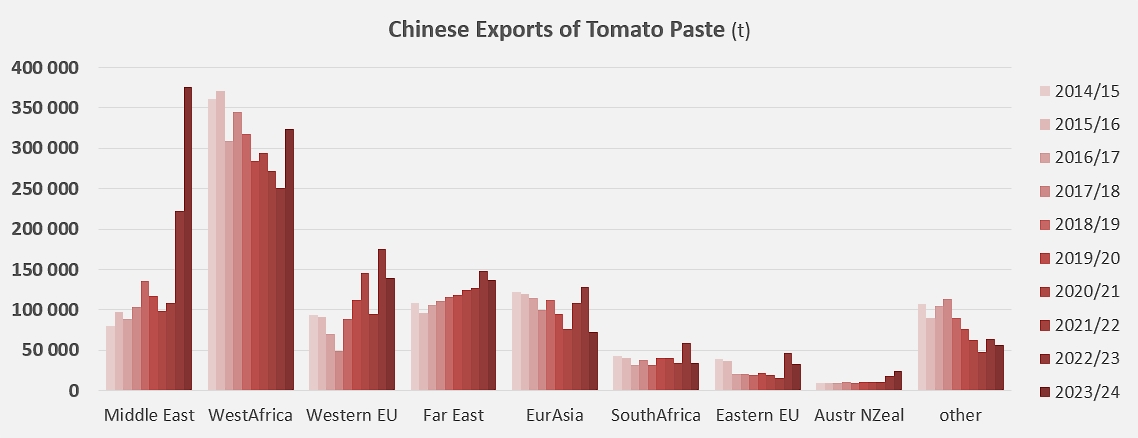
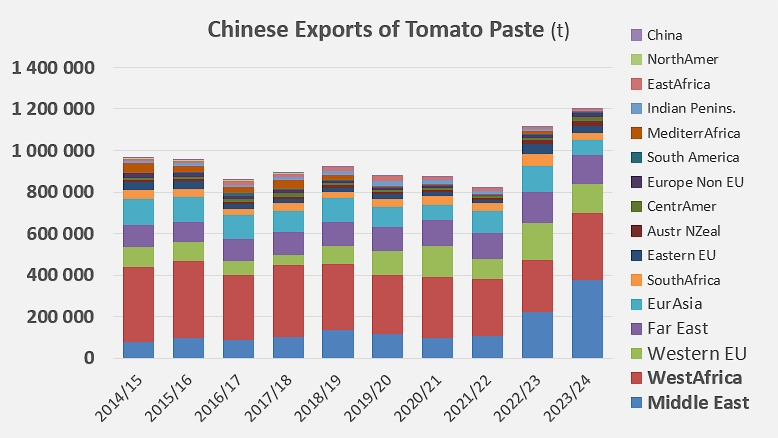
The Middle Eastern market, where Chinese sales have historically been driven by Saudi Arabia, Yemen, Oman, the United Arab Emirates and Israel, has seen very strong demand from Iraqi operators over the past two years. Although marginal until 2021/2022, this new outlet became the main market for Chinese exports last year, reaching record levels of 100,000 tonnes in 2022/2023 and 227,000 tonnes in 2023/2024. This growth in the purchase of Chinese products over the last two years has apparently occurred at the expense of Turkish and Iranian operators, who were the main suppliers to this market for many years (see additional information at the end of this article).
Some complementary data
Iraqi imports of tomato pastes, with volumes deduced from declarations by the sector's main supplier countries.
Iraqi imports of tomato pastes, with volumes deduced from declarations by the sector's main supplier countries.
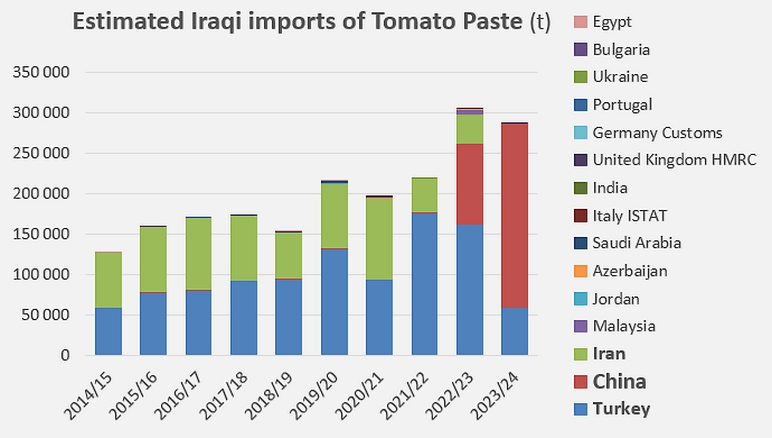
Historical record of Chinese exports to the Middle East.
Source: TDM