News
China: Response to sanctions related to “forced labor”
China’s Xinjiang vows to increase support for firms under US ‘forced labour’ sanctions.
Legislative resolution says US sanctions are ‘baseless’, calls to create ‘positive social environment’ for growth of businesses targeted. Officials should also actively help sanctioned enterprises to expand in domestic and international markets.
Legislators in the western Chinese region of Xinjiang say they will increase support for US-sanctioned enterprises, including via the legal system and overseas promotions.
In a resolution released and taking effect in early September, the regional legislature denounced US sanctions against Xinjiang enterprises over the alleged use of forced labour, calling for the creation of “a positive social environment” for the growth of those businesses.
In a resolution released and taking effect in early September, the regional legislature denounced US sanctions against Xinjiang enterprises over the alleged use of forced labour, calling for the creation of “a positive social environment” for the growth of those businesses.
“The entire region must immediately take action to support the development of sanctioned enterprises and related industries,” the legislature said in the resolution, which was adopted on August 23.
“It is both a just stance and an unshirkable responsibility for all levels of national agencies, people’s organisations, enterprises and institutions, and all ethnic groups in the region to firmly oppose the US’ baseless sanctions against Xinjiang enterprises under the pretext of ‘forced labour’.”
The US Congress passed the Uygur Forced Labour Prevention Act in 2021 targeting imports from Xinjiang, to prevent the entry of goods made under such conditions.
The act took effect the following June, and has since seen sanctions imposed on dozens of Xinjiang companies and officials accused of being complicit in labour and human rights abuses there.
 About two-thirds of Xinjiang’s nearly 26 million people are members of ethnic minorities, including the mostly Muslim Uygur and Kazakh groups. Accusations of human rights abuses, mass detention and forced labour in Xinjiang, mainly targeting the Uygur population, have been steadfastly denied by Beijing.
More than 80 Chinese companies now appear on the US Homeland Security Department’s “entity list” of sanctioned firms, over accusations of being involved in what Washington says are forced labour programmes.
The pace of additions to the entity list has sped up, according to Robert Silvers, an undersecretary at the department who chairs a committee overseeing the list. More than 30 Chinese companies have been hit with US sanctions so far this year.
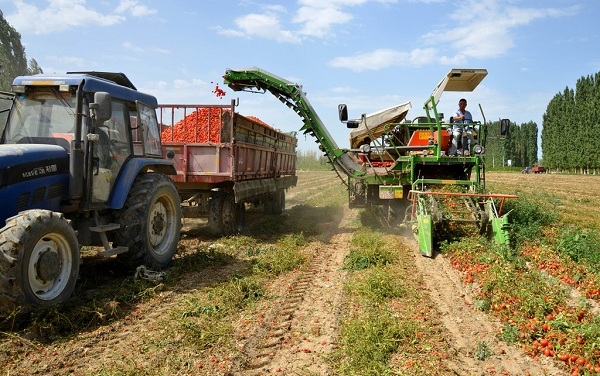
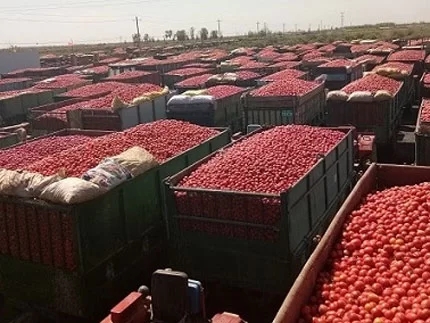
The list includes companies from Xinjiang’s key industries such as cotton and textile clothing, new energy, photovoltaic silicon, and tomato processing. It also includes Chinese companies outside the region.
According to the resolution, judicial authorities in Xinjiang should provide legal support to sanctioned enterprises so they can seek compensation from the US for losses caused, in line with international law and rules.
Legislative bodies should speed up enacting relevant laws to support sanctioned businesses and strengthen oversight to ensure effective implementation of policies and create a fair market environment, it added.
Local governments have been urged to establish a leadership system to particularly address US sanctions related to Xinjiang and address new issues faced by the businesses concerned.
 Officials should also encourage and support sanctioned enterprises in pursuing technological innovation, and actively help them to expand in domestic and international markets, the resolution said, while urging deputies at the legislature to actively promote sanctioned companies as “voluntary advocates” and “product spokespeople”.
The resolution also repeated Xinjiang’s “firm opposition” to the US accusations and sanctions, describing them as “political manipulation and economic bullying under the guise of human rights”.
Apart from repeatedly denying accusations of human rights abuses in Xinjiang, Beijing has imposed its own sanctions on foreign researchers and diplomats it deems to be vocal on the issues.
In 2021, a Xinjiang company filed a civil lawsuit against Adrian Zenz, a German researcher whose works were central to the human rights accusations about the Uygur autonomous region. The company claimed it had suffered heavy economic losses due to Zenz’s “distorted” studies. There has been no subsequent official news on the case.
Some complementary data
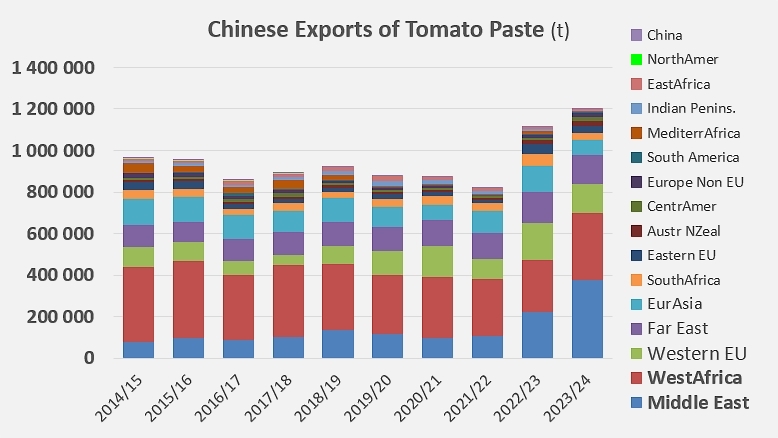
Evolution and distribution of Chinese tomato paste (200290) exports over the last ten years; after 2020/2021, the annual quantities delivered to the United States fell from 1,500 tonnes to less than 190 tonnes. An article detailing Chinese exports of concentrates will be published very soon.
Sources: scmp.com, TDM