News
Carbon price rises above Euro 60 to set new record
“…the 40th time this year that the carbon price had set a new record”
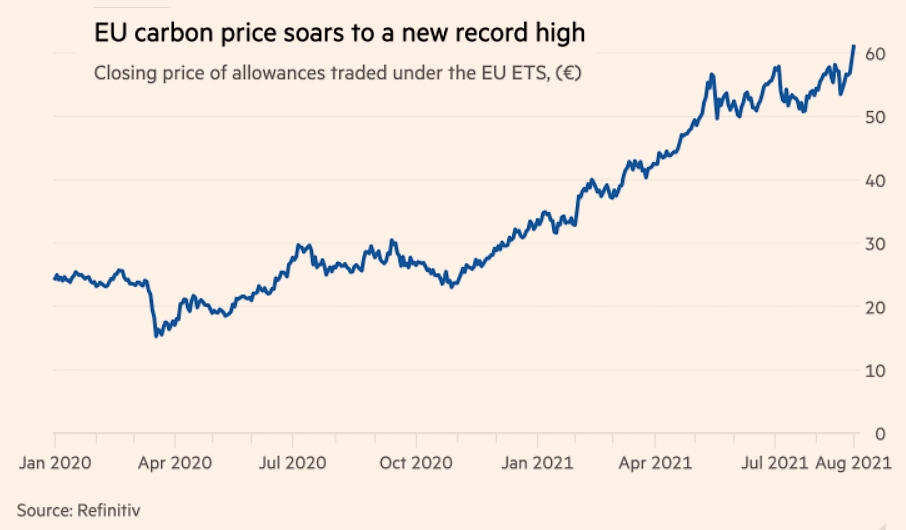
The EU carbon price touched an all-time high on Monday (August 30, 2021), as the prospect of tighter environmental regulations, as well as a brief reduction in supply this week, pushed the market to a new record.
Futures prices passed Euro 61 in intraday trading on Monday — double their levels from a year ago — before falling back to close at Euro 60.60.
The EU compliance market trades in credits, known as allowances, which give the owner permission to emit one tonne of carbon dioxide. Larger producers including most coal power plants are required by the EU to purchase enough allowances to cover their emissions.
Ingvild Sorhus, lead analyst for EU carbon at Refinitiv, a global provider of financial market data and infrastructure, said the anticipation of tight gas supplies in Europe was one factor driving up prices. As autumn arrived, high gas prices could mean that more coal was burnt for power and heat this winter, creating greater demand for carbon allowances to cover the resulting emissions, said Sorhus.
 “The recent rally has been driven by the stressed gas market, because the European gas market is quite tight,” she said. “There is nervousness that we are heading into winter with insufficient gas supply.” In addition, the regular schedule of auctions in which new allowances are released on to the market is reduced this week due to holidays. This means fewer new carbon allowances will be available than would normally be the case.
The EU’s carbon market — the largest mandatory emissions trading scheme in the world — is seen as a bellwether for global carbon pricing. A number of countries, including the US, are examining whether to introduce carbon pricing systems as a way to curb emissions. Brussels is also considering proposals for a carbon border adjustment mechanism, which would impose a levy on certain imports from countries with no carbon pricing (See related articles below).
EU carbon prices have risen from about Euro 30 per tonne at the start of this year, to about Euro 40 in March, then Euro 50 in May, before passing Euro 60 on Monday for the first time. Sorhus said that Monday’s high was approximately the 40th time this year that the carbon price had set a new record.
EU urges markets to ‘keep calm’
A senior European Commission official insisted on delivering “a message of calm” during a EURACTIV event on 2 September, as CO2 prices rose for the first time above the Euro 60 threshold on the EU carbon market.
“I think we need to keep calm with the Euro 60 market,” said Beatriz Yordi Aguirre, a director at the European Commission’s climate directorate in charge of European and international carbon markets. “We don’t expect that this is going to be a situation that will be lasting a lot,” Yordi Aguirre explained, calling on people to distinguish between short term market conditions and longer-term trends.
“It’s true that we are now in a context of high gas prices,” she conceded though, saying that this was only short term and possibly linked to “a geopolitical situation” related to the Nord Stream gas pipeline.
A senior European Commission official insisted on delivering “a message of calm” during a EURACTIV event on 2 September, as CO2 prices rose for the first time above the Euro 60 threshold on the EU carbon market.
“I think we need to keep calm with the Euro 60 market,” said Beatriz Yordi Aguirre, a director at the European Commission’s climate directorate in charge of European and international carbon markets. “We don’t expect that this is going to be a situation that will be lasting a lot,” Yordi Aguirre explained, calling on people to distinguish between short term market conditions and longer-term trends.
The Commission’s Yordi Aguirre said high carbon prices were the result of several factors, including rising gas prices and a reform of the EU ETS adopted two years ago to prop up the price of CO
2 and encourage companies to cut emissions.“It’s true that we are now in a context of high gas prices,” she conceded though, saying that this was only short term and possibly linked to “a geopolitical situation” related to the Nord Stream gas pipeline.
Frans Timmermans, the EU climate chief, also warned against intervening on the market in reaction to high prices. “That would absolutely undermine the credibility of the emissions trading system,” he said earlier this year as carbon prices rose above €50 for the first time.
Some complementary data
EU ETS futures prices as of September 9, 2021

Source : ember-climate.org
Source: Financial Times, euractiv.com
Related news








Latest news
Tomato Products Wellness Council Redefines Quality
California: Weekly tonnage as of 17 October 2026
Heritable and Kagome Partner on AI-Driven Disease-Resistant Crops
Final results of the 2026 campaign in Northern Italy: yields among the lowest in recent years
Global Tomato Paste Trade in 2025/2026: slow emergence of secondary origins