News
Australia: record trade balance deficit of USD 142 million in 2022
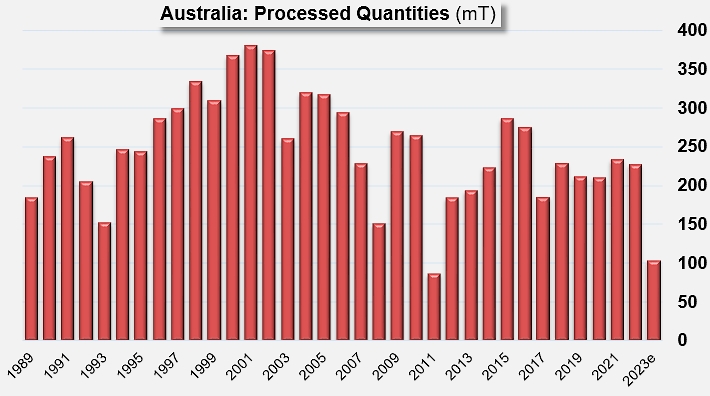
The Australian market remained highly dependent on imports of tomato products in 2022, all the more so as the local processing sector has for some years been regularly confronted with climatic incidents affecting the quantities processed, such as those that profoundly disrupted the operating program in 2023 ("flooding after planting, delays from persistent wet weather in Spring, resulting floods with large areas left unplanted, mild summer interrupted by persistent cool periods, multiple hail events", to quote the WPTC season report of March 31, 2023).
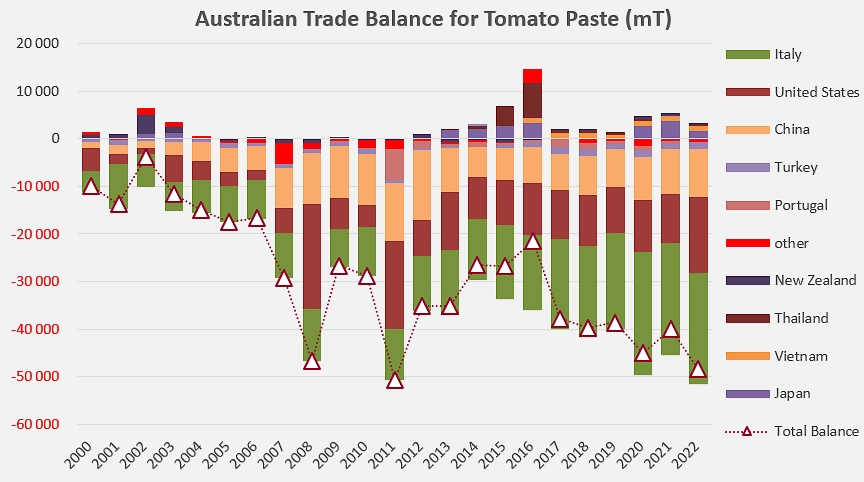
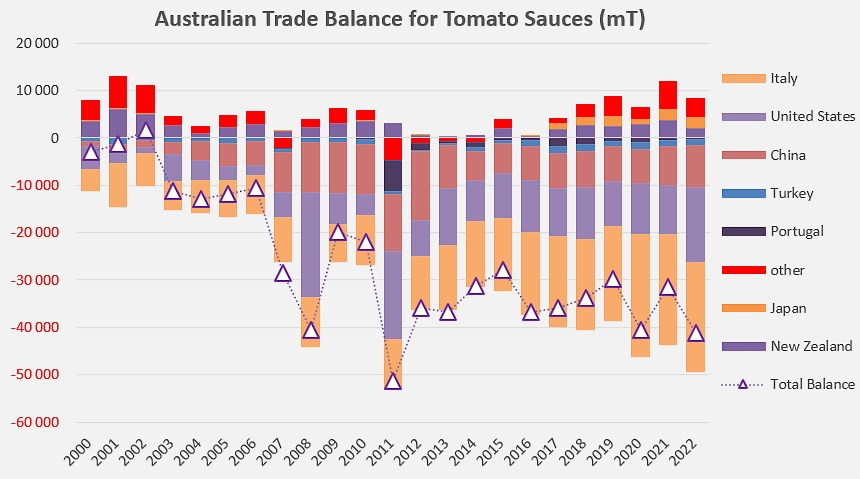
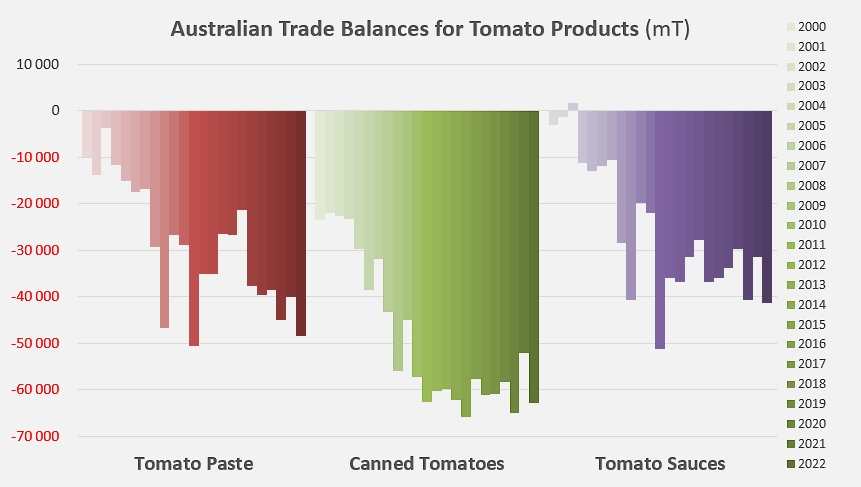
All product categories are concerned; the "pastes" and "sauces" trade balances show similar profiles, marked in particular by spectacular increases in imports in 2008 and 2011. These brutal increases were intended to compensate for the particularly weak results of the local processing sector, being the consequence of the exceptionally contrary climatic conditions during those two seasons (see our complementary information at the end of this article).
Last year, the Australian balance for pastes recorded a deficit of around 48,500 mT of finished products, close to the record results of 2008 (46,600 mT) and 2011 (50,600 mT). The Australian market is mainly supplied by Italy, the USA and China, and to a much lesser extent by Turkey and Portugal, while local operators maintain modest export flows to Japan and Vietnam.
Driven by the increase in quantities and higher paste prices, the corresponding financial deficit widened in 2022 to slightly more than 50 million US dollars, or just over a third more than during the 2019-2021 period (USD 37.6 million).
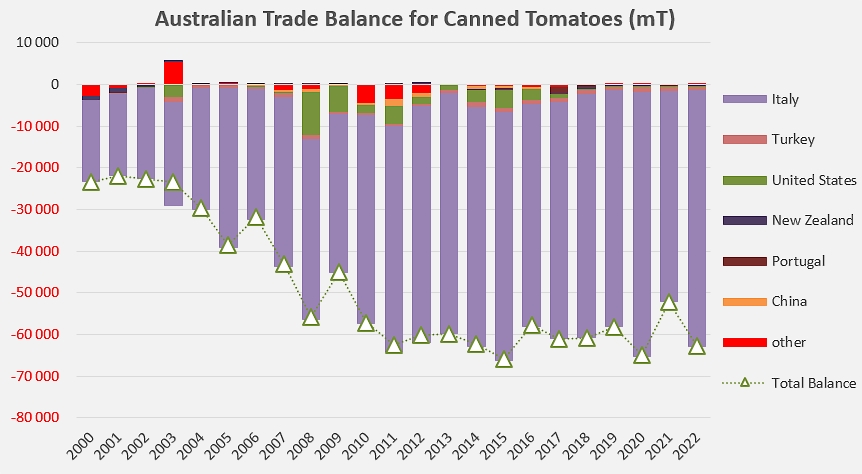
Unlike other import sectors, Australian supplies of canned tomatoes have remained stable overall over the last twelve to fifteen years, averaging around 59,000 mT of finished products. In particular, there were no significant ups and downs in the trade balance between 2008 and 2011 and, apart from a few US incursions into the Australian market for that category between 2008 and 2016, 98% of the canned tomatoes consumed in Australia have been of Italian origin (see our additional information at the end of this article). With a deficit of almost 63,000 mT of finished products in 2022, the canning sector is the biggest contributor to Australia's tomato products international trade deficit. In 2022, Australia's foreign purchases of canned tomatoes amounted to over 62 million US dollars, up 21% on the average of the previous three years (2019-2021).
The same trio of supplier countries (Italy, United States, China) share, in that order, the bulk of the Australian market's supply of sauces and ketchup, followed by Turkey and Portugal. Despite some export shipments to Japan and New Zealand, Australia's trade balance deficit in the "sauces" category reached just over 41,000 mT of finished products last year, 21% higher than the average for the previous three years (34,000 mT). Last year, the financial deficit amounted to almost USD 29 million, up 24% on the average recorded over the previous three years (around USD 23 million between 2019 and 2021).
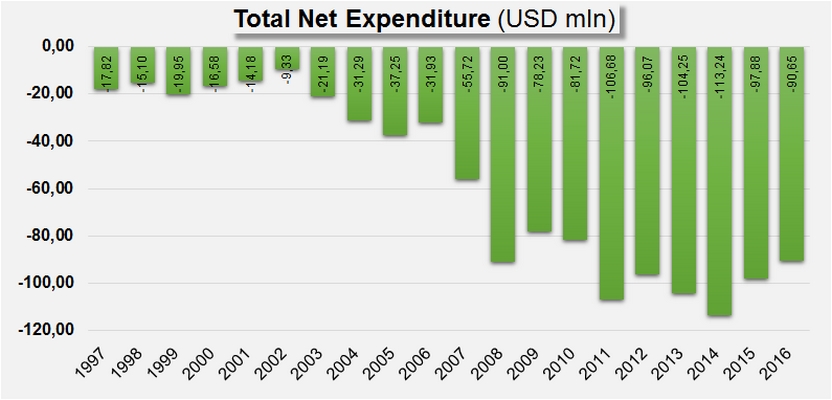
All in all, driven by volume and price increases, Australia's tomato products balance deficit widened by 26% in 2022 compared to the previous three years, reaching a record level of USD 142 million.
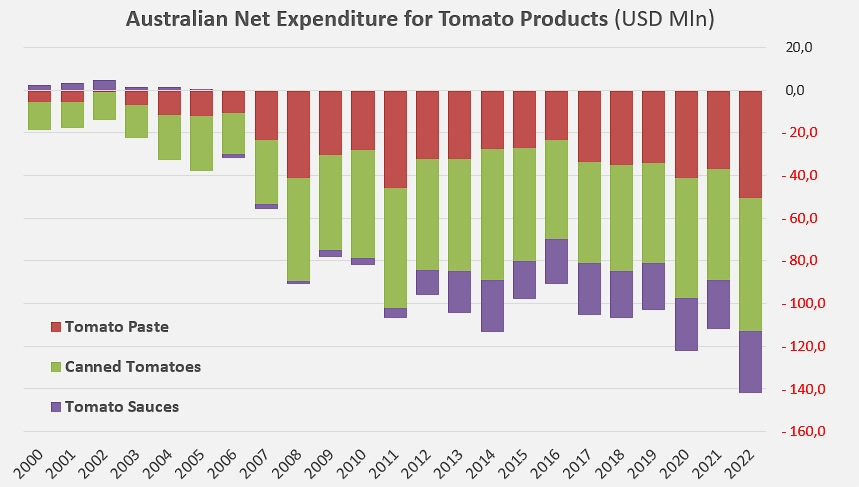
Some complementary data
Trends in Australian trade balances for different product categories since 2000.
Trends in Australian trade balances for different product categories since 2000.
Australia's balance of canned tomatoes since 2000, by country of origin.
Quantities processed by the Australian industry since 1989.
Source: Trade Data Monitor