News
Australia’s Tomato Trade Balance: Key Dynamics and Market Outlook
Between 2021 and 2025, Australia’s market for processed tomato products consistently demonstrated high demand for foreign supply. Despite processing over 210,000 metric tonnes locally in typical years (punctuated by a dip to 110,000 MT in 2023 due to extremely difficult weather with heavy rainfalls and flooding), domestic production falls short of total consumption. While Australia maintains export channels for value-added derivative products—primarily tomato sauces—it suffers a substantial trade deficit across all three major categories: paste, canned tomatoes, and prepared sauces.
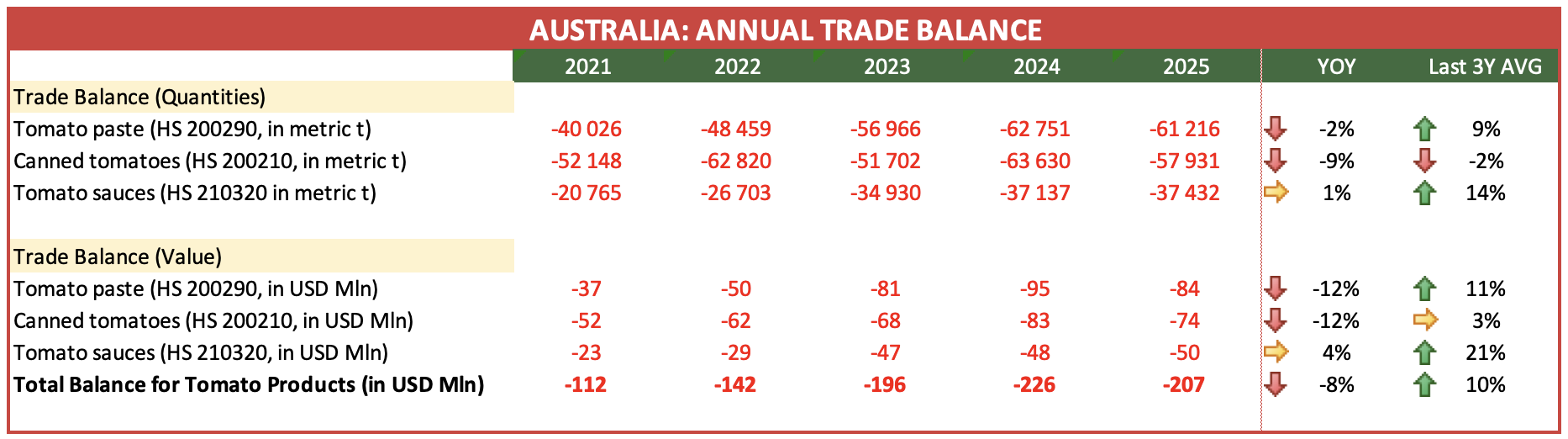
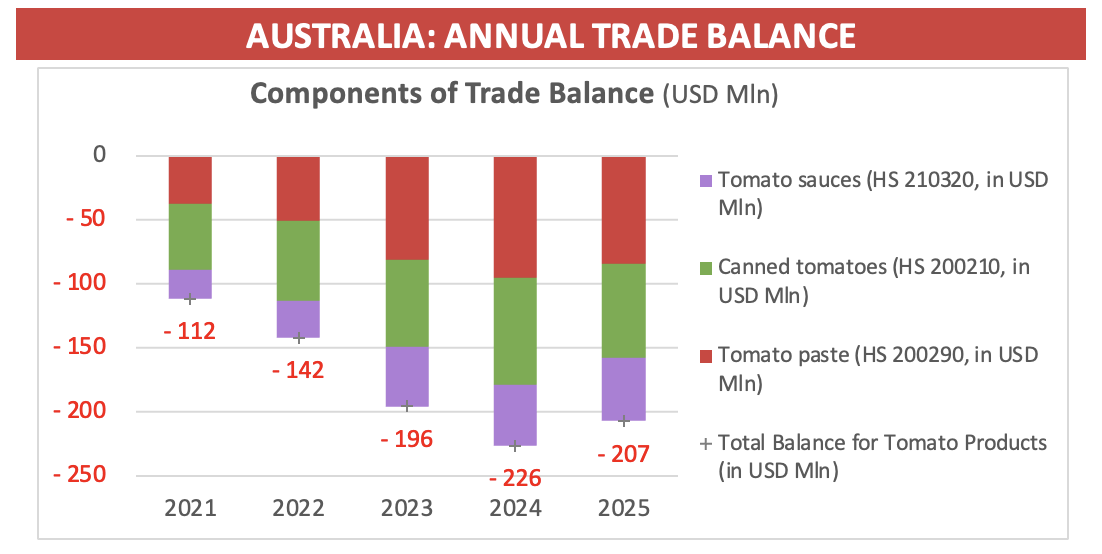
As reflected by the Australian trade data available on our website www.tomatonews.com, (Country Profiles) between 2021 and 2025, the national trade balance for processed tomato products highlights a significant financial deficit.
The overall trade deficit appears to stabilize, after having nearly doubled since 2021. Imported volumes are now slightly decreasing for paste and canned tomatoes, while sauce imports in 2025 were similar to 2024. While the volume of paste went down by 2%, its value went down by 12%, indicating lower import prices for paste, which can be explained by the market surplus carried over from 2024.
Since 2021, the average import price across all categories rose from USD 989 per metric tonne to USD 1,323 in 2025 – a 34% increase overall. This growth was primarily driven by a 48% increase in the value of paste, alongside increases of 28% for canned tomatoes and 26% for sauces.
Dynamics by Product Category
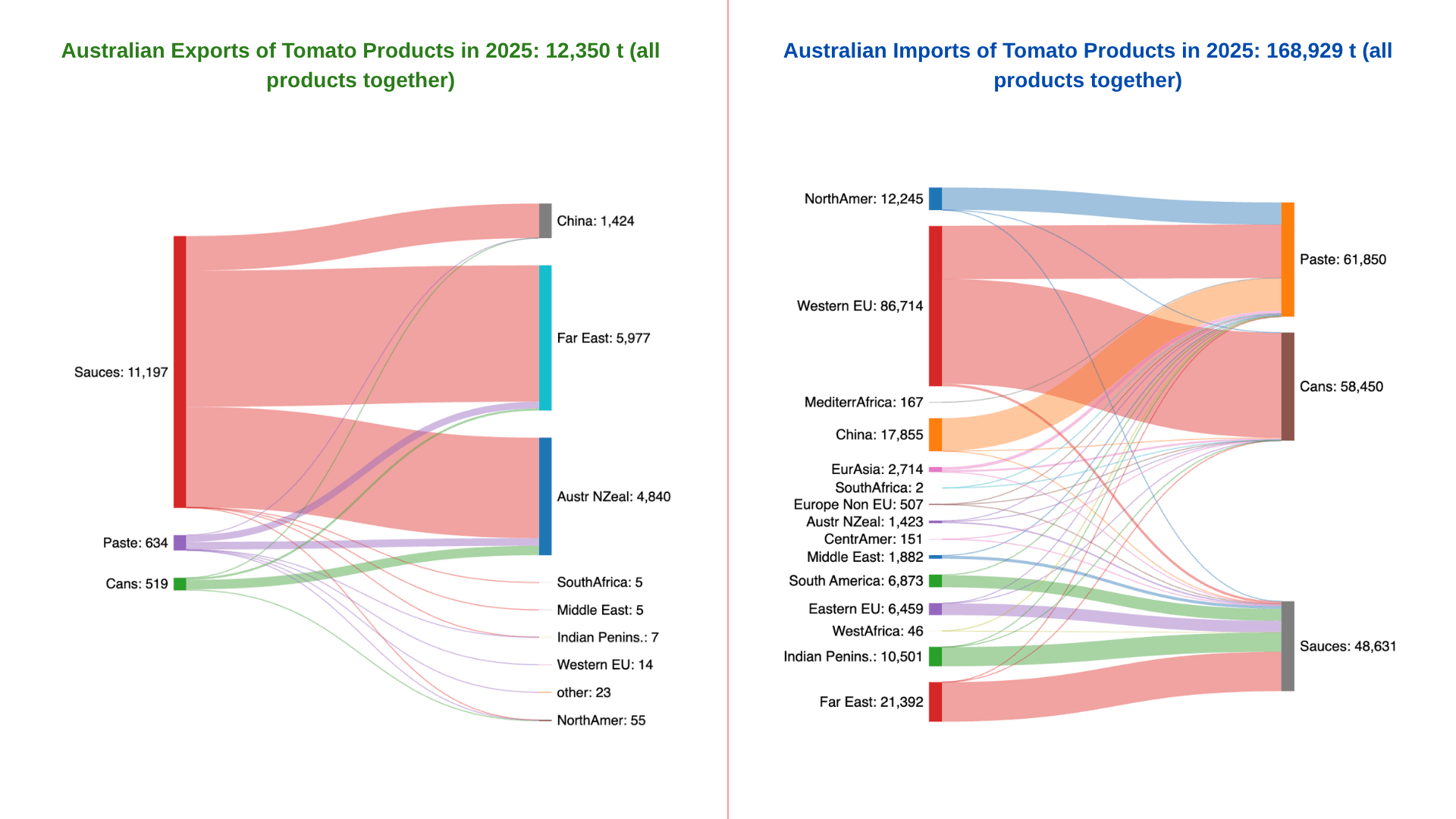
Tomato paste (HS 200290) is the most imported category by volume (representing 37%), reaching 61,850 metric tonnes in 2025, just under the level of 2024, and potentially stabilizing there, but the current level represents a huge increase from the 2021 level at 46,412. While Western EU is its biggest supplier, China is #2, followed by North America.
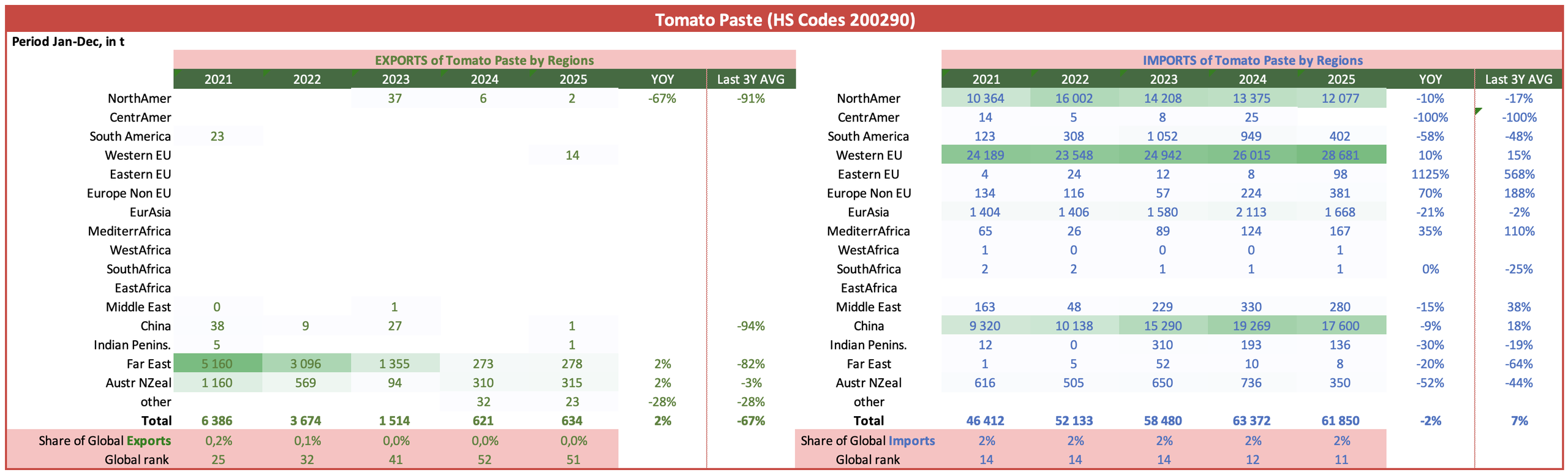
On the export side, paste exports decreased tenfold between 2021 and 2025. While Australia exported massively to the Far East and to a lesser degree to the Australia /New Zealand region (mainly to New Zealand), those two regions combined are now only importing around 300 tonnes from Australia since 2024.
Canned tomatoes (HS 200210) account for 35% of total import volume, with an average of 58.000 metric tonnes over the last 5 years. 97% comes from Western EU (of which 99% from Italy). Another 2% comes from the EurAsia region (almost exclusively from Türkiye).
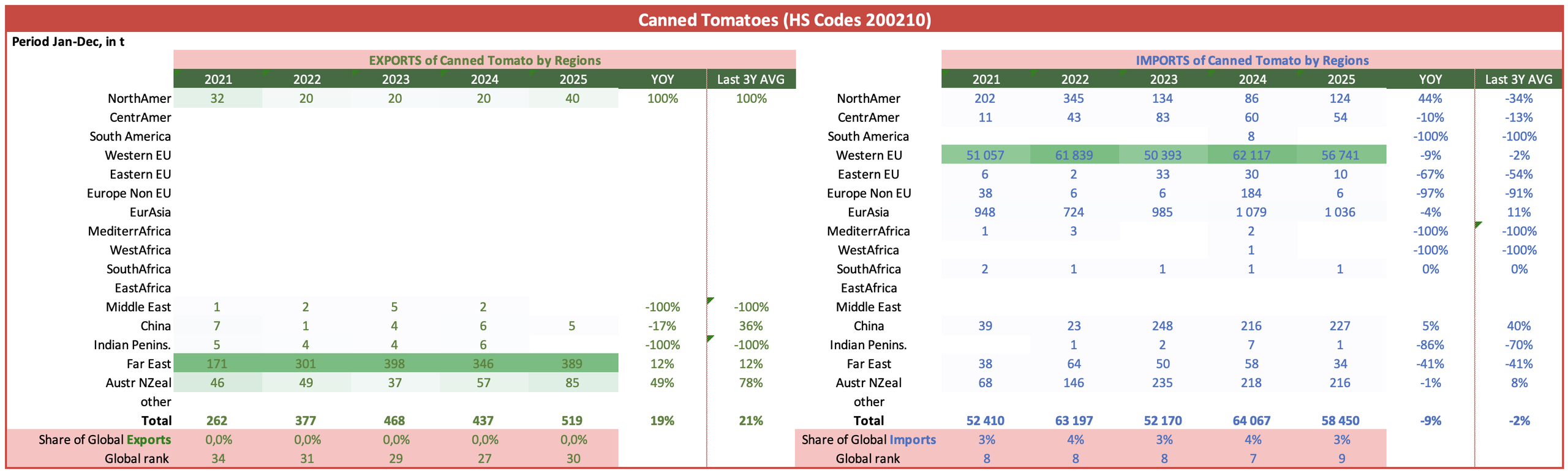
Australia ranks among the top ten global importers of canned tomatoes, currently holding 9th place with approximately 3% of global volume. Conversely, its role as an exporter remains minor, ranking 30th worldwide with a market share between 0% and 0.03%.
Prepared tomato sauces (HS 210320) represent the smallest category by import volume, accounting for 29% of total imports. In 2025, imports stood at 48,629 metric tonnes – the highest volume recorded over the five-year period. The supply structure relies mostly on nearby regions, to which Australia also exports tomato sauces & ketchup: the Far East, New Zealand and China. Imports are about four times the quantity of exports[MS1] , creating a negative trade balance in this category.
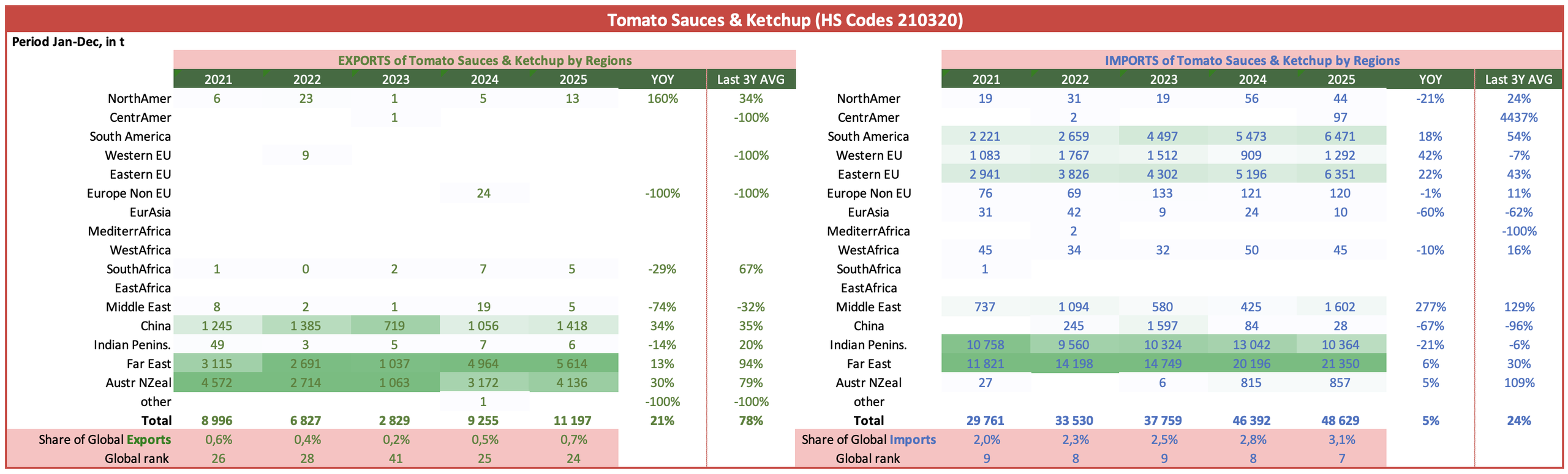
In the global market for tomato sauces and ketchup, Australia ranks as the 7th largest importer (representing 3.1% of the global market). Its role as an exporter remains secondary, ranking between 24th and 41st worldwide with a market share between 0.2% and 0.7%.
Between 2021 and 2025, Australian sauce exports – apart from the catastrophic 2023 season – increased from 8,996 metric tonnes to 11,197 metric tonnes. Exports are going mostly to the nearby regions: Far East (Japan for about half), New Zealand and China.
The real-world consequences of these trade flows on the domestic industry were summed up by Matt Stewart of the Australian Processed Tomato Research Council (APTRC):
“Australia remains a serious tomato growing and processing country, but global oversupply and import competition are currently challenging our ability to compete in the commodity processed tomato space.
Our stronger long-term opportunity lies in differentiated, value added products and leveraging Australia’s high-quality produce as a manufacturing platform for Asia Pacific markets.”
“Australia has every ingredient needed to be a manufacturing powerhouse for processing tomatoes into the future. We have access to energy, irrigation water, abundant land resources, significant expertise in growing processing tomatoes, rapid adoption of automation and advanced technologies, dedicated people, and proximity to major Asian markets.”
Looking ahead, Australia’s processed tomato sector will likely continue to depend on international supply to balance domestic consumption. Following several years of substantial unit price increases, import prices appear to be softening as global carryover stocks help stabilize trade dynamics. Should global harvests remain steady, lower paste prices could provide welcome cost relief to local food manufacturers and re-processors.
At the same time, Australia’s reliance on single supplying regions—most notably Italy for nearly all of its canned tomato imports—exposes the local market to weather disruptions and agricultural shifts in Southern Europe. Diversifying import channels will remain an important strategy for risk management. Yet, the most direct path to strengthening supply chain reliability is boosting domestic production, though this will require Australian consumers to actively increase demand for locally grown produce. Conversely, prepared sauces offer the clearest export growth opportunity for Australian processors, where strong trade links with Japan, China, and New Zealand position local brands well across the Asia-Pacific region.
Consult the Country Profile of Australia here
Source: TDM