News
Morning Star Tomato Bites July 2026 Release
California Harvest Begins with Strong Early Quality and Promising Yields
California’s 2026 processing tomato harvest is now underway, providing the first look at crop performance beyond preseason expectations. In this July TOMATO BITES by Morning Star update, Aaron Giampietro shares the latest observations on early yield and quality, harvest timing, weather impacts, and what the newest California inventory data may mean for the months ahead.ches.
Click here or on the image to access the video.
Hello everyone, this is Aaron Giampietro from The Morning Star Packing Company, with your July 16, 2026 Tomato Bites update.
Harvest is now underway across portions of California, allowing us to move beyond preseason expectations and begin discussing actual crop observations. Although volumes remain limited this early in the season, conventional processing tomatoes in the southern San Joaquin Valley have started on an encouraging note, with initial fields generally meeting or exceeding expectations for both yield and quality.
Early quality results show cumulative average season-to-date soluble solids, or Brix, approximately 6% higher than during the same period last year. At the same time, we are seeing some higher incidence of mold and limited-use fruit, along with more green fruit, indicating less uniform maturity in certain early fields. While these factors introduce some variability, overall quality is tracking close to plan, though it remains too early to draw conclusions about the broader crop. Since growing weather conditions have been more variable than what we observed last year, this helps explain some of the mixed early quality signals we are seeing.
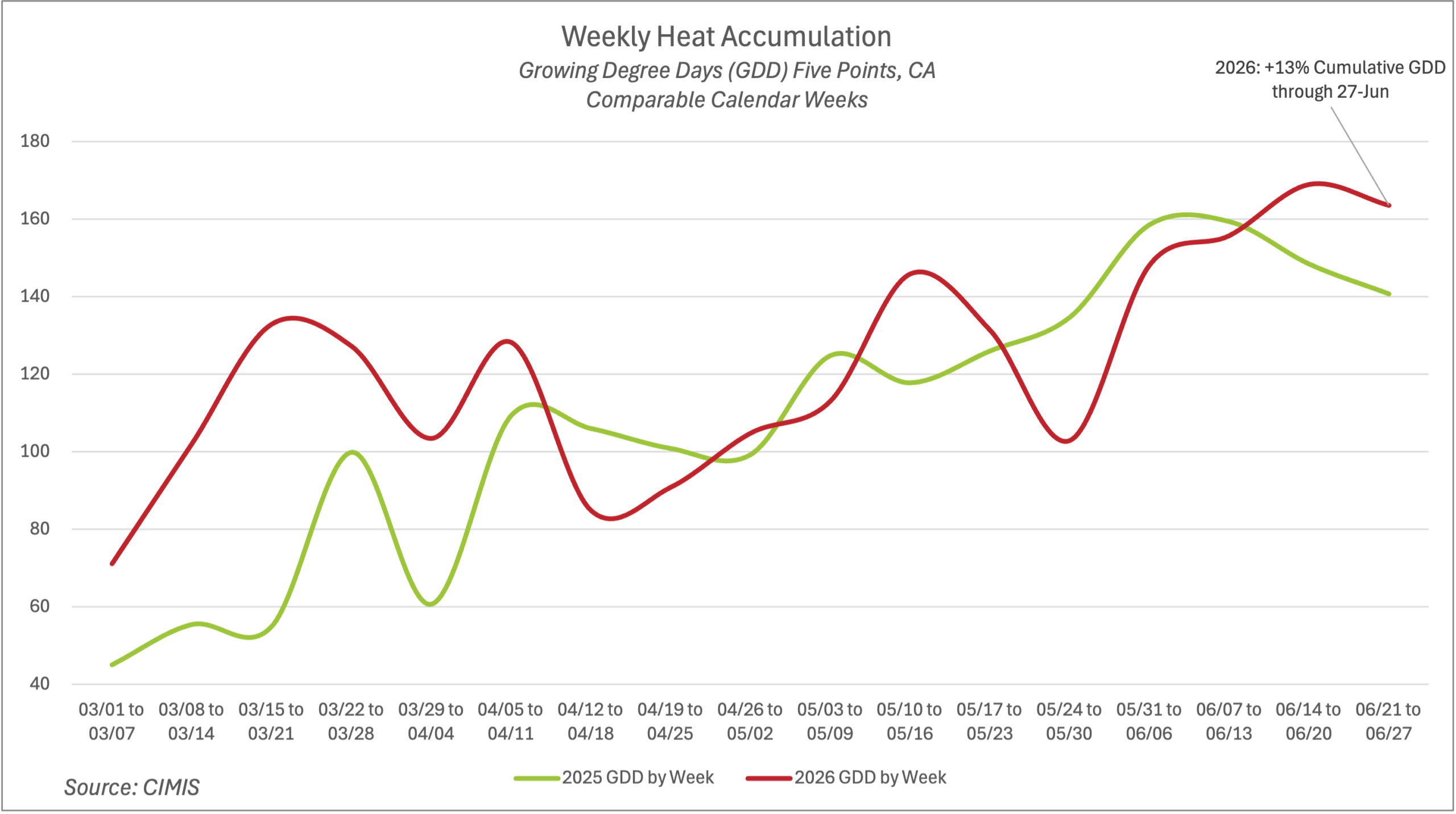
One example comes from a representative weather station in Five Points, California in the southern San Joaquin Valley. From March 1 through June 30, this location accumulated approximately thirteen percent 13% more growing degree days than during the same calendar period in 2025. However, that heat was delivered in a less consistent pattern than the remarkably steady conditions experienced during last year’s record-setting crop. While one weather station does not represent all of California, it provides a useful illustration of the temperature swings experienced by portions of the early crop.
Current field maturity estimates indicate a larger wave of harvest readiness during August. While this may create periods of concentrated incoming volume, California processors have available capacity to manage the expected peak as harvest expands.
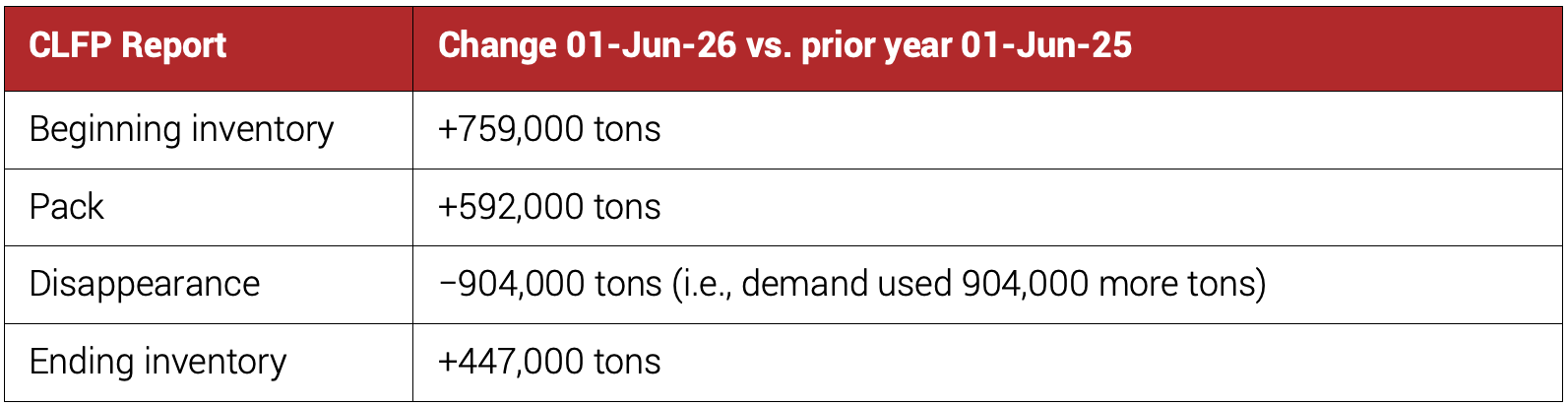
The California League of Food Producers recently released its final 2025 crop stock-on-hand report on June 24. The year-over-year changes tell an interesting story.
The industry entered the 2025 season with approximately 759,000 more tons of carry-in inventory than the year before, while the record-yielding 2025 crop added another 592,000 tons of production. Over the twelvemonth reporting period, U.S. tomato product disappearance increased by approximately 904,000 tons, absorbing a substantial portion of both the record yielding 2025 crop and the elevated carry-in inventories. As a result, ending inventories increased by only 447,000 tons, finishing at approximately 6,854,000 paid short tons.
Entering this season, inventories represent approximately 7 months of supply. If 2026 production finishes near the May USDA NASS estimate and U.S. tomato product disappearance remains relatively steady, inventories could decline by approximately one to two months before the start of the 2027 crop.
We’ll be back next month with a broader look at California harvest performance, quality trends, and how production is tracking against preseason expectations.
As always, we invite you to visit us this season in California and see our operations firsthand. In the meantime, please visit our website for the latest market information and contact us with any questions or comments.
Thank you.