News
Greek Tomato Derivatives Trade Posts Strong Growth in 2024
You can also consult the country profile for Greece here.
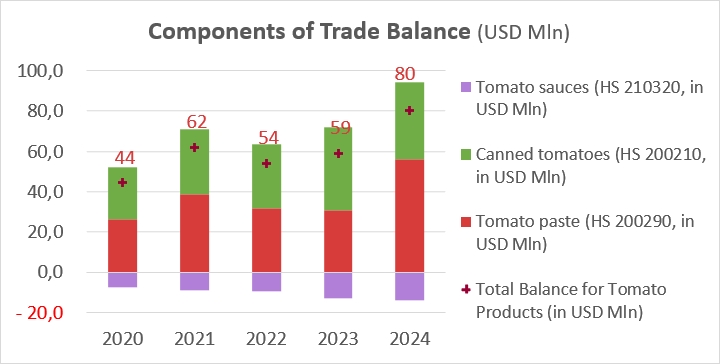
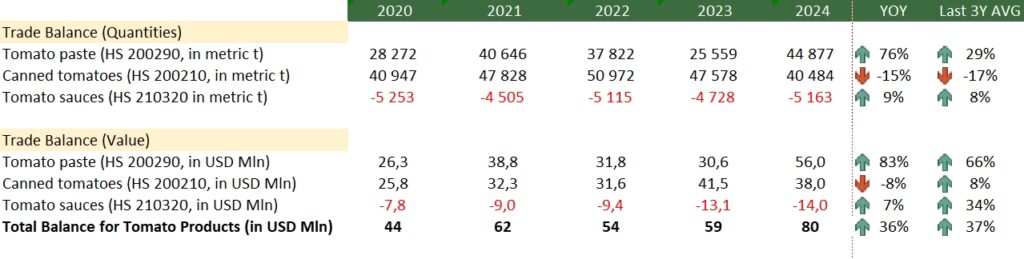
In 2024, the Greek trade balance for tomato derivatives showed a surplus of USD 80 million (EUR 74 million), up 36% compared to USD 59 million in 2023 and 37% compared to the average of the three preceding years (USD 58 million in 2021, 2022, and 2023).
The Greek trade balance for tomato pastes (HS code 200290) ended the year with a remarkable performance (USD 56 million), representing a 66% increase in value compared to the average of the three preceding years (nearly USD 34 million). This result was driven by an increase in the value of Greek products, but also by a clear recovery in 2024 in exports, which had lost ground globally over the past three years: the Greek share of the global tomato paste market thus fell from 1.4% in 2021 to 0.9% in 2023, before registering a significant rebound to 1.3% in 2024.
Greek exports of canned tomatoes (HS codes 200210) generated a surplus of USD 38 million last year, an increase of 8% over the three previous years, but a decrease of 8% compared to the 2023 result (USD 41 million). In both cases, it is important to highlight the slowdown in Greek external activity, which, with a surplus of less than 41,000 tons in 2024, decreased by 15% compared to 2023 (47,600 tons) and by 17% compared to the annual average for the period 2021-2013 (48,800 tons). The world’s fourth-largest exporter of canned tomatoes, Greece accounted for nearly 3% of the sector’s global trade, but only 2.5% in 2024.
The world’s 39th-largest exporter of tomato sauce and ketchup (HS code 210320), with nearly 3,200 tons of products exported over the last five years, Greece is also the 38th-largest importer in the sector, with quantities of around 8,100 tons over the same period. The Greek trade balance shows a consistent deficit in this product category, which widened to approximately -5,200 tonnes and -14 million USD in 2024.
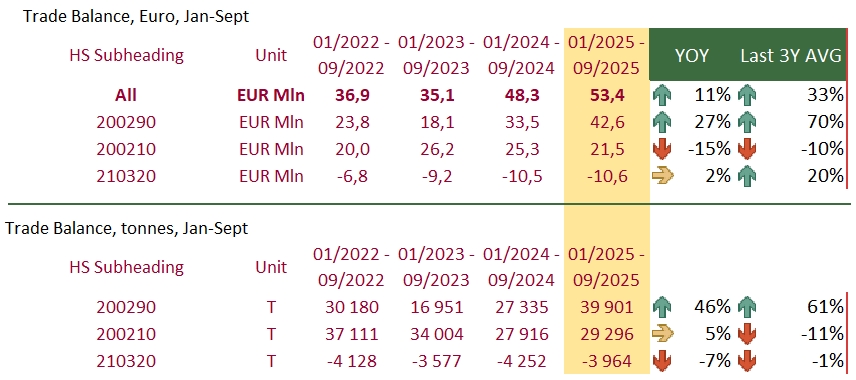
A comparison of Greek performance in the first nine months of 2025 with the same periods in previous years shows that results are improving, in both volume and value, compared to 2024 and the 2022-2024 average, for the entire Greek trade balance in tomato products. This growth is primarily driven by the performance of export sales of tomato paste (a surplus of 39,900 tonnes from January to September 2025), which increased by 61% in volume and 70% in value compared to the three previous years. For the same period (January-September), available data shows, on the contrary, a slowdown in canned goods activity, with the surplus (29,300 tons) declining by 11% in volume and 10% in value compared to the three previous years. For sauces and ketchup, the trend is mixed, with a volume deficit (-3,900 tons) slightly lower than the first nine months of 2024 and the three previous years, but a value deficit that has widened by 20% compared to the January-September periods of the three previous years.
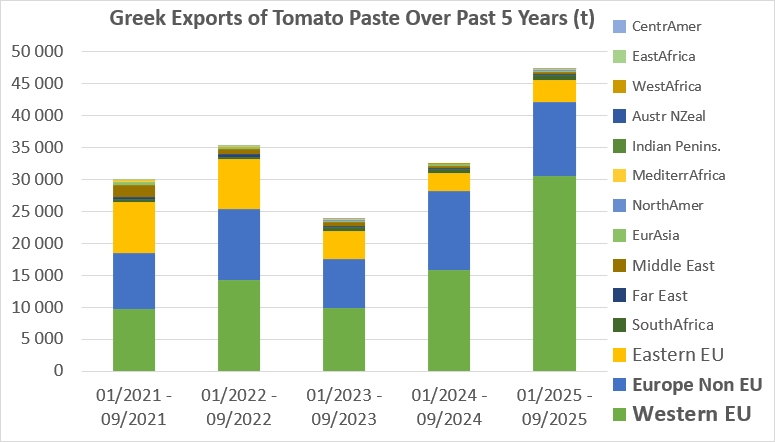
Two regions – Western EU and non-EU Europe – significantly influence the dynamics of Greek paste exports; three if Eastern EU is included. A comparison of the first three quarters of 2025 with the same periods of the three preceding years shows that the increase in Greek export activity was driven by the German, Swedish, and Italian markets, despite a fairly marked slowdown in deliveries to Austria; the British market slightly increased its purchases of Greek pastes, while Poland and Hungary significantly slowed theirs.
Some complementary data
Evolution of the Greek trade balance for tomato products.
Source: TDM