News
2026 Congress Day 1: Crop results and 2026 forecasts
According to the figures presented during the first day of the congress by WPTC members, it is estimated that 40.1 million tonnes of tomatoes should be processed in 2026, a small decrease of 1% compared the 40.4 million tonnes processed in 2025.
AMITOM
Antonio Casana, AMITOM president, presented the situation in Europe and the Mediterranean region. At 17.6 million tonnes, the total forecast in the AMITOM countries is 4% higher than the 16.9 million tonnes processed in 2025.
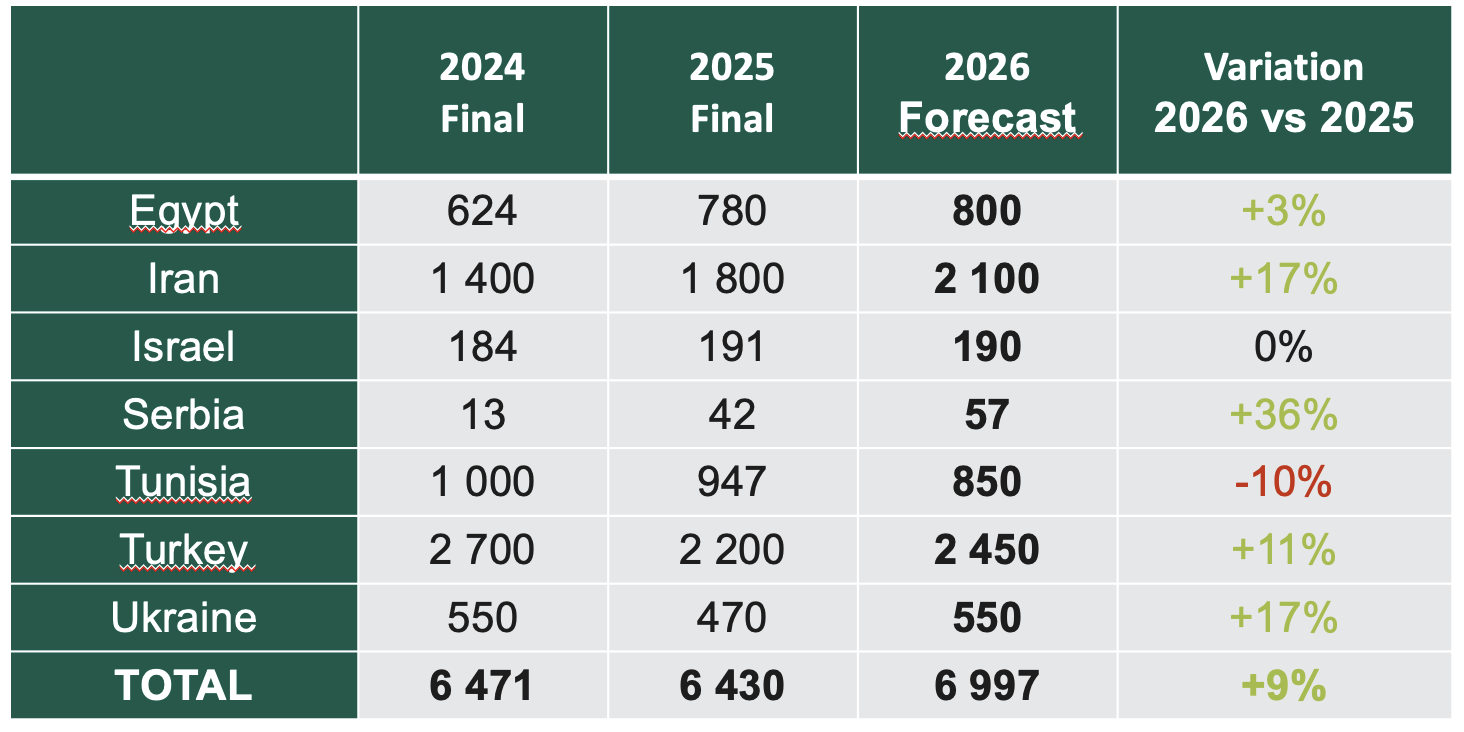
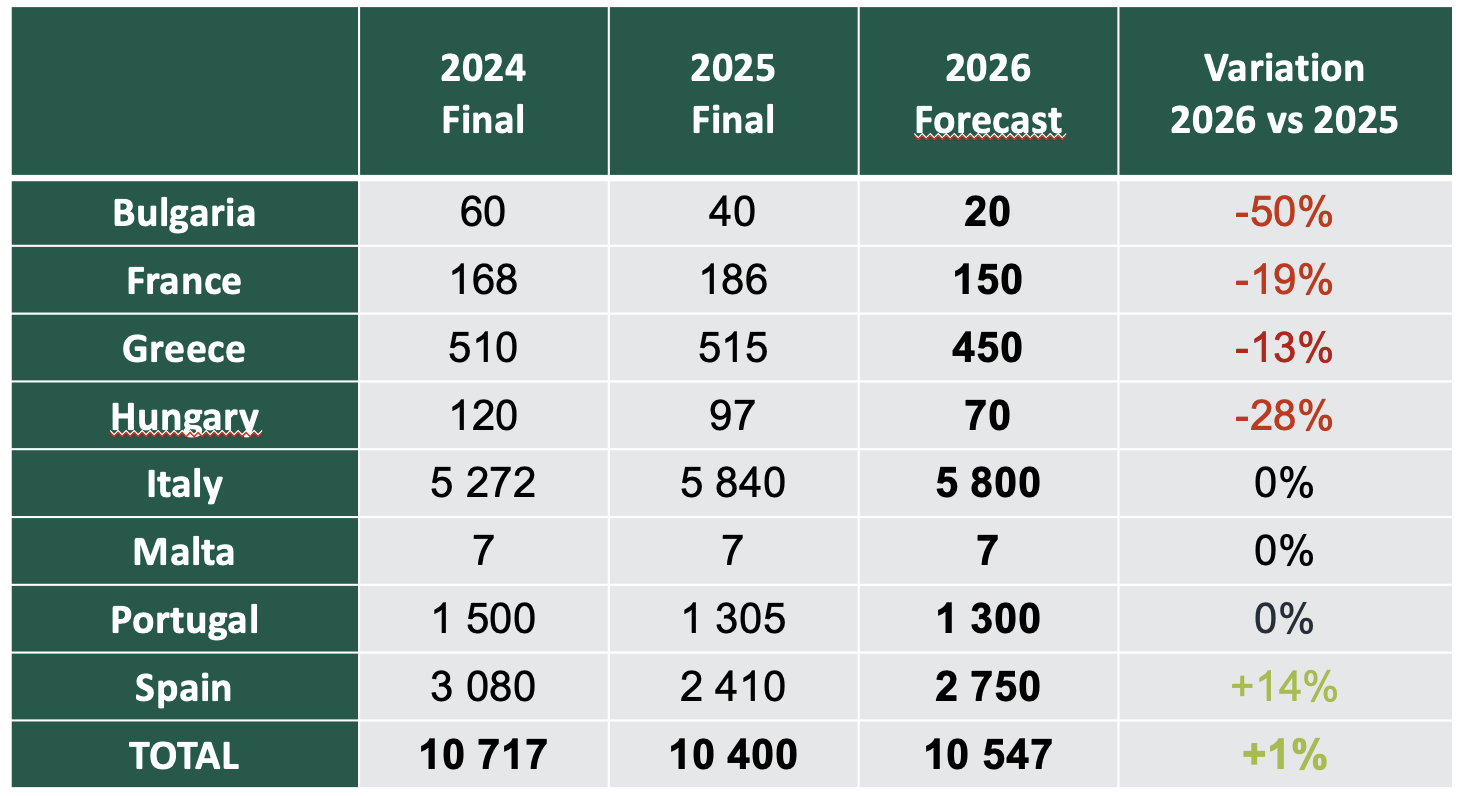
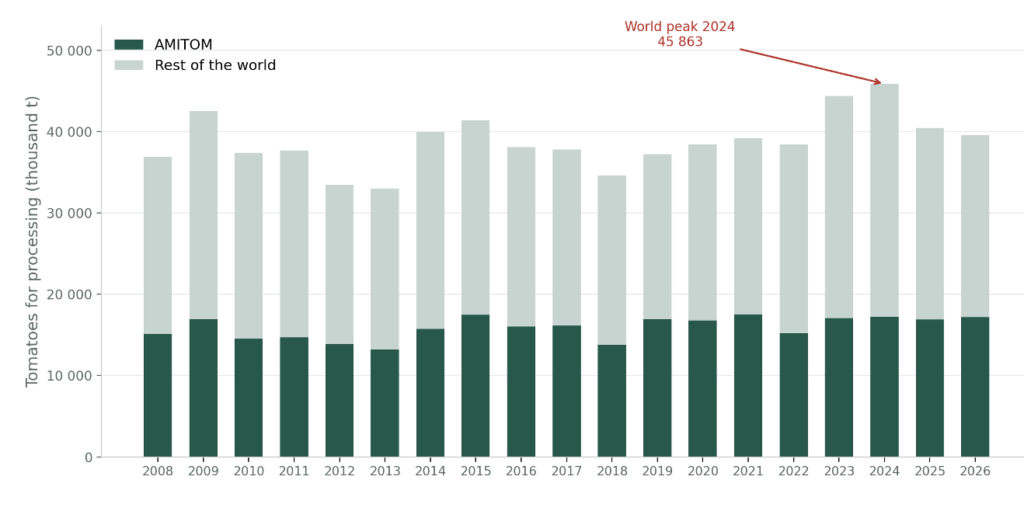
AMITOM remains the dominant region at world level with more than 40% of the total world production and with 5 countries in the top ten (Italy, Spain, Turkey, Iran and Portugal). The region’s output show a more stable production compared the world cycle, with an output remarkably stable year to year, varying only between 16 and 17 million tonnes, while world production is far more volatile. Notably, the 2024 world peak (45.9 million tonnes) was driven by non-AMITOM origins, notably China and California, but with different dynamics within members (Italy was with the lowest production output in 2024.
Currently, 3 AMITOM countries are in war situation (Ukraine, Israel, Iran) creating a high uncertainty. Also, increasing input cost for farmers and processors happened after Covid in 2020 and is reshaping the landscape of the industry also in this 2026 crop (fuel, fertilizers, agrochemicals in the fields and gas, electric energy, packaging and transport for processors) are impacting heavily the tomato industry in AMITOM countries. Climate change and water availability are the main challenges for most of the countries that in the last 5 year faced very different and opposite situation in many different countries.
EU policy & international trade agreements also have an effect, with the tightening of EU rules (ETS/CBAM carbon costs, PPWR packaging compliance, CAP reform, NGT framework) raising costs and reshaping competitiveness, while trade developments — the EU–Mercosur agreement and an unfavourable US tariff environment — open some markets but expose AMITOM producers to greater external competition.
North America
Aaron Giampietro from Morning Star presented production in North America which remains dominated by California. With about 9 million tonnes expected in 2026, the state represents 90% of the total volume processed in the USA and Canada, with 912,000 tonnes in the Midwest region and 62,000 tonnes in the Northeast region.
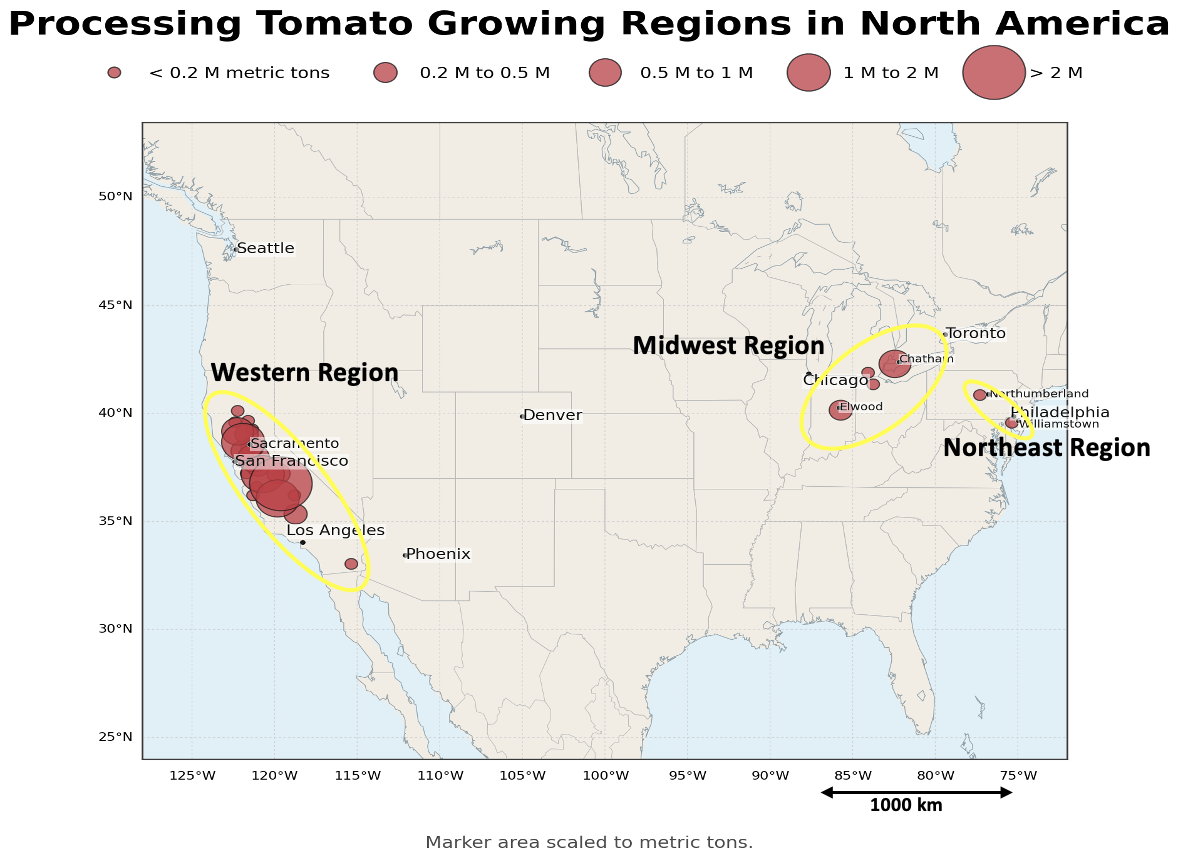
In the Northeast region, two main companies, Furmano Foods (Northumberland, PA) and Violet Foods (Williamstown, NJ) should process about 62,000 tonnes.
In the Midwest, Red Gold, Inc. (Elwood, IN) and Hirzel Canning Co. (Northwood, OH) should process 393,000 tonnes, while Highburry Canco (Leamington, ON), Sun-Brite Foods (Ruthven, ON) and Conagra Brands Canada (Dresden, ON) should together process the total of 519,000 tonnes for Ontario.
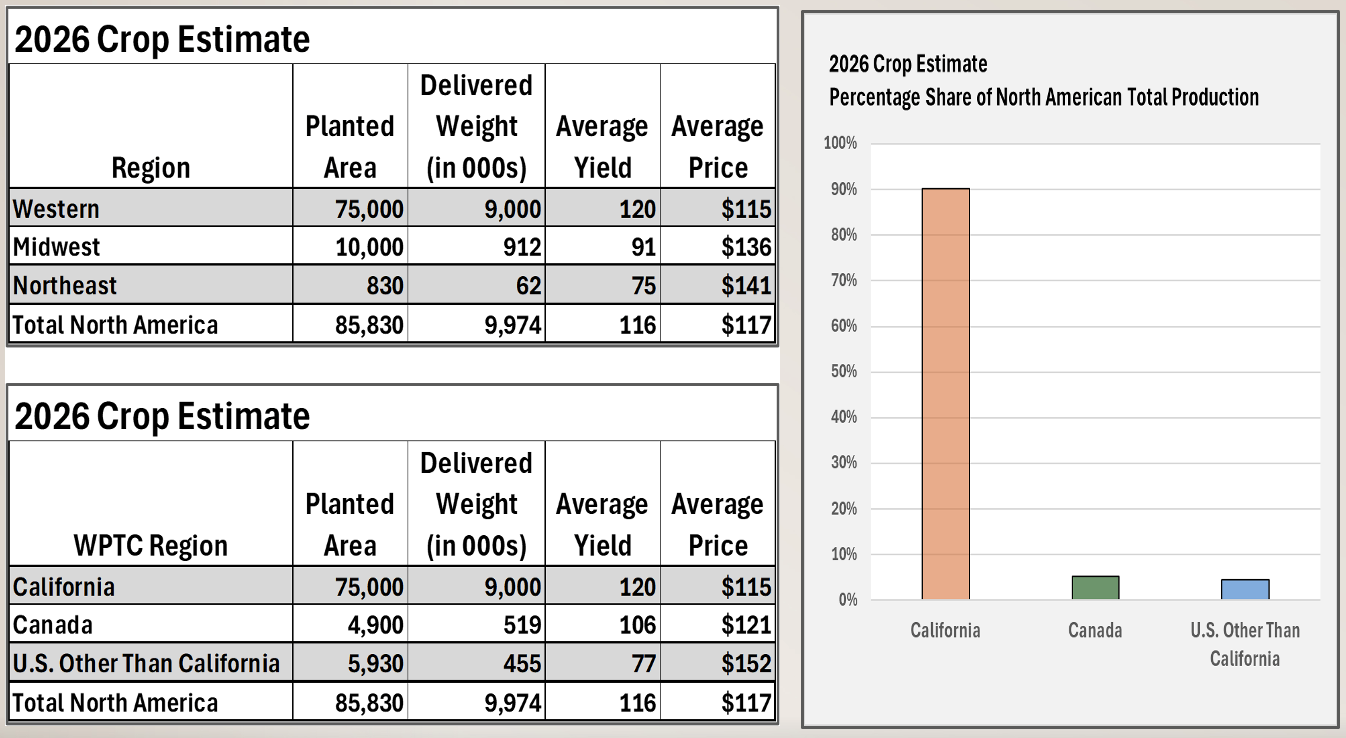
In California, the approximately 9 million tonnes estimate represents a 15% reduction compared wit the volume of over 10.5 million tonnes processed in 2025. While 2025 high production was largely a result of record yields, surfaces have been reduced in 2026. California’s forecasted production is based on an assumed average yield of 120 tonnes per Hectare. By historical standards, this is aggressive, however, 2025 performance shows it is definitively achievable.
Planting activities and crop development look to be on track. Although California has experienced some unseasonal weather, so far, any negative impacts are expected to be limited. California is expecting to begin some processing by the second week of July and the state is expected to be operating at full capacity by early August.
South America and Rest of the World
Manuel Gonçalves, WPTC Vice-President, presented production in eight countries in South America (Argentina, Brazil, Chile and Peru) and the rest of the world (Argentina, Japan, Nigeria and South Africa). These have altogether increased production over the last 10 years and represent 8-10% of the world production. However, if we look long term we notice a 28% increase until 2024 and strong (responsible) adjustment from 2024 to 2026, with volumes for 2026/27 flat-to-slightly-lower.
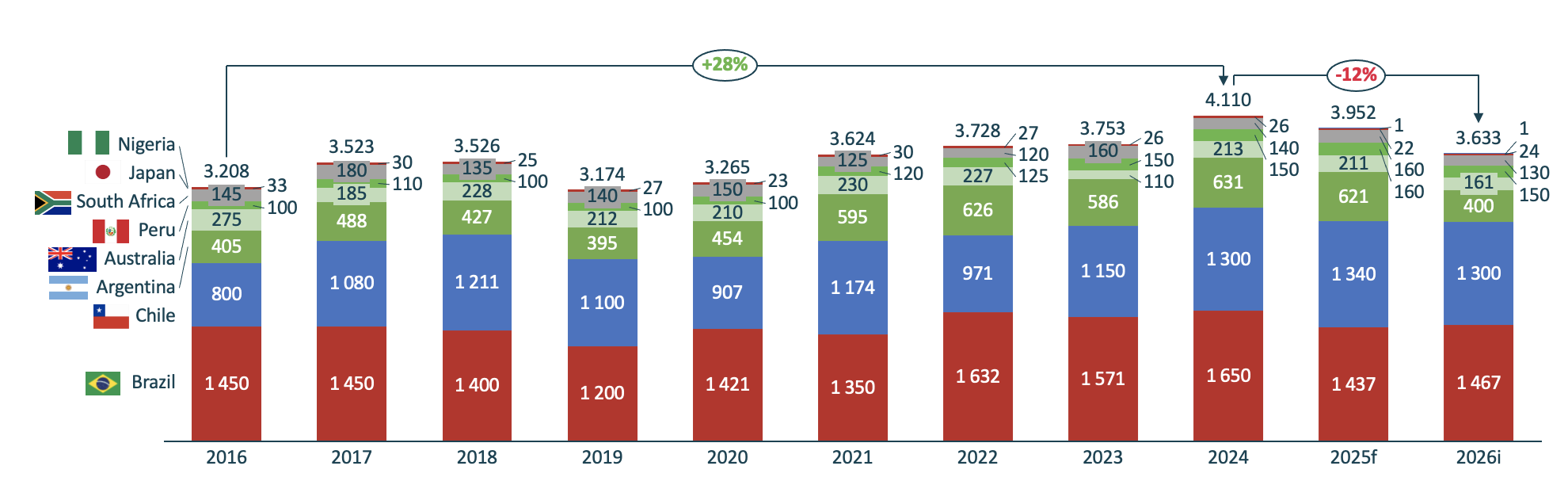
South America remains the dominant region, with Brazil (1.46 million tonnes expected in 2026), Chile (approximately 1.3 million tonnes processed in the season just finished) and Argentina (approximately 400.000 tonnes processed) accounting for the bulk of processed tomato volume, followed by Australia (161,000 tonnes), Peu (150,000 tonnes) and South Africa (130,000 tonnes expected), with a small production in Japan (24,000 tonnes expected) and in new WPTC member Nigeria (about one thousand tonnes).
Climate volatility (El Niño, drought, flooding, heatwaves) is the single most consistent risk across all countries, affecting yields, quality and planning certainty. Water availability is the critical variable to watch, with Australia, Chile and South Africa all flagging water as a top risk for the next season. Rising input costs — energy, packaging, fertilizer, transport — are squeezing margins at both farm and factory level everywhere, while on the markets, consumer behavior shifts (weight-loss trends in Brazil, social media-driven import preference in Australia, health-driven growth in Japan) are reshaping demand patterns in unexpected ways.
China
According to Zhu Chenhui from COFCO Tunhe who presented remotely from Beijing, the total volume expectation in China is currently about 5.85 million tonnes, but this figure may change with future weather conditions. This is 19% more than the 4.9 million tonnes processed in 2025, but nearly 80% less than in 2024 (10.45 million tonnes).
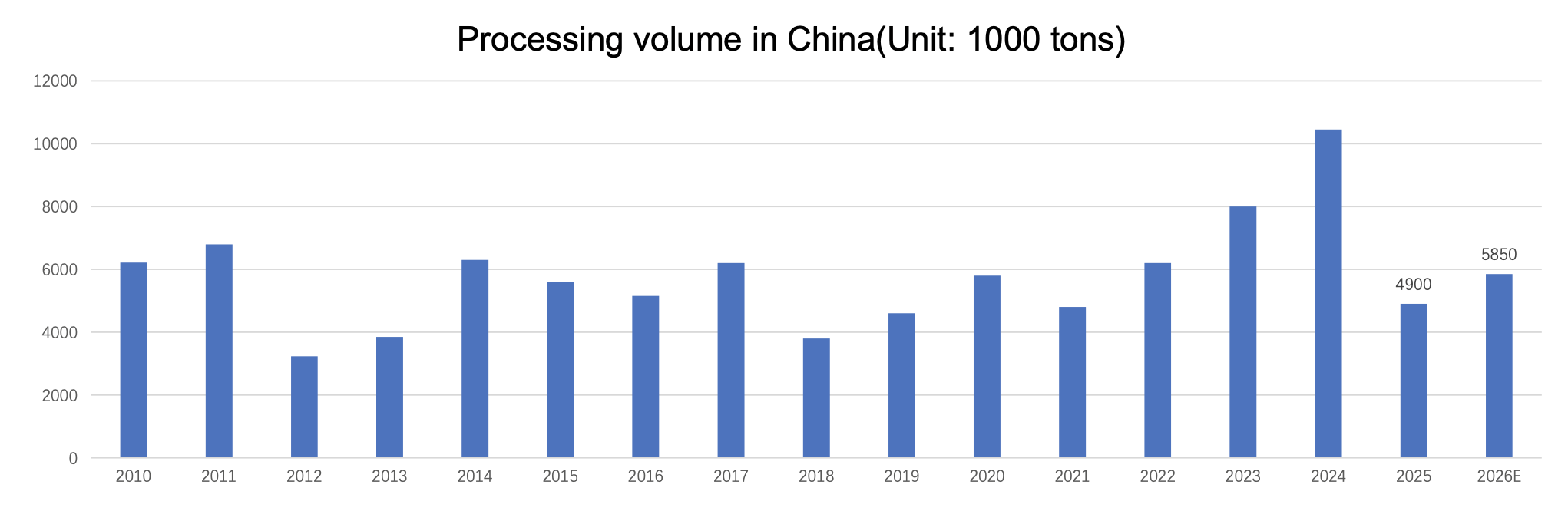
As of June 1, the transplanting work in China has been completed. The planting area in China is about 50 thousand hectares, an increase of 15% compared to 2025. Including 31.3 thousand hectares in Northern Xinjiang, 9.5 thousand hectares in Southern Xinjiang, 8.5 thousand hectares in Inner Mongolia, and 0.7 thousand hectares in Gansu-Ningxia.
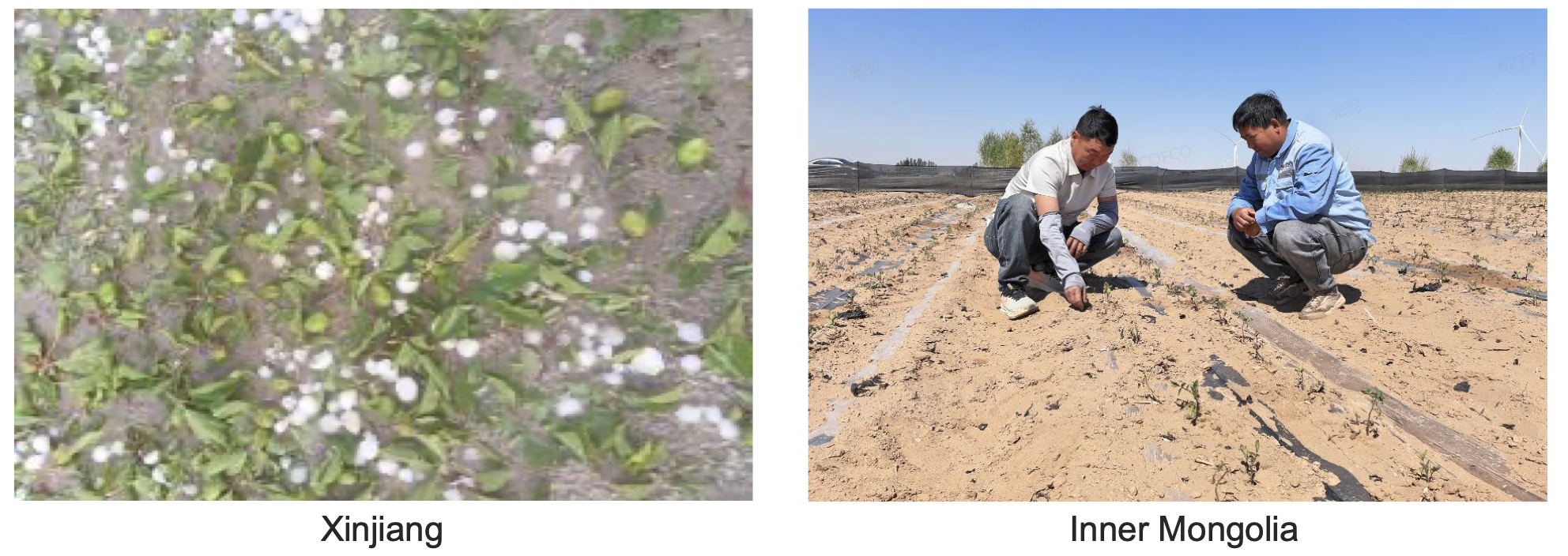
In late April and early May, parts of Xinjiang and Inner Mongolia were struck by hail and sandstorms, which impacted the early transplanting of tomato seedlings, but not significantly. According to the annual weather forecast, Growing chances of El Niño may result in extreme weather. Very high temperatures may negatively impact blossom and fruit set.
It is expected that 87 factories will be operating during the season, 5 more compared to 2025, equivalent to the 2022 level. The daily capacity is 225.000 tonnes, an increase of 20.000 tonnes compared to 2025, up by 10%.
The contract price of fresh in China is USD 70/MT, up by USD 3 per MT, a 5% increased compared with 2025. Other costs have increased by more than 10% compared with 2025. Ocean freight rose by 174% for the Persian Gulf route, 15% for the Mediterranean route. Pallets went up by 13%, aseptic bags by 5% and steel drums by 5%.
The consumption of processed tomatoes in China is estimated at 1.7 million tonnes fresh for 2026, about 28% of total production volume, more than 10% up compared to last year. According to data from Hongcan Big Data, the market size of the hot pot industry reached 639 billion yuan in 2025 and is expected to hit 670 billion yuan in 2026. The sour soup with tomato has emerged as a fast-growing segment in recent years. It reached 14.5 billion yuan in 2025, representing a year-on-year increase of 16%, and is projected to reach 16 billion yuan in 2026.
The market size of Western cuisine in China reached 328 billion yuan in 2025, a year-on-year increase of 10.3%. The total number of restaurants stood at 325,000, rising by 6.6% year on year.
WPTC world production estimate: FILE







Latest news
California: Weekly tonnage as of 17 October 2026
Heritable and Kagome Partner on AI-Driven Disease-Resistant Crops
Final results of the 2026 campaign in Northern Italy: yields among the lowest in recent years
Global Tomato Paste Trade in 2025/2026: slow emergence of secondary origins
Global Exports of Tomato Paste, Updated October 15, 2026