News
Steel prices could trend ‘much higher’
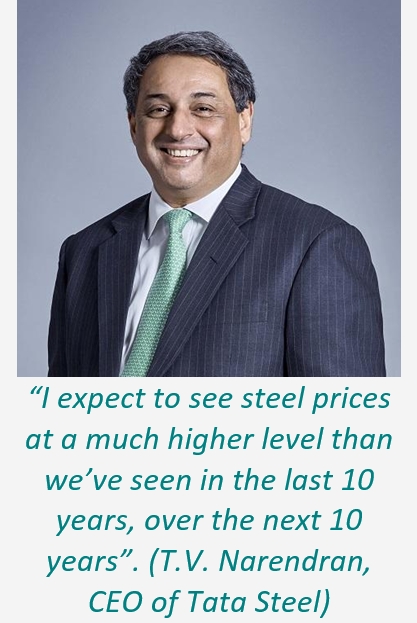
In an interview with the American television channel CNBC at the end of November, major Indian steelmaker T.V. Narendran said that steel prices could trend “much higher” compared to the last ten years.
 The steel market is going through several changes, including China’s evolving role in the market and costs rising, said Tata Steel’s CEO. In the last seven or eight years, the average price for hot-rolled coil steel was around USD 400 or USD 450 per ton. That figure is likely to be above USD 600 in the coming years, he added.
According to the Tata Steel CEO, the long-term average over the coming years is likely to be more than USD 600. Prices were USD 750 in China and USD 850 in Southeast Asia on 19 November, he said. “I expect it to be in that space and that range – fluctuating of course, but fluctuating at a higher level than we’ve seen in the past.”
Mr. Narendran explained that the steel market is going through several changes, including rising costs and China’s evolving role in the market. “The last ten years have been dominated by exports out of China. Now, there’s far more stability in world steel trade,” he said. At its peak, China exported more steel than India produced. China’s steel exports have since halved to around 60 million tons a year, and could fall further as the country pursues its net-zero carbon emissions goals, he added.
For “the first time in many years,” steel demand is not being driven by China, said Narendran. He noted that the World Steel Association expects growth in steel consumption this year to come from countries other than China. “With the Western world investing [in] infrastructure, that’s positive for demand as well.” At the end of November, U.S. President Joe Biden signed a more than USD 1 trillion bipartisan infrastructure bill into law.
On the supply side, input costs are at “historic, high levels” because of coal prices. Iron ore prices, however, have weakened and should trade within the USD 100 to USD 120 a ton range in the long term. Both coal and iron ore are raw materials used in steel production.
Steel prices may also be pushed up by the increasing carbon cost (EU’s benchmark carbon price, see related articles below) in Europe. “I expect to see steel prices at a much higher level than we’ve seen in the last ten years, over the next ten years,” Narendran said.
A slight drop in prices in Europe
In Europe however, EU HRC prices continued to slide on low buying activity. Domestic prices for hot-rolled coil in Northern Europe and Italy moved down further in the week to Friday December 10 due to lack of demand from spot buyers and reduced consumption from the automotive industry.
Fastmarkets (Metal Bulletin) agency calculated its daily steel HRC index, domestic, exw northern Europe at EUR 919.35 (USD 1,040.36) per tonne on Friday December 10, down by EUR 20.65 per tonne week on week and by EUR 102.87 per tonne month on month.
In the US, strong demand and persistent supply shortages have also led to a spike in U.S. steel prices this year to historically high levels, allowing U.S. steel companies to churn out record profits.
After plummeting to a pandemic-led low of roughly USD 440 per short ton in August 2020, the benchmark hot-rolled coil (“HRC”) prices witnessed a significant rally, breaking above the USD 1,900 per short ton level on the back of a mismatch between supply and demand.
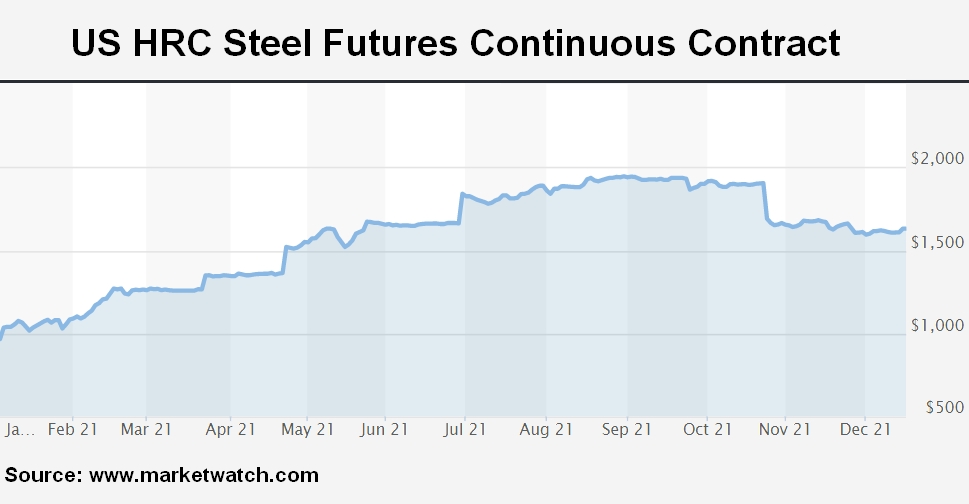
However, HRC prices have come under pressure since last month after peaking in September 2021, pulled down by a downturn in demand in the automotive sector resulting from production cuts by carmakers in the wake of the semiconductor shortage. However, prices remain elevated notwithstanding the recent declines, currently hovering near USD 1,800 per short ton.
Despite a slowdown in steel demand in the automotive space amid the ongoing chip crunch, healthy demand in other end markets including construction and supply disruptions due to mill outages and scheduled maintenance are likely to lend support to HRC prices through the balance of 2021.
France: manufacturers want to involve large-scale retailers
 In this worrying context of rising steel prices, the FIAC (French Federation of Canned Food Industries) published a press release at the end of September 2021 in which it explained why "the manufacturers of canned food, no longer able to cope with the inflation of the costs of their raw materials, are asking for an immediate reaction from retailers."
The FIAC stated that "the dramatic increase in the cost of steel, tinplate and aluminum comes in addition to the cost of agricultural raw materials, wood, cardboard, plastic, freight and energy. These metals cannot be substituted and are indispensable for the manufacturing of canned food […] and today, the exceptional economic situation is endangering the canning industry, for which packaging represents up to 50% of production costs.
• European steel prices are at an all-time high this year and are expected to be the highest of the 21st century. With inventories at their lowest and imports declining, the price […] of quality products rose by 47.1% between December 2020 and June 2021 (data provided by the INSEE (National Institute of Statistics and Economic Studies)).
• Tinplate, which is widely used by metal packaging manufacturers, will increase by 50 to 95% in 2022 (preliminary estimate of the variation in price for an annual contract, HARBOR data).
• The price of aluminum has risen by 24% on the London Metal Exchange since the beginning of the year.
The 120 companies of the FIAC cannot, on their own, absorb these tensions, which seem to be settling in for the long-term. All economic players – retailers first and foremost – must take their share of responsibility and commit to ensuring the future of the entire industry, so that French consumers can continue to access quality products prepared from agriculture and the fishing industry.
Christophe Bonduelle, President of the FIAC, said: "With their nearly 50,000 direct and indirect jobs, our SMEs (small and medium-sized enterprises) and intermediate-sized enterprises are essential links in the dynamics of our regions. They cannot absorb this unprecedented crisis alone: their ability to invest, innovate and pursue actions in favor of the ecological transition are at stake."
Sources: cnbc.com, metalbulletin.com, marketwatch.com, adepale.org