News
South Africa: demand exceeds processing capacities
South Africa: demand exceeds processing capacities
Regular increase in imports
South Africa is a net exporter of tomatoes (27 253 tonnes exported in 2015, of the 441 328 tonnes produced by the country) but fails to meet the local demand for tomato-based processed products, especially tomato paste – a gap that points to a lack of industrial capacity in the agro-processing sector. An increased demand for tomato paste makes South Africa a net importer of the product, although processors are making great strides to address the shortage.
 The Agricultural Research Council-Institute for Agricultural Engineering reported that in South Africa, only 10% of the local tomato crop is processed. Of this amount, 85% is destined for the tomato sauce market and 10% for frozen tomato products (WPTC figures report processed quantities amounted to 140 000 mT on average over past three years, and are expected to reach 160 000 mT in 2017, editor’s note).
Last year in May, Trade and Industry Minister Rob Davies launched a ZAR 100 million Dursots & All Joy tomato processing plant in Modjadjiskloof, Limpopo. While tomatoes are produced in all provinces, this region has the largest production area, with 3 590 hectares, accounting for more than 75% of the total area planted with tomatoes. A short while later, fast-moving consumer goods producer Famous Brands announced that it had acquired a state-of-the-art tomato paste manufacturing plant in the Eastern Cape, as the local industry was unable to supply the growing demand for the product.
The company said that between 30 000 and 35 000 tonnes of tomato paste are imported into South Africa annually. Famous Brands itself imported between 1 500 tonnes and 2 000 tonnes of tomato paste per year, which it used for sauce products for its restaurant network.
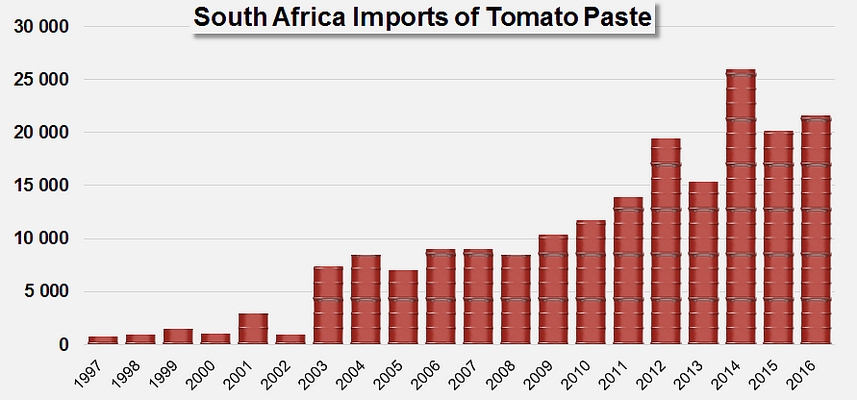
South-African imports of paste amounted to 21 600 mT in 2016, of which 74% came from China, 9% from Italy, 7% from the USA and 4% from Spain
In 2012, the Department of Trade and Industry raised the customs tariffs on imported tomato paste to 37% in a bid to protect the fledgling local tomato paste industry. Imports have nonetheless continued to increase, reaching close on 22 000 tonnes in 2016 (up by more than 5% against the average for 2013-2015).
A senior agricultural economist of the Department of Agriculture recently said that small-scale farmers could benefit from the shortage of tomato paste by increasing their production capacity, as there was a guaranteed market. However, most factories would need farmers to sign elusive forward contracts for the supply of tomatoes to the processing plants.
At the launch of the Dursots & All Joy plant, Davies described the facility as a good example of the industrialisation objectives of building manufacturing capacity aimed at creating employment, and supporting small, medium-and micro-sized enterprises.
In 2015, Dursots Food Corporation, the controlling shareholder of AH-Vest, acquired a tomato processing factory in Duiwelskloof, Limpopo, with the objective of satisfying the shortage in tomato paste.
Even then, it might still be some time before South Africa can meet all of the demand for what appears a standard product.