News
Research: Life Cycle Assessment of tomato products packaging
A study carried out at the University of Salerno in South Italy and published in April 2025 in the scientific journal Sustainability highlighted that the packaging phase of tomato products is the primary source of environmental burdens, accounting for more than 66% and 56.7% of CO2eq emissions in peeled tomato and tomato puree production, respectively. Glass bottles and tinplate cans are the main contributors across all environmental impact categories.
Through the utilization of Life Cycle Assessment (LCA) to determine the environmental footprint of the tomato processing industry, crucial insights into the hidden environmental costs associated with various stages of production can be obtained, from the cultivation of tomatoes to the processing, packaging, distribution, and waste management stages. This knowledge empowers stakeholders to identify inefficiencies, target hotspots, and individuate and implement effective strategies for reducing the industry’s overall environmental footprint.
Numerous LCA studies have revealed that the packaging phase of the tomato processing industry carries the highest environmental impact for puree in glass bottles, diced tomato, peeled tomato, tomato paste, and sauce in tinplate cans and steel drums and ketchup in polypropylene bottles. This significant environmental impact stems from multiple factors, including the extraction of raw materials, manufacturing processes, and transportation of packaging materials, all of which contribute to greenhouse gas emissions. This exacerbates concerns related to climate change and resource depletion.
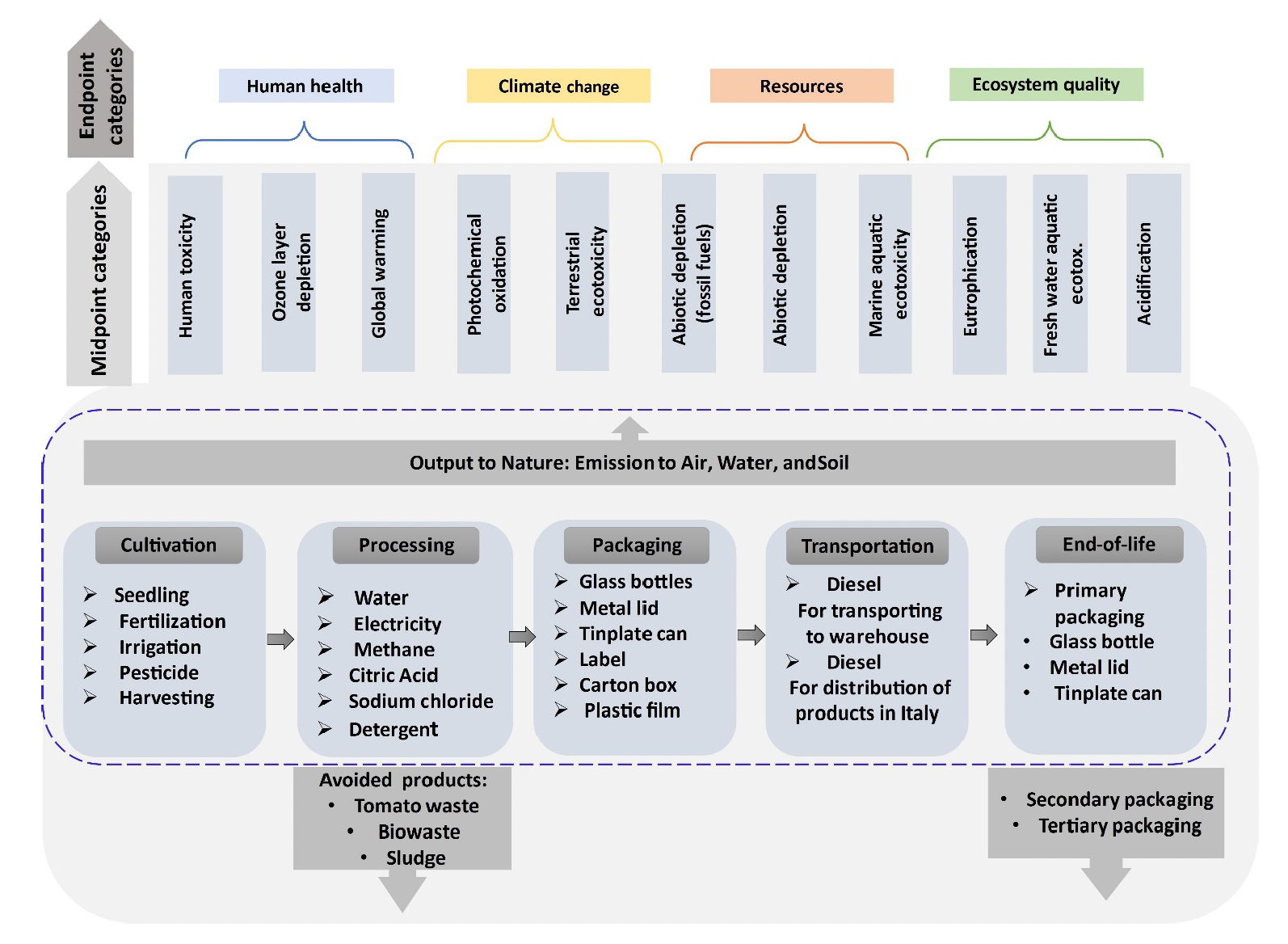
Figure 1: The blue dashed line shows the system boundaries of the case study of the tomato prcessing industry (copyright: study authors)
To bridge the gap regarding the packaging phase, this article presents a real case study conducted on a tomato processing company situated in southern Italy. The primary objective of this research was twofold: to evaluate the LCA of the tomato processing industry to evaluate the environmental impact in different stages to define the hotspots and then to explore potential improvement scenarios within the packaging phase by sensitivity analysis. To explore potential improvements, various development scenarios were evaluated, focusing on packaging material type and appropriateness for recycling.
The results demonstrated that current end-of-life (EoL) practices for glass and metal packaging in Italy could reduce global warming potential (GWP) by 48% and 46% in the packaging phase, respectively. Carton-based and pouch packaging for tomato puree exhibited the potential to decrease global warming impacts by 37% and 32%, respectively, considering the current recycling of glass packaging in Italy.
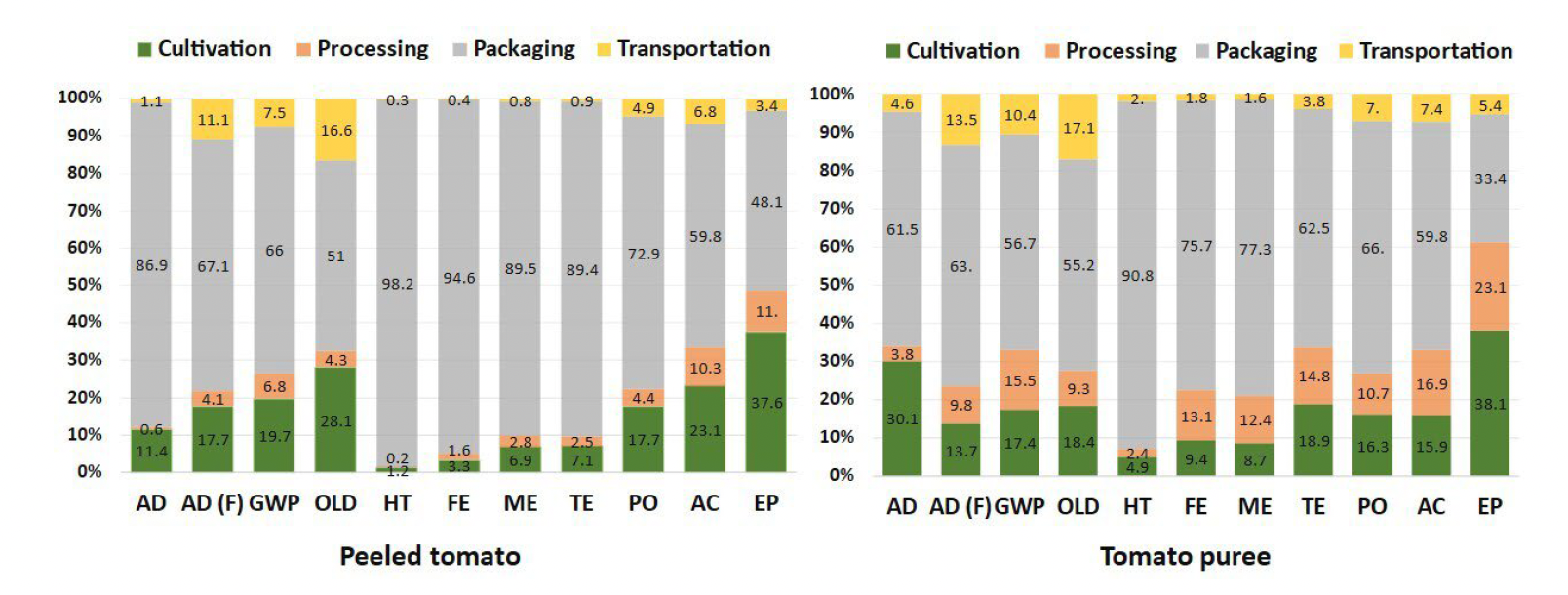
Figure 2. Environmental impact contributions at the midpoint level for a can of peeled tomato (400 g) and bottle of tomato puree (500 g)
Midpoint impact categories: Abiotic Depletion (AD), Abiotic Depletion-Fossil Fuels (AD-FF), Global Warming Potential (GWP100a), Ozone Layer Depletion (OLD), Human Toxicity (HT), Freshwater Aquatic Ecotoxicity (FE), Marine Aquatic Ecotoxicity (ME), Terrestrial Ecotoxicity (TE), Photochemical Oxidation (PO), Acidification (AC), and Eutrophication (EP) [32]. Furthermore, in this study, the IMPACT 2002+ method was employed to classify the environmental impacts of peeled tomato and tomato puree on climate change (CC), human health (HH), resources (R), and ecosystem quality (EQ) at the endpoint level (copyright: study authors)
Midpoint impact categories: Abiotic Depletion (AD), Abiotic Depletion-Fossil Fuels (AD-FF), Global Warming Potential (GWP100a), Ozone Layer Depletion (OLD), Human Toxicity (HT), Freshwater Aquatic Ecotoxicity (FE), Marine Aquatic Ecotoxicity (ME), Terrestrial Ecotoxicity (TE), Photochemical Oxidation (PO), Acidification (AC), and Eutrophication (EP) [32]. Furthermore, in this study, the IMPACT 2002+ method was employed to classify the environmental impacts of peeled tomato and tomato puree on climate change (CC), human health (HH), resources (R), and ecosystem quality (EQ) at the endpoint level (copyright: study authors)
However, considering consumer preferences and the potential for glass packaging to be produced more sustainably, it can serve as an environmentally friendly option. This underscores the crucial role of innovations in glass packaging production in reducing its environmental impact, reinforcing its position as a preferable choice. For peeled tomatoes, considering the EoL of tinplate and glass jars, the latter packaging, leading to a reduction of 34% of GWP, emerged as the preferable option. However, it is crucial to acknowledge that changing packaging materials may pose challenges, requiring alterations in production lines, especially packaging machines, with associated costs. In line with SDG 13 (Climate Action), 100% recycling of packaging materials is a promising strategy, preventing disposal and reducing resource consumption, both in materials and energy. However, to select the most sustainable solution, a thorough assessment by Design for the Environment (DfE), Life Cycle Assessment (LCA), and Life Cycle Cost (LCC) for economic evaluation as well as consumer preference should be taken into the consideration. The new solution must be proven more suitable than the existing ones from environmental, social, and economic perspectives.
Thes study concluded that further work should encompass all three pillars, namely sustainability, economy, and society, to understand the interconnections and impacts across various domains in selecting alternative solutions to reduce the environmental footprint of the food industry. Through such a holistic perspective, researchers can develop strategies that promote sustainable development, addressing the complex challenges and opportunities that arise at the nexus of these interconnected systems.
Reference: Eslami, E.; Carpentieri, S.; Pataro, G.; Ferrari, G. Comparative Life Cycle Assessment (LCA) of Packaging Materials for Tomato-Based Products to Pave the Way for Increasing Tomato Processing Industry Sustainability. Sustainability 2025, 17, 3648.
Full text: https://doi.org/10.3390/su17083648