News
Processed Tomato Products in Germany: Domestic Market Structure and Consumer Trends
Analysis of the German domestic market, Euromonitor data
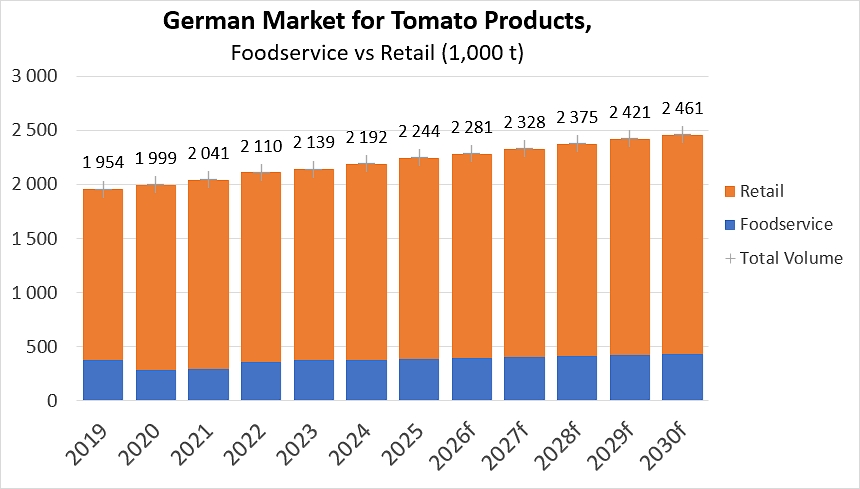
An analysis of Euromonitor data from 2019 to 2030 reveals the structural dominance of home consumption in the German market for processed tomato products. In 2025, retail sales accounted for 82.7% of total volumes (1.857 million metric tonnes), relegating foodservice to 17.3% (387,000 metric tonnes). This imbalance temporarily widened during the 2020–2021 health crisis, when foodservice collapsed by more than 25% before returning to pre-crisis levels in 2024. Over the 2019–2025 period, total demand grew at an annual rate of 2.33%, reaching 2.24 million metric tonnes.
Category Trends and Market Dynamics
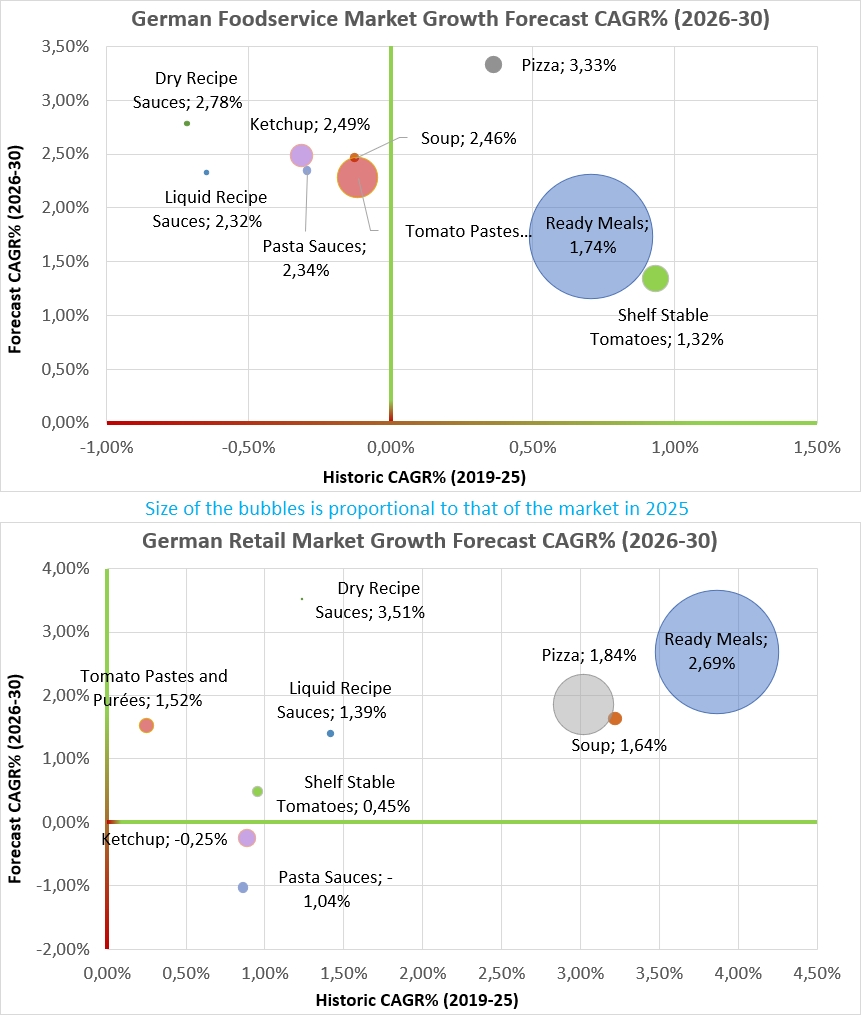
Total growth has been overwhelmingly driven by processed and ready-to-eat products. Ready Meals represent the primary market driver, with retail sales surging from 678,000 metric tonnes in 2019 to 851,000 metric tonnes in 2025 (a compound annual growth rate of +3.86%). Similarly, the retail pizza segment expanded at a steady +3.03% per year, reaching 421,000 metric tonnes in 2025.
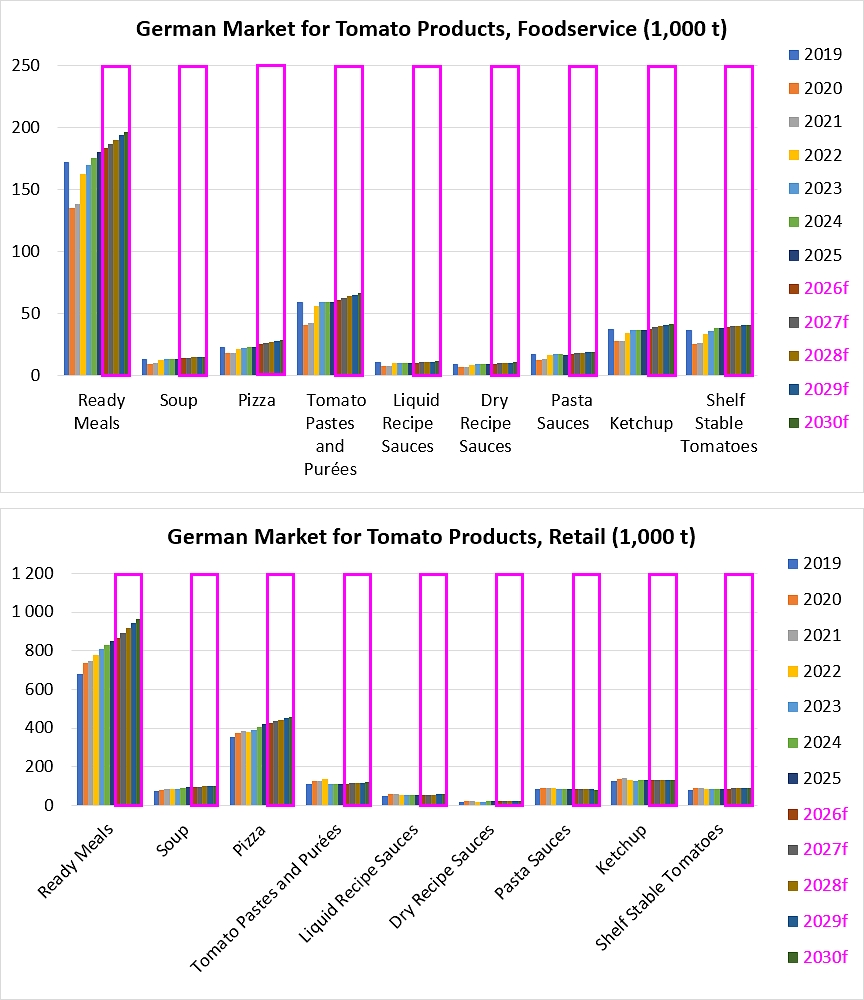
Conversely, less complex culinary ingredients followed a more moderate trajectory: retail tomato pastes and purées, after peaking at 136,000 metric tonnes during lockdowns in 2022, stabilized at 111,000 metric tonnes. Canned tomatoes grew steadily but modestly, reaching 87,000 metric tonnes in retail and 39,000 metric tonnes in foodservice by 2025. Finally, store-bought traditional pasta sauces and ketchup showed signs of long-term deceleration, with slightly negative projected growth rates (CAGR) between 2026 and 2030 (-1.04% for pasta sauces and -0.25% for ketchup), as consumers shift toward fully prepared meals.
Outlook Through 2030
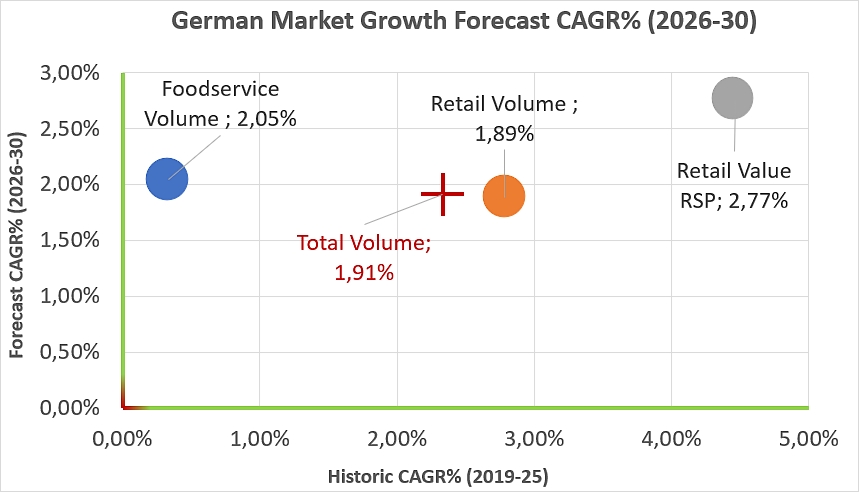
According to Euromonitor data, total consumption of processed tomato products in Germany is expected to reach approximately 2.46 million metric tonnes by 2030, supported by an overall volume growth of +1.91% CAGR per year. This period is expected to be marked by a reversal in distribution dynamics: growth in the foodservice sector (+2.05% per year) could now outpace that of retail (+1.89% per year). The recovery in the foodservice sector will be primarily driven by fast food and pizza delivery (+3.33% per year), along with increased demand for dry recipe sauces (+2.78% per year), soups (+2.46% per year), and ketchup (+2.49% per year) (see additional details at the end of the article).
Estimated Per Capita Consumption in 2025
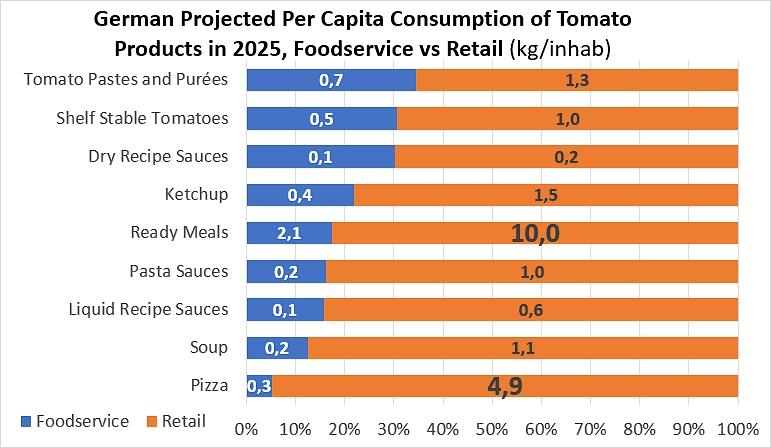
In 2025, German per capita consumption of processed tomato products is estimated at approximately 26.4 kg per inhabitant, illustrating a clear preference for retail purchases over volumes consumed in foodservice channels.
Volume breakdown highlights a market driven by convenience and value-added products. Ready meals are the country’s single largest consumption category at 12.1 kg per capita overall, heavily dominated by retail sales (10.0 kg/inhabitant vs. 2.1 kg/inhabitant in foodservice). Pizzas represent the second major pillar of demand at 5.2 kg per capita overall, displaying one of the sharpest channel imbalances: 4.9 kg/inhabitant are purchased in retail stores (frozen and fresh), compared to just 0.3 kg/inhabitant in foodservice.
Less complex culinary ingredients hold a more modest share of the average consumer basket. Tomato pastes and purées reach 2.0 kg per capita (1.3 kg/inhabitant in retail and 0.7 kg/inhabitant in foodservice, the latter making it the primary basic product category used in commercial catering). Canned tomatoes (peeled or crushed) total 1.5 kg per inhabitant.
Finally, condiments and seasonings round out overall consumption: ketchup stands at 1.9 kg per inhabitant, soups at 1.3 kg/inhabitant, and pasta sauces at 1.2 kg/inhabitant. Taken together, these metrics confirm a German consumer profile heavily oriented toward ready-to-heat or ready-to-eat everyday items.
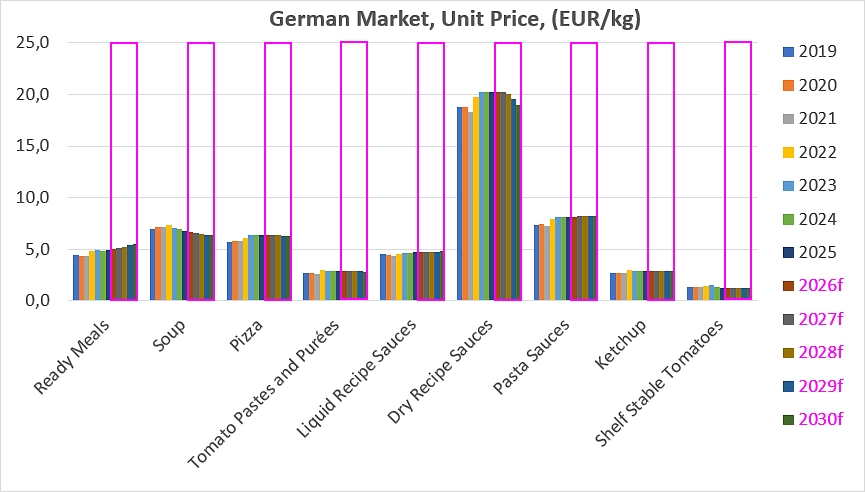
Between 2019 and 2025, the average retail price of processed tomato products in Germany increased from EUR 4.8 to EUR 5.2 per kg (+1.63%/year), driven by a strong surge in inflation during 2022–2023. Prices vary significantly depending on the level of processing, ranging from basic ingredients like canned tomatoes (EUR 1.2/kg) and pastes (EUR 2.9/kg) to high-value-added products like pasta sauces (EUR 8.2/kg) and dry recipe sauces (EUR 20.3/kg).
Through 2030, prices projected by Euromonitor are expected to stabilize markedly (+0.86%/year CAGR). With the exception of ready meals, which will continue to rise (+2.18%/year), most categories (canned tomatoes, pastes, ketchup, pizzas) are expected to experience price stabilization or even slight declines.
Some complementary data
Source: Euromonitor