News
OI Pomodoro Nord Italy: Policy Tools for Climate Resilience
OI Pomodoro da Industria Nord Italia organized the inaugural conference of Tomato World, “The challenges of climate change: what tools for industrial tomatoes,” which was held this morning at Piacenza Expo.
During the conference, introduced by greetings from the mayor of Piacenza, Katia Tarasconi, Giuseppe Cavalli, President of Piacenza Expo, and a video message from Francesco Lollobrigida, Minister of Agriculture, Food Sovereignty, and Forestry, the challenges facing the industrial tomato supply chain in the coming years were discussed, starting with the difficulties generated by climate change.
In his opening speech, Giuseppe Romanini, President of OI Pomodoro da Industria Nord Italia (Northern Italy Industrial Tomato Organization), reiterated how the tomato supply chain in Northern Italy has demonstrated its capacity for organization, innovation, and responsibility over the years, while emphasizing the need for this commitment to be accompanied by consistent policies and adequate operational tools.
“We send a clear message to politicians and institutions: industrial tomatoes are not just an agricultural product, but an organized system of primary production and industrial processing that is strongly connected to the local area and requires regulatory stability, investment in water infrastructure, support for innovation, means of plant protection, more effective insurance and mutual aid tools, and real enhancement of supply chain organizations. Climate change is not a variable we can simply endure; it is a condition we must learn to live with, strengthening the resilience of the system. But resilience cannot be built alone: it requires an alliance between businesses, research, and institutions.“
Maria Chiara Cavallo, Secretary of OI Pomodoro da Industria Nord Italia, presented an analysis of weather trends recorded in recent years in Northern Italy and their effects on tomato production in the area, with a look to the future.
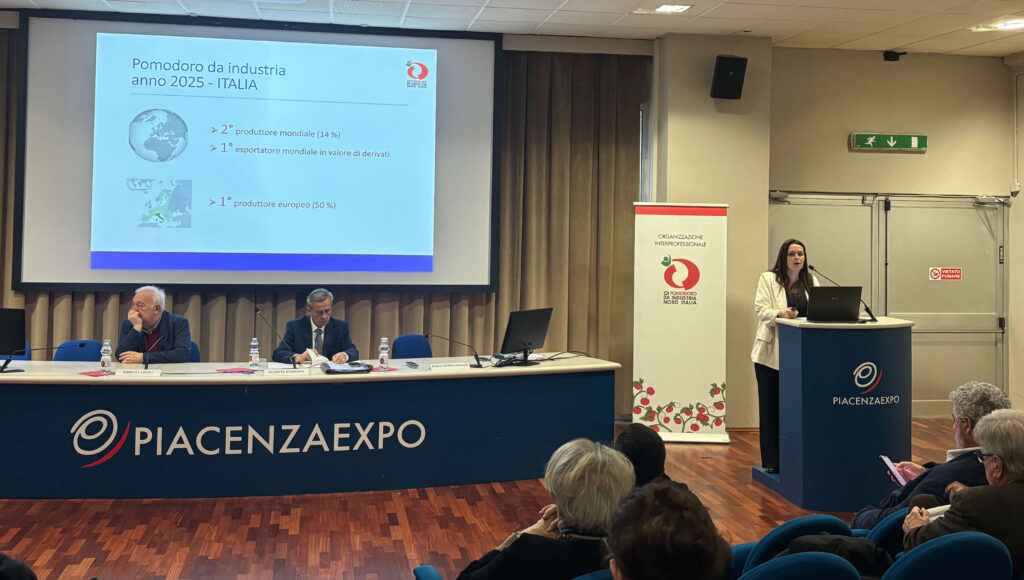
Climate change manifests itself in the alternation between years of drought and years of excessive rainfall, extreme events, and a general increase in average temperatures. These phenomena have a direct impact on the supply chain, creating difficulties in quantitative planning, transplant planning, and harvest management, with obvious effects on quality and yields, and therefore on the competitiveness of the sector.
Arpae’s climate projections for the period 2021-2050 also indicate a net decrease in annual rainfall and an increase in average, maximum, and minimum temperatures of approximately 2.5 °C, an extension of the maximum period without rainfall from 21 to 30 days, an increase in the duration of heat waves from 2 to 7 days, and an increase in tropical nights from 11 to 29 per year. To address this scenario, a high level of organization, planning, and coordination is required throughout the entire supply chain, with the appropriate tools available.
Gabriele Canali, Scientific Advisor to OI Pomodoro da Industria Nord Italia and Professor at the Catholic University of the Sacred Heart in Piacenza, highlighted the problems facing the supply chain from an agricultural and industrial perspective and strategies for mitigating and adapting to climate change. Among the priorities highlighted were the optimization of water use, energy resources, and means of production. In addition: the importance of maintaining and strengthening the current CMO fruit and vegetable system, which has yielded excellent results so far; strengthening cooperation between businesses, institutions, and research, including in a territorial context; operating in a truly sustainable manner, avoiding greenwashing. Finally, investing in technology and knowledge at the level of individual companies, the production system, and the country.
Francesca Mantelli, President of the Parma Land Reclamation Consortium, and Luigi Bisi, President of the Piacenza Land Reclamation Consortium, recalled how in recent years the two organizations have been committed to upgrading the region’s infrastructure through PNRR funds, while highlighting the need for new infrastructure—such as the Vetto Dam between Parma and Reggio Emilia – and resources for their maintenance so that the Land Reclamation Consortia can guarantee water – including through greater withdrawal from surface water bodies – to an area suited to agri-food production.
The Head of the Plant Sector – General Directorate of Agriculture of the Emilia-Romagna Region, Nicola Benatti, pointed out that the industrial tomato supply chain in Northern Italy has achieved the highest level of organization, with almost all producers belonging to producer organizations (POs) and the latter associated with processing companies in the inter-branch organization (IO). He then focused on the funding that reaches the supply chain through the fruit and vegetable sector intervention and its operational plans, and on the four pillars of rural development: technology (investment in plant and machinery), environment (adoption of eco-sustainable practices), innovation (research and experimentation), and support (technical assistance to farmers).
Nicola Lasorsa, Head of ISMEA, Risk Management Tools Department, spoke about risk management tools – which in the agricultural sector are supported by around half of public contributions – presenting the situation and trends in the uptake of insurance tools by industrial tomato producers. The sector has particularly high levels of insurance coverage: in the northern district, almost all farms and cultivated areas are protected. Overall, industrial tomatoes are among the most protected sectors, ranking third after wine grapes and rice.
Alessio Mammi, Emilia-Romagna Regional Councilor for Agriculture and Member of the European Committee of the Regions, pointed out how the effects of climate change have characterized recent years, along with geopolitical tensions and an economic situation that affects consumption and confidence. “In this scenario, two fundamental conditions emerge for weathering the ‘storm’. The first is unity within the supply chain. Working together in a coordinated manner and with a shared vision is the necessary path to managing crises and instability. The institutions and the Region confirm their commitment to the sector, with a constant commitment to accompaniment and support. The second condition is the development of a clear and structured strategy capable of supporting not only this supply chain but the entire agri-food system. There must be three objectives: to continue production, focusing on quality and income generation; to support businesses in their innovation processes; and to strengthen competitiveness in an increasingly complex global context. Investment is therefore essential: to reduce management costs, implement technological innovations, combat the effects of climate change, and improve the overall efficiency of the system.“
In his closing remarks, Stefano Bonaccini, Member of the European Parliament’s Committee on Agriculture and rapporteur for the same committee on the EU budget for 2028-2034, stated: “The climate is no longer an abstract scenario, but a concrete and increasingly unstable factor. In recent years, we have witnessed prolonged droughts, sudden floods, heat stress, and new plant diseases that reduce tomato yields and quality, affecting planning. In this context, resilience must become a structural condition of the system. For the industrial tomato supply chain, this translates into three operational guidelines: the development of modern water infrastructure and efficient water management and reuse systems; more accessible, flexible, and timely insurance instruments and mutual funds; and the strengthening of planning and collaboration between all actors in the supply chain.“
As rapporteur on the EU budget for 2028-2034, he supported the importance of a CAP with adequate financial resources, with the regions continuing to manage the funds; the need for reciprocity between the social and environmental sustainability standards of European production and those of non-EU production. Finally, he recalled the recent approval of the European Regulation against unfair cross-border commercial practices.
Source: Press Office OI Pomodoro da Industria Nord Italia, Veronica Fumarola
Related Companies








Latest news
Tomato Products Wellness Council Redefines Quality
California: Weekly tonnage as of 17 October 2026
Heritable and Kagome Partner on AI-Driven Disease-Resistant Crops
Final results of the 2026 campaign in Northern Italy: yields among the lowest in recent years
Global Tomato Paste Trade in 2025/2026: slow emergence of secondary origins