News
Italy’s processing tomato industry: the value of the interbranch organization
2023 Season
By Tiberio Rabboni, June 15, 2023
In an editorial published in Terra e Vita n°19/2023, Tiberio Rabboni, President of the Pomodoro Da Industria Nord Italia, northern Italy's interbranch organization for the tomato processing industry, explains why the IO is so important for the entire "red gold" sector.
In an editorial published in Terra e Vita n°19/2023, Tiberio Rabboni, President of the Pomodoro Da Industria Nord Italia, northern Italy's interbranch organization for the tomato processing industry, explains why the IO is so important for the entire "red gold" sector.
How does the interbranch organization add value to the competitiveness of the processing tomato sector in northern Italy, particularly in problematic times like the ones we are currently going through?
The question is a relevant one. To begin with, we must clear up a misunderstanding into which the more superficial observers are likely to fall: interbranch organizations are not a context for partners to reach an agreement on framework contracts, prices and the marketing of raw materials and processed products. That is against the rules. Articles 158 and 210 of European Regulation 1308/2013 clearly state this in order to protect competition on the EU market.
 So, what is the purpose of an interbranch organization?
To find out, all you have to do is read the articles in the above-mentioned regulations. Here, however, we don't want to deal with interbranch organizations in general. We are focusing specifically on northern Italy's IO, which was set up by the POs and processors, now 100% represented within the Pomodoro Nord Italia IO, for one essential purpose: to ensure fairness, transparency and equal opportunity in contractual and commercial relations between industry players. How does that work? Firstly, by entrusting the IO with the task of ensuring compliance with the "shared rules" signed by all members when they joined, and secondly, by assisting and monitoring, on behalf of the signatories, the correct and uniform execution of the annual inter-regional framework contract.
The common rules state that for members, the contractual system is normally based on individual supply contracts in line with the content set out in the territory's framework contract. But that's not all: they set the parameters for assessing raw material quality, payment conditions, criteria for assessing the conformity and suitability of supply contracts, controls, penalties, and measures to support production planning.
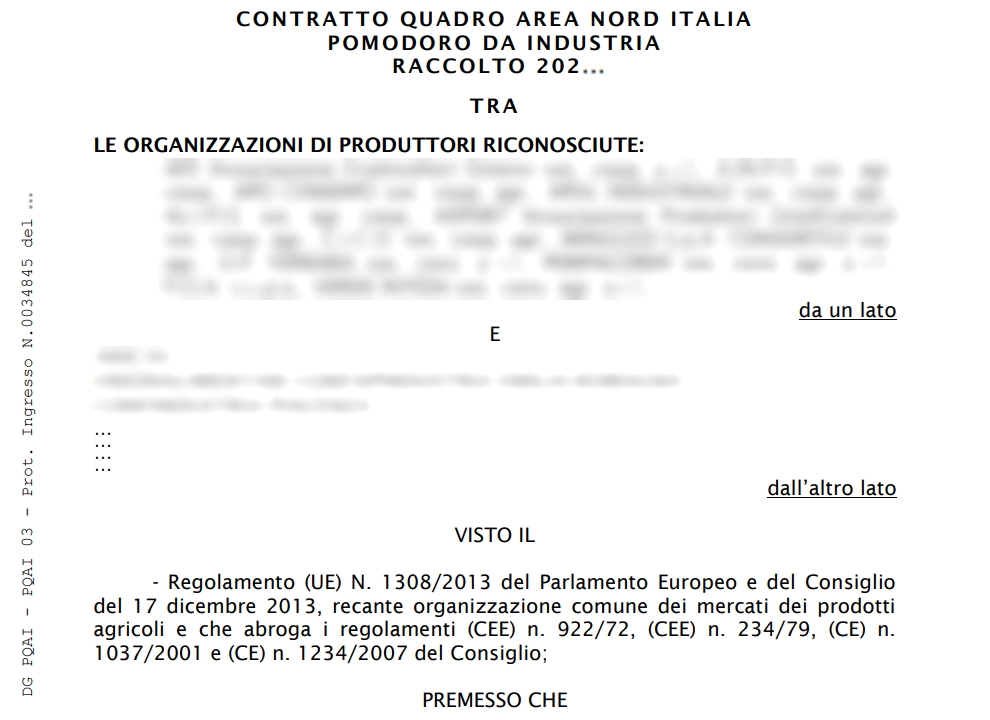
As for the framework contract, it transposes these shared rules and delegates to the IO, as a third party between the signatories, the responsibilities of supervising, controlling and implementing its content. These activities include checking that individual contracts comply with the framework contract, authenticating the surface areas actually planted, analyzing plantings with projected delivery times, publishing weekly reports on deliveries, managing surprise checks, training members of the joint quality-control committees, providing internal arbitration, verifying the regularity of payments from companies to Producers' Organizations and from the latter to member growers, verifying adequate guarantees for the repayment of arrears, analyzing finished products, assessing varietal choices and raw material costs, and producing various final reports.
Anyone can understand that a system regulated in this way guarantees all participants the certainty of opportunities and competitive advantages that others can only wish for or imagine, and that in our country interbranch organizations and framework contracts should undoubtedly be further supported and strengthened.
Some complementary data
 Regulation (EU) N°1308/2013 of the European Parliament and Council of December 17, 2013, establishing a common organization of the markets in agricultural products and repealing Council Regulations (EEC) N°922/72, (EEC) N°234/79, (EC) N°1037/2001 and (EC) N°1234/2007
In force: This act has been changed. Current consolidated version: 01/01/2023
Sources: terraevita.edagricole.it, eur-lex.europa.eu