News
Italy: the rebound of tomato products exports in 2023/2024
In recent years, the unit value of products sold cross-border has risen much faster than the tonnages involved. Despite contrasting results in terms of quantity according to product type, Italian export sales of tomato products saw a further upturn in 2023/2024.
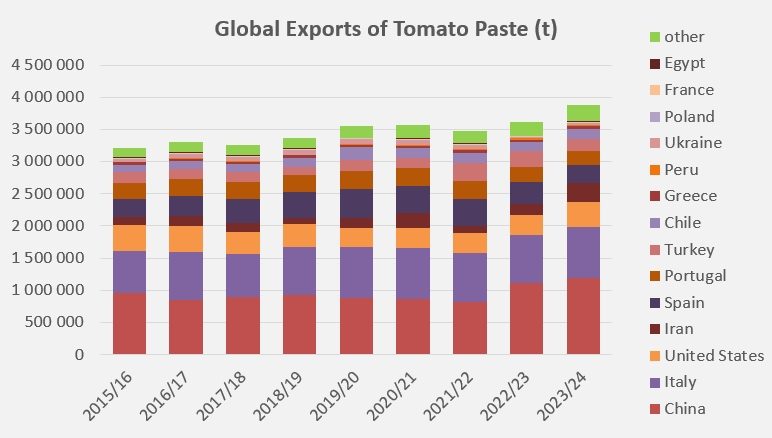
For the 2023/2024 marketing year, Italy ranked second among world exporters of tomato pastes (HS codes 200290) with a total (all categories combined) of 791,500 t, behind China (1.198 million t) and ahead of the USA (385,000 t).
According to data collected by Trade Data Monitor, concentrated purées shipped under 20029019 codes (with a soluble solids content not exceeding 12%, in immediate packaging of a weight less than or equal to 1 kg) accounted for exactly half of the quantities mobilized (396,150 t), ahead of the 93,300 t of products under 20029049 codes (with a soluble solids content greater than 20% but less than 34% by weight, in immediate packaging of a weight less than or equal to 1 kg) and the 89,000 t of those under 20029039 codes (with a soluble solids content between 12% and 30%, in immediate packaging of a weight less than or equal to 1 kg) (see also additional information below).
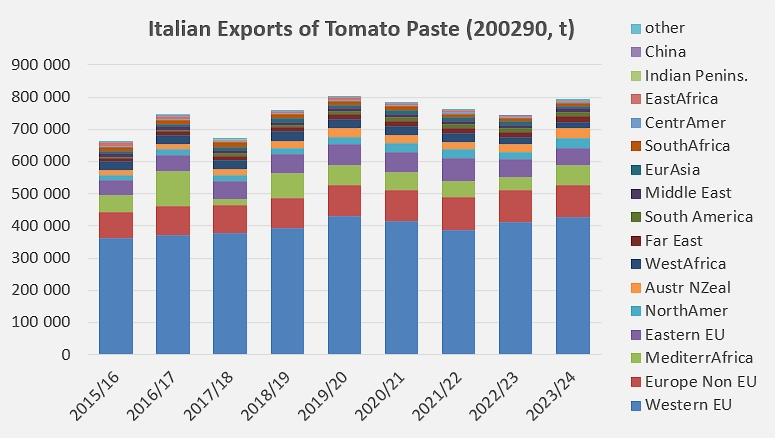
After three years of decline, tomato paste exports from the Italian processing sector have rebounded, approaching 800,000 t, their all-time record from 2019/2020. Annual growth mobilized 49,000 t more paste than in 2022/2023 (+7%) and 30,500 t more than the average for the period running 2020/2021-2022/2023 (+4%).
Last year's biggest increases were on the Libyan, Austrian, French, US and Canadian markets, to name but a few. These developments more than offset the downturns recorded for Romania and Hungary, Germany and the Netherlands, Ukraine and Belarus, as well as for the UK and Burkina Faso markets.
Last year's biggest increases were on the Libyan, Austrian, French, US and Canadian markets, to name but a few. These developments more than offset the downturns recorded for Romania and Hungary, Germany and the Netherlands, Ukraine and Belarus, as well as for the UK and Burkina Faso markets.
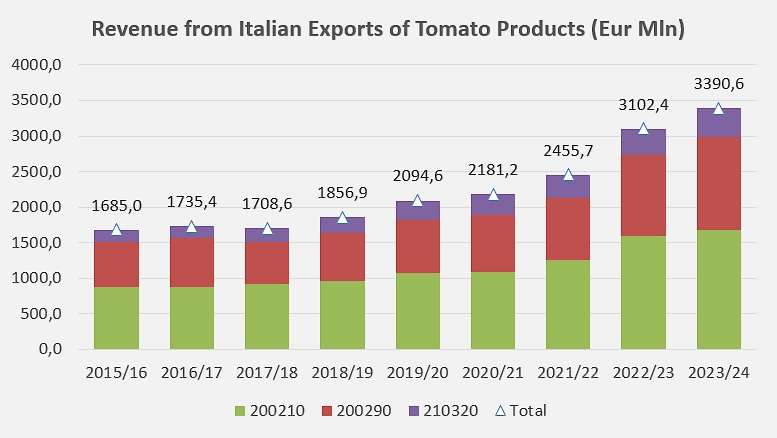
Foreign sales of tomato pastes generated sales of EUR 1.3 billion (around USD 1.41 billion) in 2023/2024, up 15% on the previous year (EUR 1.13 billion) and up 40% on the average figure for the previous three years (EUR 936 million) (see also additional information below).
However, the value of exports of pastes remains lower than that of exports of canned tomatoes (customs codes 200210), which last year totaled EUR 1.67 billion (USD 1.81 billion), up 5% on the 2022/2023 result (EUR 1.59 billion) and 27% higher than the average for the previous three years (EUR 1.31 billion).
These improvements in sales are not the result of an increase in the quantities absorbed by foreign trade. In terms of quantity, results for the 2023/2024 marketing year (1.434 million t) are virtually identical (-0.3%, or -3,700 t) to those of the previous year, and only slightly different (-0.8%) from the average results for the previous three marketing years (1.445 million t). As in the case of pastes and, even more so, of sauces and ketchup, the unit value of products sold cross-border has grown much faster in recent years than the tonnages involved.
These improvements in sales are not the result of an increase in the quantities absorbed by foreign trade. In terms of quantity, results for the 2023/2024 marketing year (1.434 million t) are virtually identical (-0.3%, or -3,700 t) to those of the previous year, and only slightly different (-0.8%) from the average results for the previous three marketing years (1.445 million t). As in the case of pastes and, even more so, of sauces and ketchup, the unit value of products sold cross-border has grown much faster in recent years than the tonnages involved.
The virtual stability of total export tonnage masks strong annual variations in regional markets. Quantities of canned tomatoes exported to Western European markets fell by almost 44,000 t (-7%), mainly due to a sharp drop in German (-46,000 t) and Dutch (-25,000 t) purchases, which was not offset by the spectacular 29,000 t rise in Austrian purchases. Other countries have also significantly reduced their imports of Italian canned tomatoes, including the UK, Russia and Bulgaria. Over the same period, however, Italian sales rose sharply in the USA, Japan and South Korea, Australia, Saudi Arabia and the United Arab Emirates, to name but a few.

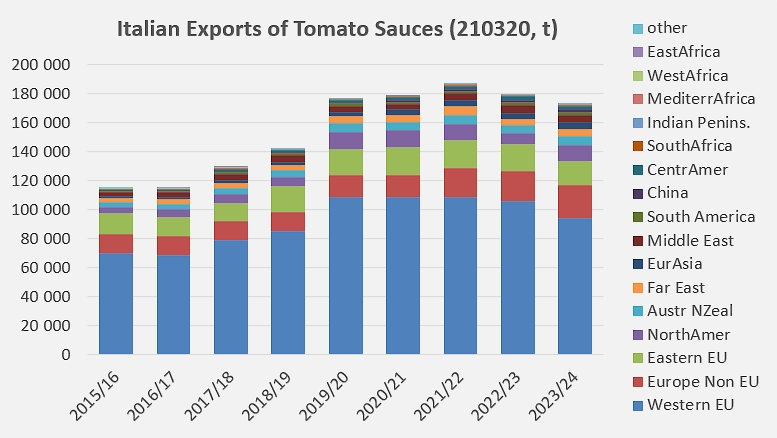
After several years of growth, particularly pronounced during the period of the Covid health crisis between 2019/2020 and 2021/2022, Italian exports of sauces and ketchup (customs code 210320) recorded two consecutive declines, bringing the annual level of activity down to around 173,000 t, some 6,300 t (3.5%) less than in 2022/2023 and 8,600 t (4.7%) less than the average for the previous three years.
The most notable slowdowns were on the German market and, to a lesser extent, on the French and Polish markets. Conversely, the UK and US markets increased their imports of Italian sauces in 2023/2024.
Exports of sauces and ketchups only contribute an average of 12% to total sales generated by Italian foreign trade in tomato products. Last year, despite the drop in export quantities, the sector accounted for around EUR 409 million (USD 442 million), up 9% on the 2022/2023 result (EUR 375 million) and 25% on the average figure for the last three years (EUR 327 million).
The most notable slowdowns were on the German market and, to a lesser extent, on the French and Polish markets. Conversely, the UK and US markets increased their imports of Italian sauces in 2023/2024.
Exports of sauces and ketchups only contribute an average of 12% to total sales generated by Italian foreign trade in tomato products. Last year, despite the drop in export quantities, the sector accounted for around EUR 409 million (USD 442 million), up 9% on the 2022/2023 result (EUR 375 million) and 25% on the average figure for the last three years (EUR 327 million).
Overall, Italian exports of tomato products generated sales of EUR 3.39 billion (USD 3.66 billion) in 2023/2024, up 9% compared to 2022/2023 (EUR 3.1 billion) and 31% compared to the average for the previous three years (EUR 2.58 billion) (see also additional information below). The proportional distribution of Italian sales according to the various importing regions is relatively stable, with various EU member countries accounting for a large half of shipments (around 52%). Non-EU European countries accounted for around 17% of Italian sales, North America 8% and the Far East 6%.
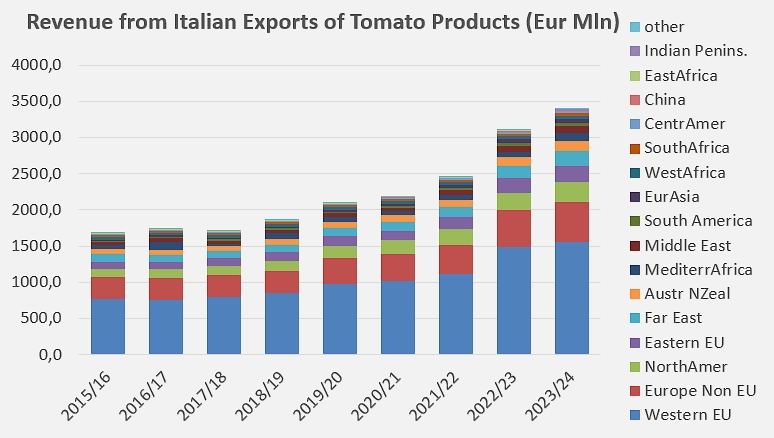
More specifically, over the last three marketing years, Germany has been the leading outlet (all product types combined) for Italian tomato products, with an average expenditure of EUR 568 million. The United Kingdom and France ranked second and third respectively among importers of Italian products, spending EUR 366 and 287 million. At EUR 196 million, US purchases put that country in fourth place among customers for Italian products, ahead of the Netherlands (EUR 133 million), Japan (EUR 118 million), Austria (EUR 116 million) and Australia (EUR 107 million).
Spending by these eight countries on supplies of Italian tomato products accounted for almost two-thirds of the Italian industry's export sales.
Spending by these eight countries on supplies of Italian tomato products accounted for almost two-thirds of the Italian industry's export sales.

“Good results for tomato products”
According to data from the 2023 Report on the foreign trade of Italian Agrifood products (the 32nd edition produced by "CREA Politics and bioeconomy"), the Italian agrifood industry set new records for foreign trade in 2023. In particular, agrifood exports were up 6.6% on 2022, reaching a record EUR 63.1 billion (compared with just EUR 42 billion in 2018). But 2023 was also a record year for imports, which totaled EUR 64.7 billion, up 4.1% on 2022. Overall, Italy's agri-food balance improved in 2023.
According to data from the 2023 Report on the foreign trade of Italian Agrifood products (the 32nd edition produced by "CREA Politics and bioeconomy"), the Italian agrifood industry set new records for foreign trade in 2023. In particular, agrifood exports were up 6.6% on 2022, reaching a record EUR 63.1 billion (compared with just EUR 42 billion in 2018). But 2023 was also a record year for imports, which totaled EUR 64.7 billion, up 4.1% on 2022. Overall, Italy's agri-food balance improved in 2023.
The 2023 CREA report also notes that international price patterns have led to a misalignment between value and quantity trends, albeit more limited than in 2022.
In 2023, the EU27 zone accounted for 59.4% of Italian agri-food exports and 70.5% of imports, proportions that increased compared to 2022. The impact of the Asian market is diminishing, after the increases of recent years, with a drop in imports from Indonesia and China of 16% and 21.5% respectively. These dynamics are partly due to the crisis that has been affecting the Red Sea since the last months of 2023.
Exports to Germany and France, the two main destination markets for Italian agri-food products, increased by around 10%. The increase in the value of sales to the United Kingdom (+7.8%) was also significant, while sales to the United States were more limited (+2%).
Crea's report also mentions that data for the first three months of 2024 confirmed the trend observed in the latter part of 2023, highlighting a further increase in exports (+6.7% compared with the first quarter of 2023) against a decrease in imports (-2.5%). This dynamic led to an improvement in the agrifood balance, which was positive in the first quarter. Exports of tomato products and peeled tomatoes in particular increased, in value and quantity, by over 10% compared with the first quarter of 2023. Generally speaking, all the main export products posted increases in both value and volume sold abroad.
"These figures from CREA's thirty-second report on policies and the bioeconomy speak volumes about our competitiveness on international markets," concluded CREA President Prof. Andrea Rocchi, "and about the attractiveness of the Italian food model, made up of quality, culture, tradition and care, to the global consumer. In this context, innovation and research are strategic to maintaining the identity and leadership of the Made in Italy agri-food industry in the current circumstances."
Some complementary data
Download the infographic HERE.
Download the report HERE.
To access previous editions, click HERE.
Development and distribution of Italian expo
rts of tomato pastes (HS codes 200290), according to tariff subheading (see also related articles below).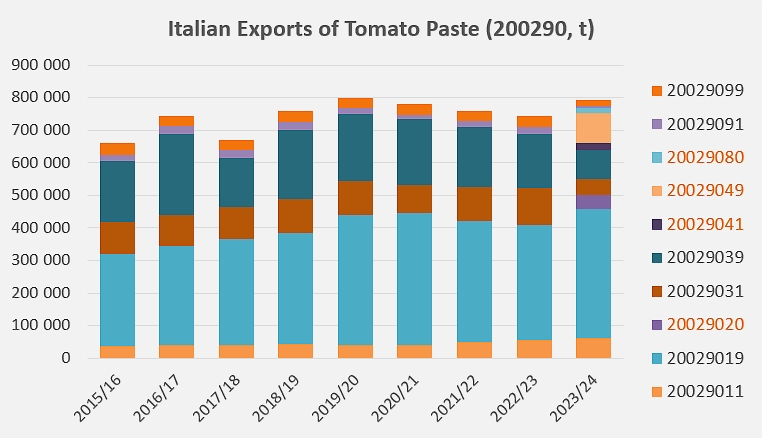
Evolution and composition of Italian tomato product export sales.
Sources: Trade Data Monitor, crea.gov.it