News
Interview: Reinhardt Kotze, CTO of Incipientus
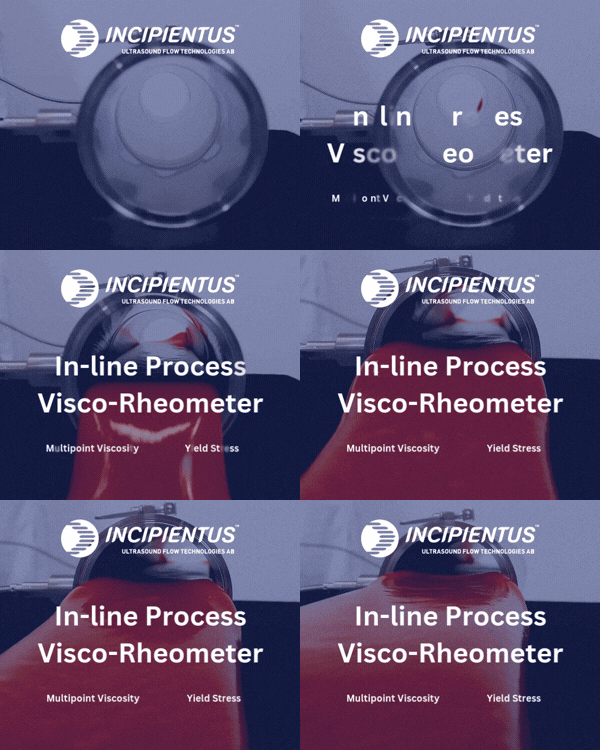
In this interview, Madeleine sat down with Reinhardt Kotze, the CTO of Incipientus, to discuss his journey from academic research to co-founding a leader in industrial technology. Incipientus has developed a groundbreaking solution for the real-time measurement of fluid properties across various sectors. Unlike traditional methods, their technology enables inline, non-invasive monitoring of complex products—such as tomato paste—ensuring consistent results and continuous quality control. Through the integration of smart sensors and AI-driven systems, Reinhardt explains how Incipientus is transforming traditional facilities into smart factories that optimize processes, reduce environmental impact, and maintain a sharp competitive edge.

Click here or on the picture to access the interview on Vimeo.
Transcription
Madeleine: Well, welcome, Reinhardt. I’m happy to have this interview with you today, so let me first introduce you to our audience. Your name is Reinhardt Kotze, so let me know if the pronunciation is okay, and you are the CTO of Incipientus.
So, let’s start with you. Can you tell us a bit more about your career? Also, I saw that you started as a researcher. How did you go from being a researcher for some years to co-founding a tech company like Incipientus? Can you tell us a bit more about that?
Reinhardt: Well, thank you. The name pronunciation is 100% correct, so thank you for that. Thank you for the opportunity. It’s nice to be in the interview. To answer your question, it is a bit of a long story, but I can try to condense it.
Madeleine : We have got time!
Reinhardt: I come from South Africa, and I started to do my studies in electronic engineering, so that’s my background. And then from my bachelor’s studies, I transitioned into the master’s level, and from that point in time, I learned about the ultrasonic velocity profiling method that my supervisor Prof Haldenwang at the time introduced me to after attending a conference at ETH Zurich.
But to carry on the research in this ultrasound field, he realized that he would need a candidate with electronic engineering background to work with the technology and do the signal processing. We had a discussion, and I was very interested. And in that time, we were discussing that if we can progress in this technology, it doesn’t exist in the world, we can even use this technology to measure fluid properties. And that was of great interest in the civil engineering department, more specifically the mining sector, or the mining slurries the mining is very big in South Africa. So that was sort of how we started off, and in my mind, I thought it was very exciting that, if we can do this postgraduate research, who knows, maybe we can end up with a new product, a new technology, that we could commercialize, in the future and, introduce into the market…That’s how it, started off …
Madeleine : Okay.
Reinhardt: The classic, story is, you know, the more you learn, the less you know. So after my master’s, we realized, okay, there’s a lot of work still to be done, and we got funding for my PhD. And in that time, during my master’s degree, I traveled for conferences, and I met another person from Sweden, that’s Johan Wiklund, who is today the CEO of Incipientus. He had just finished his PhD in the same field, so of course, it made sense that when I started, that we could ask him to be my co-supervisor for my PhD, so he’s progressed many years ahead of me in this field, more knowledgeable, and it might make sense that he could guide me in my PhD as well.
And in that time, I traveled to Sweden many times, did research in South Africa, went back and forth, and then, yeah, fast forward after 2012, finished the studies, and at that time, we thought, okay, what do we do now? Now, we’ve done many things, we learned a lot about the sensors, the electronics, and how we can get the data out of the measurements for the customers. And at that point…
Madeleine : You were still working on mining in South Africa, or you had expanded to other things?
Reinhardt: Yeah, good question. So, a lot of things in South Africa were still with the mining slurries, to see how we can measure it, but in Sweden, the applications were very different. It was more food products, even other types of products, could be cosmetics, things like that. So I had quite a lot of exposure in different fluids or products. And yeah, and then 2012, we made a decision to file patents, to start the commercialization project, and we then started a collaboration between Research Institutes of Sweden, and CPUT, Cape Peninsula University of Technology, where I was studying and working.
The patents, it took quite a while, it took probably 4 years to get that granted, so in that time, we had a collaboration between South Africa, Sweden, so I was, again, traveling quite many times, back and forth, and in 2017, 2016, patents were granted, and then I had made a decision, we need to register the company, start the company. And in that time, I moved to Sweden, with my family, so when I started, it was just me, but as the years progressed, I got married, and so the family, plus two dogs, so we all moved to Sweden, and we officially registered the company in 2017 and became operational in 2018. So yeah, it was quite a journey, and…
Madeleine : Definitely.
Reinhardt: So it’s another 7 years after we started the company.
Madeleine : Okay. So, I saw somewhere, that you also explored, deglutition during your research. Is that true?
Reinhardt: Yeah, it was a project, it actually started, in Rise, in Sweden. Dysphagia, you know, the health condition.
Madeleine : Yes.
Reinhardt: Swallowing difficulties. So there was a project started by Professor Mats Stading, a Swedish professor at Rise Research Institute.
Madeleine : Okay.
Reinhardt: The Gothenburg Throat mode is a robotic system that mimics the throat and the swallowing process, so you can add a sample of a food product, and it will mimic the swallowing process, and as this process is happening, we could then use our ultrasound to visualize the flow.
Madeleine : Oh, so it was even linked to the ultrasound technology, but something different, it was linked to it.
Reinhardt: Exactly, and there were also some measurements done on a human being, of course, with the ultrasound by the throat, to see how the liquid is moving. So, that was just the side project, and we published a paper about that as well.
Madeleine : Okay. So, now that you explained what you measured exactly, it feels… because I was wondering how you go from exploring the way humans swallow to, designing the sensors for the industrial pipes, but now that you explain the way it goes, it feels more normal to go from the throat, which is a human pipe, to an industrial pipe, finally!
Reinhardt: Well, we started off with pipe flow and open channels. In the mining industry, you have open channels, open to atmosphere, so the slurries would just flow with gravity in a flume, and so we’ve done experiments in that condition, of course, in pipes, and then we had, some more projects relating to health, like the swallowing project. So, predominantly, we focus on pipe flow, so that’s where the production normally occurs, especially in the factories.
Madeleine : That makes me think back at my engineering studies, because from studying, I’m a food industry engineer, and I remember that the worst topic that I was studying… well, the thing that I really liked the least, that I didn’t understand a thing about, it was called, in French, “mechanique des fluides”, so it’s basically how a fluid goes into the pipes, and this is exactly what you’re doing, actually…That’s something I could never understand properly, and no matter how they tried to explain it to me, I really had bad grades with that one…
Reinhardt: It’s a very multidisciplinary field that we are working on, so we are using ultrasound technology, so it’s the physics of that, so you have to know about the ultrasound physics. Then it’s the signal processing, or the electronic engineering part. And then, of course, what we measure is, like you said, the fluid dynamics part. These, the viscosity of a liquid, and more complex things like the rheology, the yield stress, and that’s what we measure, and give to the customer, so it’s pretty multidisciplinary.
Madeleine : Definitely, and fascinating as well. So, coming back to co- founding Incipientus in 2017, 2018, what was it that you thought, okay, we need to start this company, and the industry needs us, needs this technology? What was the missing link?
Reinhardt: I mean, already back 20 years ago, when we started the research, the link, or the missing link, as you put it, is that all the quality control and the measurements being taken on different industries. We just take, a food industry as an example. If I make a product like mayonnaise or ketchup. typically, a sample is removed from the process in a container or in a cup, and then that could be taken to a lab, and maybe a measurement would be done using a really old technology. Maybe using a Bostwick consistometer. Or other technologies that’s, coming from the 1950s. And even today, as we speak, many factories are still using these approaches, and the problem is, is that the data that you get is really limited, and the frequency of these measurements is a few times per day, so you do not really have a handle on what’s happening during production, and if something would go out of spec, you would actually learn about it too late in the process.
Madeleine : Okay, yes.
Reinhardt: Because of the infrequent sampling or quality control being taken. And the data that we provide as well is the rheology, or the complete flow curve that characterizes the flow behavior of these products. And that’s really important, because the products that we are dealing with in the industry are non-Newtonian products. Which means that the viscosity changes with shear, and it’s a nonlinear trend. And the only way to measure that is to have a flow curve that characterizes your product, and that’s your quality parameter. And the old technologies do not give you this information.
So that was the missing link, to provide inline measurements, but also the complete flow curve that will give you the actual quality information about the product 24-7, and if you have this information, of course, you can unlock a lot of benefits in terms of knowing immediately when things are going wrong, when things are out of spec, you can make fast decisions to correct the process. And of course, the knock-on effect is that you will reduce wastage, save on ingredients, and have the final product be consistent as well for the consumers.
Madeleine : Yes, so with your technology, you can have the measurements 24-7.
Reinhardt: Yes.
Madeleine : Yeah, so, indeed, a big change compared to what you were describing with the Bostwick measures and so on. Okay.
Reinhardt: It’s a massive, paradigm shift, I would say.
Madeleine : Completely.. So, coming back to you, you co-founded Incipientus? So, within the company, what is your personal mission?
Reinhardt: Well, as a CTO, I would say my personal mission is to have the technology as a standard. You can call it a gold standard for any factory that’s looking into how to measure the quality of the product. Especially if it’s, complex products, non-Newtonian products, which is more than 90% of all products, from food to cosmetics to creams, or whatever the application might be, is to have the Incipientus technology as the standard for measuring these quality parameters. And we have other goals as well, like I said, it’s a very multidisciplinary technology. And it can become quite difficult, but also, make it so easy for the operators to use the technology and ideally, just press a button, and then everything will just work, and the data will start streaming. And we make a very complex thing very easy for the operators to work with and to optimize their production processes. I would say that’s my goal.
Madeleine : Okay, thank you. Good! So, the technology. So, when we hear ultrasound, we often think hospital. You know, I have to go for an ultrasound or something. But, so, ultrasound is what you use with industrial pipes. Can you explain for non-technical people, how the technology that you’re proposing, how it kind of sees inside the tomato processing line. And how we can have those measurements, like, 24-7, as we mentioned.
Reinhardt: Sure, I can quickly explain that. So, it is a medical ultrasound system that we adapted to the industry, the processing industry, and it works on Doppler echography. You can imagine an ultrasound sensor on a pipe, on the outside of the pipe, and it will send pulses through the pipe wall into the liquid flowing in the pipe. And for every pulse, this liquid will scatter ultrasound energy back to the same sensor. So, between the pulse being sent and the pulse being received, there would be a shift in time, based on the classic Doppler theory. And this shift in time is related to the speed of the liquid moving. And, based on this principle, we can visualize the flow across the whole pipe diameter. The Doppler images that we measure, typically can be referred to as a B-scan image, in the medical field, and like I said, we’ve adapted it for processing industry, and we have similar images that will show you the complete velocity profile of the liquid moving into the pipe, or inside the pipe, and that information is quite important to determine the behavior of the liquid, and the non-Newtonian properties.
Madeleine : Okay, I think it’s a bit clearer for me. So, the sensors that you plug in, they are non-invasive, and clamp on. So those sensors, they never touch the food. They are outside the pipe. So, why is it such a big deal for a factory that they never touch the food?
Reinhardt: Oh, it’s a really good question. Of course, it’s mainly the hygienic requirements, so our sensors are completely touch-free. It’s on the outside of the pipe, and the pipe material is normally 316L stainless steel. To comply with our hygienic requirements, especially in food processing, but also cosmetics and creams and things like that. Our sensors are very unique. We can measure right through stainless steel. But I mean taking Doppler measurements, not just, basic ultrasound flow rate measurements. We actually have pulsed ultrasound that will give us the velocity profile as a function of distance and it will reveal the shape of the velocity profile.
And to go back to your question, why is it important, it’s hygienic requirements, of course, and also the cleaning requirements. Often CIP processes are used to clean the pipe between production runs, of course. During CIP the temperatures can be up to 100 degrees Celsius, or even higher. So, it’s quite important, as you’re seeing, that it’s not in contact with this type of chemicals being used, or steam or very hot water during the CIP. The sensors are CIP friendly, as you would tell the customer.
Madeleine : Okay, yes. Because the other technology, the 1950s, as you call it, technology, then you need to take a sample every time to measure the parameters, right? So, every time you take a sample, then there are risks of contamination, or hygiene risks, yeah?
Reinhardt: 100%, and it’s always the question, where should you measure? You should actually measure during the production, as it’s being produced in the process, in the production pipe, but often samples are being taken, it’s being stored in a container, and then maybe even 24 hours later, an operator would come and then take a measurement on the sample, but this sample is already 24 hours old. Maybe the temperature is not exactly as it was during production. And some products have time dependence, so if you would leave a product outside for many hours, the product will start to change in consistency, or the properties will change slightly, so in the end of the day, what are you measuring on, if you’re having these samples? You should actually be directly in the production process and measure inline, so…
Madeleine : I get it. Okay, good. You also mentioned cosmetics a few times, so I understand you have applications in cosmetics and maybe pharmaceuticals as well? How are they similar, to monitoring tomato paste, for instance?
Reinhardt: Just to go back to the classic properties of all this type of industrial liquids, they all share the same properties in terms of non-Newtonian behavior, so the viscosities are nonlinear, And, different products, like the creams or pharma products, compared to food products, you can also go into paint products, if you can imagine. It’s quite complex, the way these products behave. Like a cream, you need to be able to shear or to apply it on your hands, for example, but it comes from a container, so you also don’t want to turn the container upside down, and then the cream product will just fall out of it like water. So you can’t have that, no one will buy this product. The properties of these products are very important, and a new way to measure this properly is by measuring the rheology, or the multipoint viscosity flow curve of those products that will show you how this product behaves over different shear rates. So it can be food products or any non-Newtonian products.
Madeleine : Thank you. You mentioned a few times a non-Newtonian fluid. Why would you say that tomato paste is one of the hardest liquids in the world to monitor in the factory?
Reinhardt: Tomato paste, it is a very thick product. It behaves like a solid until it doesn’t, And like I said, the viscosity will change quite a lot with shear, so as you would pump the product at different rates, the viscosity will start to change. It also contains fibers, a lot of particles, there could be air trapped as well in the product… It’s a very thick product, and if you imagine taking a thick product and using a sampling technique, it’s not that easy even to take the samples as well…
We have, paste applications, and we measured quite successfully in this application, so we’re quite happy about that. So, the customer is very happy, because it is a difficult product. And we could say that, yes, we can measure inline, while it’s flowing, and we can characterize it very nicely, and then tell the customer about the consistency of the paste as well.
Madeleine : Okay. Consistency is something that feels difficult to get exactly right, but, you touched upon it before, but the traditional ways the companies have measured this in the tomato processing industry are to take some samples and to measure the Bostwick and so on, as you said. And your technology is completely different. Why would you say it is necessary and we can’t use the old technology anymore? Why is it failing now, the old technology?
Reinhardt: Yeah, we talked a little bit about that, before, but it is the problem of that it’s not an inline measurement, the old technology is based on old principles, you know, maybe it’s gravity flow, and the way that the data is being recorded often can be an operator looking at the ruler, for example, and recording a number on a piece of paper, so it’s all about the digitalization of this, the measurement methods, of course.
We measure in real time, 24-7, that you cannot, of course, do with infrequent sampling throughout the day. And of course, our sensors are touch-free. Like you also mentioned, there’s a risk of contamination if you would try to take a sample as well. The thing is, it’s a technology that will provide you repeatable results as well. So there’s no problem of different operators. We’re all human beings, and we look differently at the ruler. Maybe I record a number of 3. Maybe my friend will say, no, that’s 2.5, or 2.8. So there’s also the problem of inaccuracy.
Madeleine : So you remove the risk of error with your system.
Reinhardt: 100%, and so you can rely on repeatable, continuous, real-time, and inline results during the production process.
Madeleine : So, if you were to implement your system, your technology, on a massive, 1,200 ton a day facility, what kind of nightmares would your system help them avoid on a typical day?
Reinhardt: Many things can go wrong, as we are having our discussions with customers, but if you have that scale of production, if you have batches that’s drifting out of spec, it’s a lot of money, that can be, recovered, if you can prevent batches drifting out of spec. Sometimes, we have shown for different customers that there’s air inside the products, so air, of course, can cause problems in the process, with valves opening, or actually interfering with the product consistency. And because we use ultrasound, we can quickly identify if there’s, any air entrained into the product. So that’s also quite important. Depending on the application, of course, we are visualizing the flow inside the production pipe. So, if there would be fouling present, or build up around the walls we will be able to detect that. We can prevent pipe blockages, or any stresses on the pump. So, of course, a pipe blockage is quite a big event in the factory. You would have to shut down the factory and of course fix the problem, come up with a solution. And every minute or every half an hour of downtime, that is going to be a loss to the factory.
And of course, the consistency. So, if you have your final stage, where the final product is being filled into a container, that consistency for the end consumer, that’s quite important, because if it’s not, you don’t want to have callbacks from the consumer side, where there are complaints about the product not being the right consistency. I’ve taken my mayonnaise, and now I can’t even get it out of the container, it’s so thick. The opposite is too thin, I’m now putting the mayonnaise on my food, now everything falls on my plate. It’s very thin. Why is it like this? So, of course, that level of consistency, the final stages for the consumer. That’s very important to prevent any, you know, future callbacks, or recalls, as they say.
Madeleine : I get the picture, thank you. So, would you say that the technology helps to make the food better, or is it purely about the factory itself, making it more efficient?
Reinhardt: I would say it’s both, it’s about the control, so the better control, it means you have your consistency in the texture, like I explained just now. You have your predictable taste, and also fewer defects, so I would say efficiency, it’s the path, but the quality of the product, that’s the destination. So I would say, to answer your question, it’s both. It’s better food. And to have a bit better efficiency to arrive at this destination of high-quality food and consistency.
Madeleine : Okay, thank you. So, staying on the factory itself, we hear a lot those days about industry 4.0, smart factories, and that kind of terminology. So, how does your company turn a standard food plant into a smart food plant?
Reinhardt: We provide the smart sensors, and the data that we measure is immense, and we characterize the liquids in rheological terms, so that information is critical for smart systems or technologies that you can use. It can be AI algorithms that you can use to optimize your production process, but you need input data. You need to know what is happening with the product, so that your process can be made smarter, and automated to optimize the whole process, so we can close control loops, also, predict deviations, we are working on that in our data science department as well, more predictive algorithms that will help a lot when it comes to the smart factory.
And we also go a lot back into historical behavior, where we can look at the past, and if there were any problems, try to identify why that happened. How can we prevent that in the future? And, of course, we can go levels up higher, and when we have sensors in different factories, we can compare performances, you know, of different factories at different locations as well. Often producing the same product, using the same methodologies, but one factory is not performing the same as the other factory, why is that the case, and that’s where the smart technology and the industry 4.0 can come in, it’s to really get everything up to the same level.
Madeleine : Okay, Great! Let’s talk a bit about sustainability now. That’s also a word that we use often, those days. How does better monitoring, help the planet? How does your product…
Reinhardt: Sustainability, of course, is to have less wastage, to use less ingredients, also to have less failure, so that you don’t have, final products being put to wastage, or even if there’s a reworking process, because of out-of-spec products, if it has to be reworked, that’s, again, an energy consumption. Better monitoring would mitigate those losses.
Also, when it comes the whole process, you can go into over-processing. Of course, in any production process, there’s water being used, cleaning. I talked about the reworks as well, but just the cleaning process. If you can monitor the cleaning process, and actually inform, okay, after 20 minutes, the pipe is fully clean, there’s no product inside. And then you stop the process, of course, then it’s a chemical saving, water saving, energy saving.
And typically, CIP or cleaning processes, it’s just a procedure being followed, and it could be 30 minutes, could be 1 hour, and nothing will stop before those procedures have been completed, but you can actually tweak the procedure and monitor the cleaning process and see, okay, now it actually doesn’t take an hour, It actually takes a shorter amount of time, and now you know when it is clean, and you can stop earlier and save that water usage.
Madeleine : So, a lot of savings, to be had. Okay, thank you. Now let’s look to the future. So, 5 to 10 years down the road, what would you say your ultimate vision is for Incipientus? I asked that for you, but now for the company itself.
Reinhardt: I would still go back and, for the next 5 or 10 years, when we continue through our journey, I would like our Incipientus technology to be the standard for measuring. And I know I mentioned this before, but that’s really one of my goals, in the industry, to measure the quality of whatever the application might be, or the product, the non-Newtonian product. It’s to have a standard to use Incipientus technology for quality control and monitoring processes. So that would be great if we can achieve that. I think it’s possible.
Madeleine : Well, I wish it for you, yes, of course. Last question for today. If you could give one piece of advice to a food processor who is still doing things the old way, in your words, in the 1950s way, what would that advice be?
Reinhardt: Well, II would say, when we have the conversations with our customers, if you’re measuring your product quality, if you measure your product of yesterday, but you’re measuring today. I mentioned, sometimes samples are taken, and they’re stored for 24 hours, and things like that, so if that’s the approach even today, and with this old technology, I would say that the customer is already too late. They should measure while it’s happening, while the production is in progress, and measure inline 24-7, with repeatable results, fully digitized, streamed to your factory, and that will give you the competitive edge compared to using the old methodologies and technologies for quality control, and I would just say that that’s your competitive edge, and that’s where the future is, definitely now, that we’re approaching, Industry 4.0, and we are now in 2026. We cannot continue to use these very old methods for quality control purposes…
Madeleine : Okay. Well, thank you very much. I have come to the end of my questions.
Reinhardt: Thank you for, arranging this, and I think you had very good questions, so appreciate that.
Madeleine : Well, thank you very much for your time and for answering my questions. I certainly learned a lot, and now I know what I’m talking about when I talk about ultrasound technology for measuring. So, thank you!