News
How Respiration Drives Tomato Ripening
Determining exactly how a tomato transforms from a hard, green fruit into a soft, vibrant red one has long centered on the role of ethylene. While ethylene is the undisputed hormonal signal for ripening, the sheer metabolic cost of this transition has remained something of a mystery. Recent groundbreaking research led by the Centre for Research in Agricultural Genomics (CRAG) has finally identified the biological “engine” that powers this change: the alternative oxidase (AOX) pathway. Published in Plant Physiology and synthesized in a recent review in New Phytologist, these findings reveal that ripening is not just a signaling event, but a massive energetic feat supported by a specialized respiratory bypass.
Traditional plant respiration usually operates under a system of “energetic brakes.” When a cell has produced enough energy, the process naturally slows down. However, the ripening process in climacteric fruits like tomatoes requires an intense, rapid supply of carbon building blocks to create pigments and hormones. The CRAG team discovered that the AOX pathway allows the tomato to circumvent these usual cellular restrictions. By activating this specific mitochondrial route, the fruit can continue to burn sugars at a high rate without being throttled by the cell’s standard energy limits. This “secondary engine” ensures a steady flow of the carbon skeletons necessary for the synthesis of lycopene, the pigment responsible for the tomato’s red color, and the amino acids required to produce ethylene.
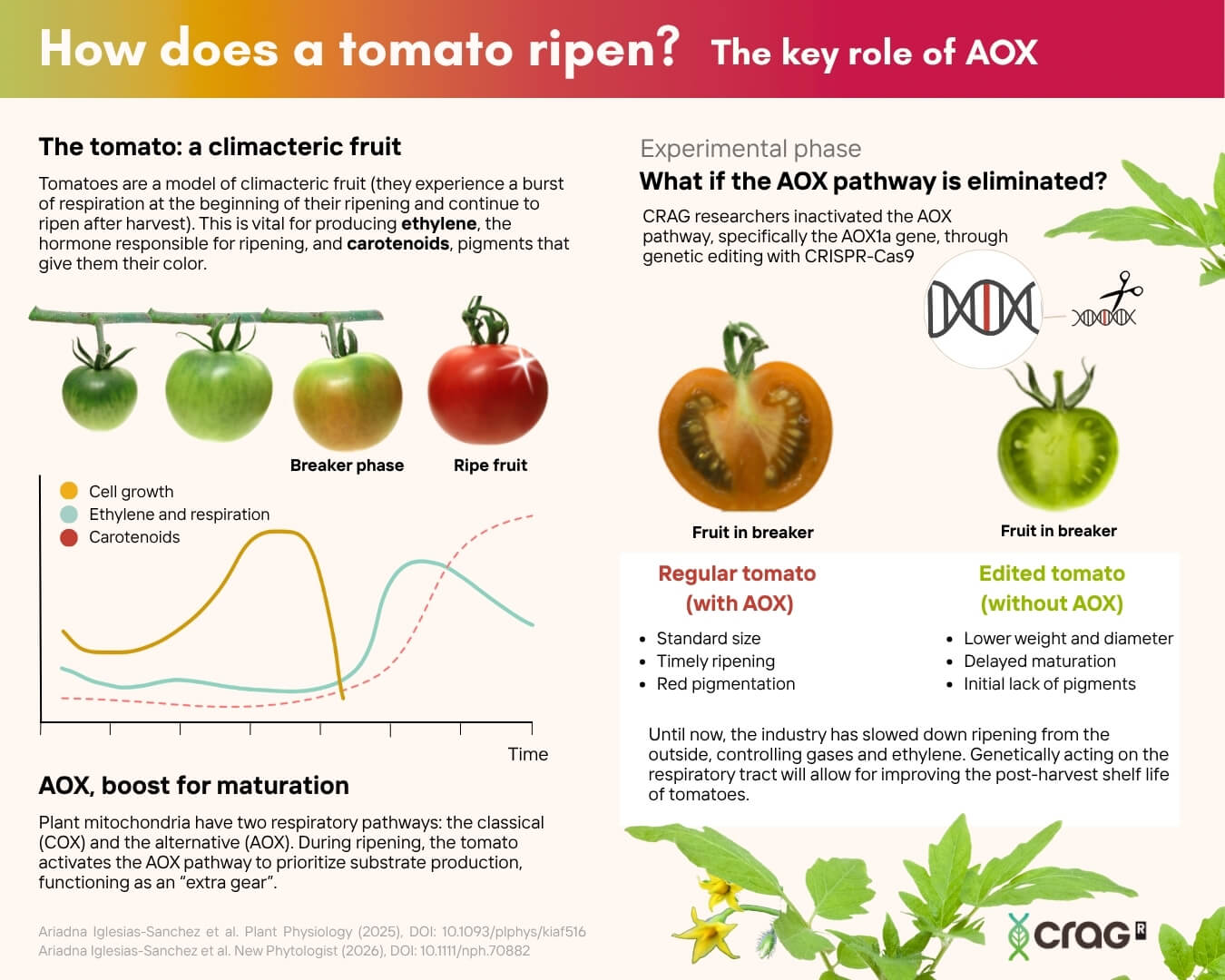
To confirm the essential nature of this pathway, researchers utilized CRISPR-Cas9 gene editing to deactivate the AOX1a gene. The results were stark; without this metabolic bypass, the mutant tomatoes were unable to accumulate critical levels of aspartate and methionine, which are the fundamental precursors to ethylene synthesis. Consequently, these tomatoes experienced significant ripening delays. Furthermore, the lack of carbon flow through the AOX pathway led to a drastic reduction in lycopene and phytoene levels, resulting in poor color development during the early stages of the ripening cycle. This demonstrates that without the AOX pathway, the signals for ripening simply do not have the “fuel” required to manifest physically.
These discoveries provide a transformative perspective for the agricultural sector and plant breeding programs. By identifying the AOX pathway as a key regulator of fruit quality, researchers have opened a new door to modulating ripening traits beyond traditional ethylene treatments. Understanding this metabolic engine allows for the potential development of new varieties with enhanced nutritional profiles, better color uniformity, and improved shelf-life stability. Instead of focusing solely on the hormonal trigger, the industry can now look toward optimizing the internal respiratory efficiency of the fruit, ensuring that every tomato has the metabolic capacity to reach its full aesthetic and nutritional potential.
Sources: CRAG
References :
Iglesias-Sanchez, A., et al. (2025). Activation of alternative oxidase ensures carbon supply for ethylene and carotenoid biosynthesis during tomato fruit ripening. Plant Physiology, https://doi.org/10.1093/plphys/kiaf516
Iglesias-Sanchez, A., et al. (2026). Fruit respiration: putting alternative pathways into perspective. New Phytologist, https://doi.org/10.1111/nph.70882