News
Global tomato products trade: 2016 revenue
Overall value is up, number of operators is down
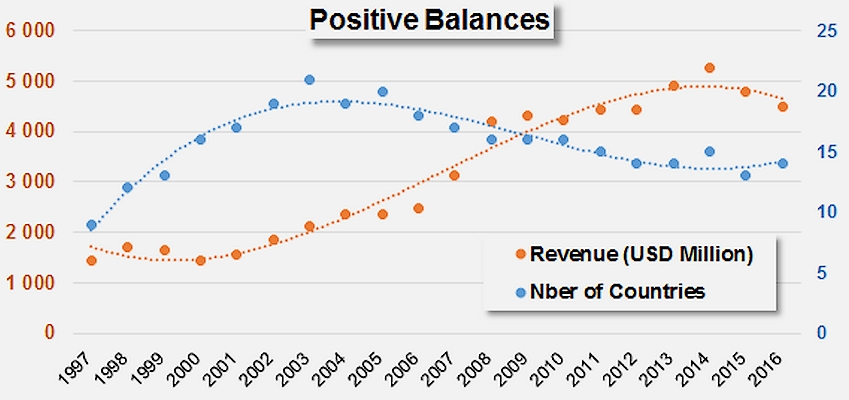
In 2016, only fourteen countries reported an active trade balance for the "tomato products" sector, which is one more than the previous year. Since 2003, the year when this number reached its maximum with twenty-one countries, the number of nations belonging to this restricted circle has progressively shrunk. The number of countries with an "active balance" has not been so low for almost seventeen years.
At the same time, the turnover achieved by these countries has considerably increased. The 2016 result, far from being the best, nonetheless amounted to USD 4.5 billion for the fourteen countries overall, down 6% compared to the USD 4.8 billion of 2015 and far behind the record result (USD 5.3 billion) reported in 2014 for the Top15 tomato products exporting countries. Ten years ago, the turnover generated by countries with a positive balance (18 of them in 2006), peaked at USD 2.5 billion. Twenty years ago, there were nine top exporting countries and they generated a turnover of USD 1.44 billion.
Overall, it is clear that each year sees an increasingly tough commercial context in terms of competition, with a global market that is only growing slowly. Processing capacities and the revenue generated by worldwide trade is progressively becoming more and more concentrated.

In 1997, the average turnover for each country of the Top9 amounted to approximately USD 160 million. In 2016, the average turnover for each country of the Top14 amounted to USD 322 million.
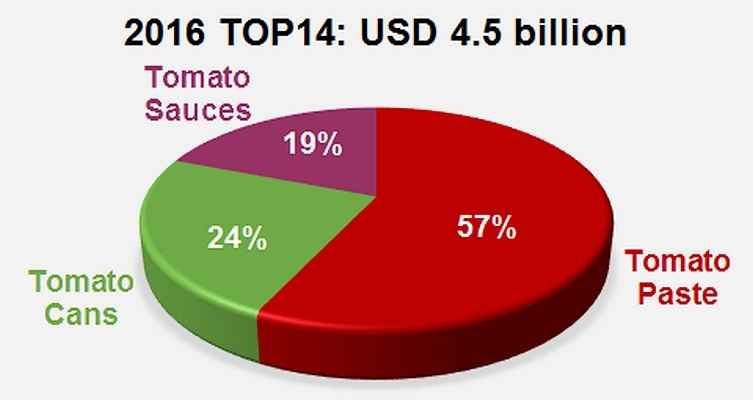
Within the Top14 exporting countries, most of the value generated in 2016 (57%) stemmed from sales of pastes (USD 2.57 billion). Countries like Serbia, Costa Rica and the Netherlands recorded passive trade balance results for this sector, despite having active trade balances for the tomato products sector as a whole.
Canned tomatoes accounted for slightly less than one quarter (24%, USD 1.07 billion) of the total value absorbed by the Top14 countries last year. The trade balances of the Netherlands, Chile, Ukraine, Costa Rica and Serbia were passive for this sector.
The value of sauce exports for the Top14 accounted for approximately USD 861 million last year. Three countries (Chile, Greece and Peru) recorded negative trade balances for this sector.
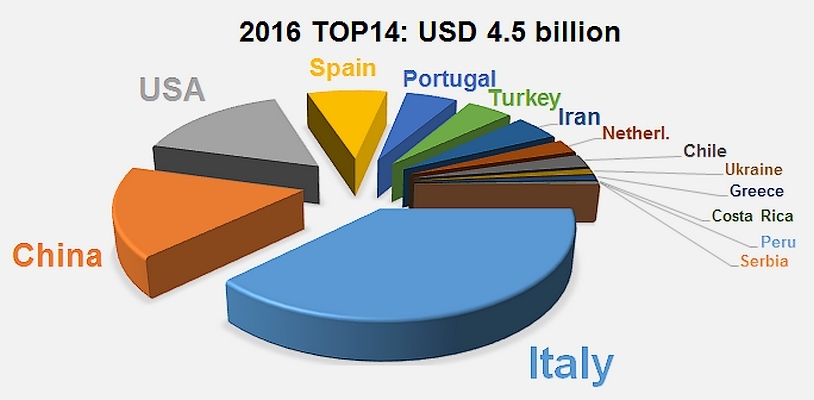
Not surprisingly, Italy once again ranked first among tomato paste exporting countries, with an active trade balance margin of USD 1.7 billion (EUR 1.54 billion), mostly thanks to canned tomato exports (56%). This product category generated a net turnover of USD 958 million, while foreign sales of pastes (34% of the total balance) "only" generated USD 579 million and sauces USD 169 million (10% of the balance).
Italy is the only country to record a foreign business pattern that is so clearly diversified. Its main challenger, China, is far behind, and has for many years been obtaining most of its profits from massive exports of tomato paste, a category that continued to account for 98% of the total turnover (USD 740 million) in 2016. Another major rival on the worldwide market, the United States, features a dipolar pattern of operations in which the revenue generated by sauce exports (50% of the total positive proportion of the trade balance, with USD 354 million last year) and by pastes (46% of the total, USD 323 million) only leave a very minor role to be played by foreign sales of canned products (USD 29 million).
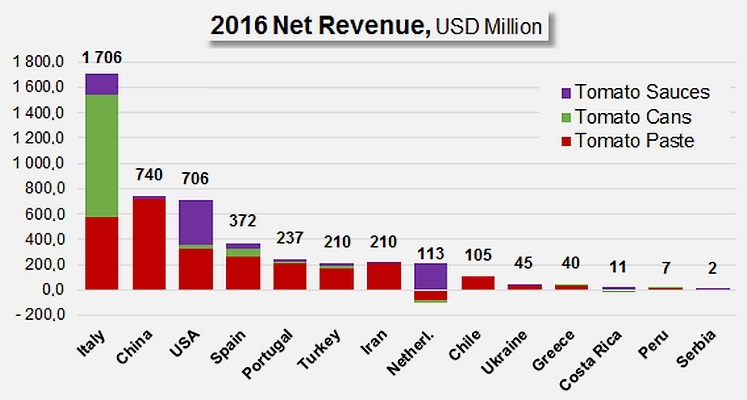
Italy, China, the United States, Spain, Portugal, Turkey and Iran are the only countries to record a positive trade balance result for each of the three export categories (pastes, canned tomatoes and sauces).
Despite its growing importance, Spain remains well behind these three leading players, which altogether accounted for exactly 70% of the turnover of the Top14 in 2016. With a total result of USD 372 million, mainly based on foreign sales of pastes (USD 267 million), Spain nonetheless ranks well ahead of the group of its followers, made up of Portugal (USD 237 million), Turkey and Iran (USD 210 million for each of these countries), whose operations are almost exclusively focused on paste exports.
Last year, the Netherlands reported a considerable active balance for the sauces sector with a positive balance result of USD 215 million. But this excellent performance was penalized by the chronically negative trade balance result for the canned tomato category (USD -19 million) and, even more importantly, for the category of pastes required for second stage processing (USD -82 million). The positive proportion of the Dutch trade balance is however bigger than that of Chile (USD 105 million, generated exclusively by paste exports) and more than twice as big as that of Ukraine (USD 45 million, of which a considerable proportion is generated by the sauces category) and of Greece (USD 40 million, of which a considerable proportion is generated by the canned category).
Some complementary data
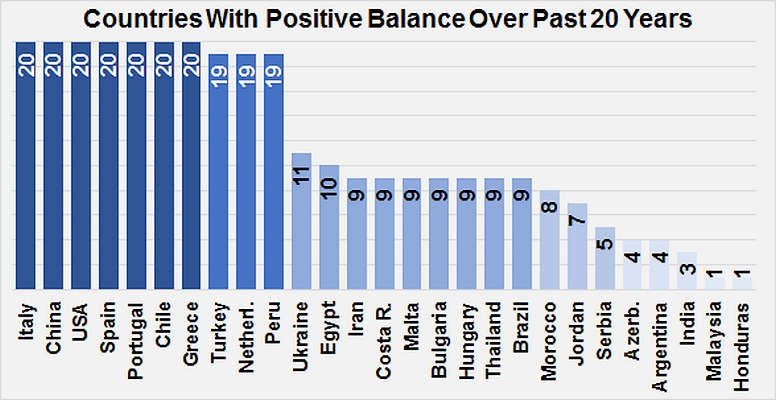
Only seven countries have featured continuously in the worldwide top ranking of tomato products exporting countries over the past 20 years: Italy, China, the United States, Spain, Portugal, Chile and Greece.
Turkey, the Netherlands and Peru have been included 19 times. Of the 27 countries that have recorded at least once a positive tomato products trade balance, 17 have only irregularly featured in this worldwide ranking.
Total turnover of the world's Top14 countries that export tomato products: distribution according to country.
Total turnover of the world's Top14 countries that export tomato products: distribution according to product category.
Appendices/Annexes
Results of the trade balance, according to product categories, for the 14 countries that ranked in the world's top tomato exporting countries list in 2016.

Number of countries that recorded a positive trade balance for tomato products over the past 20 years and annual amounts of their net turnover (in millions of US dollars).