News
France: the tomato industry interbranch organization celebrates its 60th anniversary
SONITO: "Twice thirty years, and lots of plans for the future"
On 30 November, the Sonito (SOciété Nationale Interprofessionnelle de la TOmate, national Interbranch Organization for the tomato industry) celebrated its 60th anniversary. More importantly, it restated its ambition to energize the industry as a whole.
 The event provided an opportunity for the current leaders of the Sonito (its president André Bernard, its director Pascal Lenne and the engineer Robert Giovinazzo) to look back over the road traveled since the days when factories only used the surplus of the fresh tomato market as raw material. They mentioned the first contracts between growers and processors (interbranch agreement of April 1961), the development of agricultural performance with improved yields and early season varieties, resistance to aggression from biological factors, adaptation of varieties to industrial requirements, evolution of cultivation practices (earth mounds, plant density, fertilizers, irrigation, etc.), introduction of harvesting aids – the early stages of integral mechanization, in close collaboration with experts from the fields of the different topics being addressed: the Institut National de Recherche Agronomique (INRA), the Centre national du Machinisme Agricole du Génie Rural, des Eaux et des Forêts (CEMAGREF), the Société du Canal de Provence (SCP), the Centre Technique de la Conservation des Produits Agricoles (CTCPA), etc.
The Sonito has participated in the development of the French industry, confronting new social and economic contexts, integrating the evolution of mechanization with the cultivation cycle as a whole (from field preparation to harvest), working on improving irrigation methods and getting drip irrigation accepted, all the time collaborating with the INRA on a widely respected European survey called "Qualitom", which has contributed in a major way to improving cultivation methods. Among other achievements, this project has contributed to the worldwide acknowledgment of the skills and expertise of the Sonito, thanks to contributions to several European projects and world congress events.
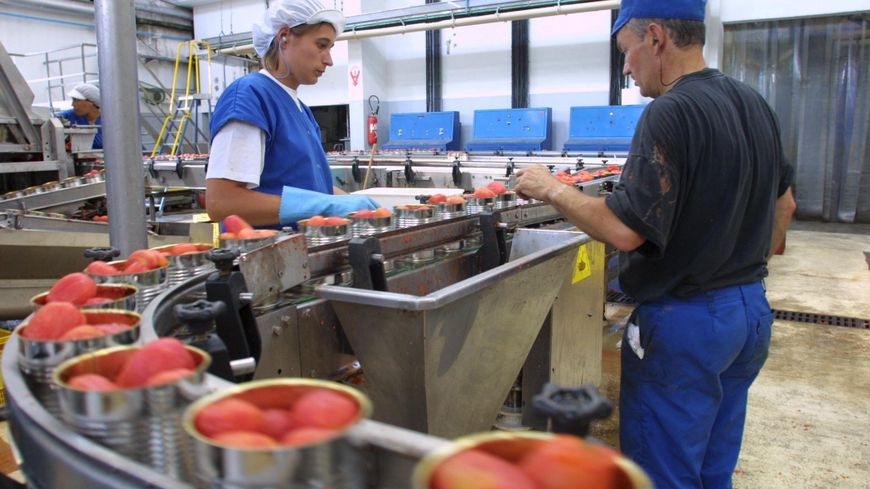 The Sonito has also greatly contributed to progress made in the area of new varieties, with results combining increased agronomic yields and better soluble solids levels for several varieties (Cantou, Pistou, Caladou and Terradou), which for a long time have had a good reputation with French growers and processors.
The history of the Sonito and the French industry was also impacted by the major progress achieved in terms of early varieties thanks to the adoption of a solution that is currently used in all major tomato-growing countries: plug seedlings, which made it possible to carry out plantation operations with machines and to prolong the harvest and therefore the processing period. In recent years, the work on improving and adapting tomato varieties (geographical issues, climate constraints, resistances (TSWV, bacterial and fungal diseases)) has been pursued, in a context that is increasingly marked by ecological considerations and by the constraints imposed by ever more stringent regulations.
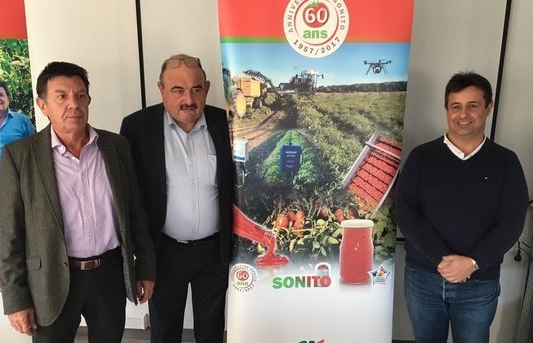
From left to right: Pascal Lenne, André Bernard and Robert Giovinazzo, respectively Director, President and head of the Sonito technical department.
As the head of technical development stated, "the French industry and the Sonito have encouraged a shift in cultivation methods over the coming years." The objective of the research and development approach of the Sonito is a commitment to the major evolutions involved in genetic research, with varieties that are constantly becoming more effective and presenting a growing number of resistances like the recent mildew tolerance. Future cultivation systems were described, based on the reduction of inputs thanks to the increasing use of mulching (biodegradability, layered green manure, etc.), the use of sensors for water management and fertilizers, even for the analysis of disease hazards. As for relationships with processors, these same systems of cultivation and monitoring help to further increase the quality of tomatoes arriving at the processing plants.
"For the Sonito, our objective is to bring the industry back to a point of 50% French consumption, whilst preserving quality crops and adequate income for growers," explained the president, André Bernard. After several difficult years shortly after the year 2000, linked to the difficult economic context worldwide and to the competition of foreign products, the French industry has been able to reconquer markets in terms of volumes and return to a level that, whilst remaining well below the production levels of neighboring countries, allows the French tomato industry to continue existing. During this period of time, the interbranch organization has known how to be "present at all levels of the decision-making process in order to guarantee the continuation and development of the industry to the benefit of all stakeholders," pointed out Sonito director Pascal Lenne. At the time of the CAP reforms (2001, 2007 and 2011), "the Sonito was heavily involved and was able to obtain, amongst other things, the continuation of specific subsidies for tomato production, whilst working alongside local operators in order to mobilize the necessary investments for modernizing the industrial infrastructure and setting up new processing installations."
In 2017, the French industry processed close on 200 000 mT of tomatoes. In 2016, growers' organizations delivered almost 186 000 mT to French processing plants. After a production peak of 370 000 mT just before the year 2000, and a nosedive to less than 100 000 mT in 2007, the French tomato industry seems to have found a new stability, if not a new growth impetus. The volumes processed in 2017 were 7% higher than those of the 2016 season, but also and more importantly, 10% above the average level of operations of the three previous years.

That said, for the Sonito, an increase in volumes is not an end in itself. "Today, France's production meets approximately one sixth of the country's consumption needs (estimated at 1.1-1.2 million tonnes in farm weight equivalent, editor's note).The target is to reach the halfway mark," stated André Bernard. In other words, the current crop needs to be tripled, including the production of organic tomatoes (7% of the French total) in order to produce and process approximately 600 000 mT of tomatoes. This target seems ambitious but, from a practical point of view and according to President Bernard, it is not unreachable. The surfaces and expertise are there, and the market is waiting. But Sonito leaders have also observed that "more processing installations are needed, as those already in operation in France are virtually operating at maximum capacity. There is also a need for long-term contract systems with distributors."
In the meantime, France is heavily dependent on imports of tomato products in order to meet national demand. Over the past three marketing years (2014/2015, 2015/2016 and 2016/2017), the French tomato products trade balance has recorded an average deficit of more than 89 000 mT, of which more than 60% concerns paste of over 12° Brix (20029031, 39, 91 and 99) and more than 40% conditioned in bulk formats (20029011, 31 and 91) (intended for remanufacturing operations). Over the same period of time, the "canned tomato" trade balance has been passive by more than 115 000 mT for each of the marketing years, and the average deficit of the trade balance has exceeded 161 000 mT for the sauces sector.
After a slight improvement, this deficit has continued to grow for each of the three categories over the past five marketing years. Net French expenditure on tomato products, which reached close on EUR 402 million in 2013/2014, has decreased slightly in recent years, largely due to the deterioration in worldwide prices for tomato products. It did however amount to more than EUR 366 million over the most recent marketing year (2016/2017). Sauces have largely accounted for the main line of expenditure, with 54% (EUR 203 million) of the average amount spent over the past three marketing years (EUR 367 million).
Italy ranks first among suppliers of tomato products to France (461 000 mT in farm weight equivalent in industrial pack formats recorded in 2016/2017). A large proportion of French purchases also originate from Spain (380 000 mT in farm weight equivalent last year). These two countries alone supply 75% of the French market's needs that are met by foreign operators, with the complements coming from Germany (99 000 mT last year), Portugal (75 000 mT), the Netherlands (57 000 mT), Belgium (27 000 mT) and other countries (19 000 mT).
The French industry only exports very small quantities of products. The French trade balance for tomato products is active with regard to Algeria, Switzerland, Hungary, Mexico, etc., with volumes that do not exceed a few thousand tonnes.

In order to increase the volume of French processing operations to the level recommended by industry leaders, it would be necessary to also work on production methods to deliver a product of the highest possible quality. "Quality is our added value. Consumers need to be aware that they are buying healthy products that have been subjected to a number of checks, endeavoring to minimize environmental impact, which is not necessarily the case for imported tomato products," stated André Bernard. On this point, the interbranch organization is going to work with the "Fruits et légumes de France" [Fruit and vegetables from France] label, so that this sentence will be mentioned on the packaging.
 Set up in October 2015, this accreditation is aimed at helping consumers to better identify products that have been grown in France, in order to provide a visual image of the products' notice of origin, which is obligatory on shop shelves. Thanks to this visual image, which is harmonized with the other logos identifying French products initiated by different agricultural sectors in France, the "Fruits et légumes de France" logo is now recognized by consumers, which makes it effective.
The use of this interbranch identification is reserved to operators who comply with the technical regulations applied to users of the corresponding logos.
Sources: Vaucluse Agricole, francebleu.fr, laprovence.com, Brantomate Consulting, fruitsetlegumesdefrance.interfel.com, IHS
Some complementary data
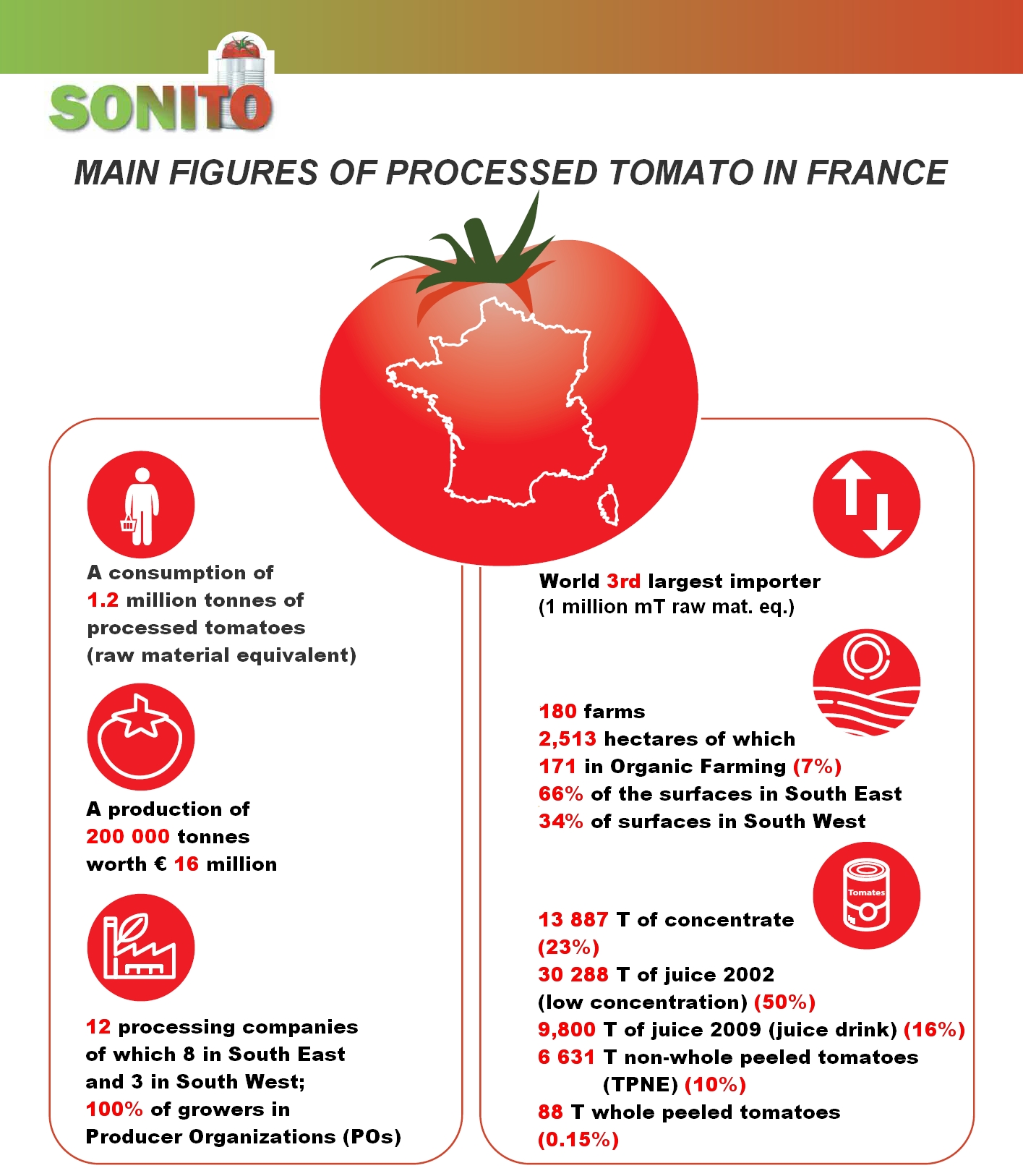
Main statistics for the processing tomato industry in France
Evolution of the level of national consumer demand that is covered by the country's processing industry

In 1985, France processed 400 000 tonnes of tomatoes, out of the 800 000 consumed throughout the country. In 2016/2017, French production (183 000 mT) covered approximately 14% of the country's demand.
Evolution and composition of the tomato paste trade balance

Evolution of the canned tomato trade balance

Evolution of the ketchup and sauces trade balance

Evolution and distribution of French expenditure on tomato products from abroad

Sonito: in Latin, one of the verb tense forms meaning "to make heard", "to resonate", or declension of the word "sonitus", which can be translated as "resonance" or "impact".