News
Fixing the Tomato’s Internal Drought Defense
Water is one of our most precious inputs. We know that when a crop hits a heatwave or salt-heavy soil, the plant’s internal “safety officer” (a hormone called ABA) is supposed to trigger a lockdown, closing the leaf pores to prevent dehydration. However, new research from Fudan University suggests that even our best varieties might have a built-in “saboteur” that prevents this lockdown from working effectively.
This recent discovery from Chinese researchers reveals a complex conflict happening deep within the plant’s signaling network. Typically, a tomato plant survives a dry spell by relying on its “safety officer” to shut the stomata—the tiny pores on the leaves. This lockdown is a critical defense, preserving the internal pressure the plant needs to stay upright, healthy, and productive.
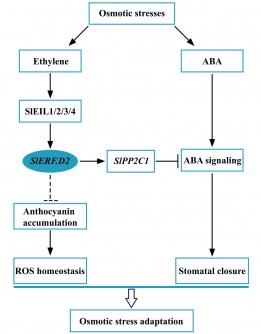
A proposed working model of SlERF.D2-mediated osmotic stress adaptation in tomato.
Credit: Horticulture Research
But the researchers found a hidden “saboteur” within the plant’s DNA: a gene named SlERF.D2. This gene is triggered by ethylene, a hormone the plant produces in a moment of panic as stress levels climb. Instead of helping the defense, SlERF.D2 acts like a molecular brake. It steps in and overrides the safety officer’s signals, forcing the leaf pores to stay open even as the plant’s water reserves vanish. It is a genetic glitch that effectively tells the plant to keep the windows open during a sandstorm.
To see if they could fix this internal sabotage, the scientists used CRISPR gene-editing to “silence” this traitorous gene. They didn’t need to add anything new or artificial; they simply removed the “brake.” The result was a dramatic shift in the plant’s survival. Without the interference of SlERF.D2, these tomatoes became master conservationists. The moment the environment turned salty or dry, their pores closed tight, their water levels remained stable, and they began producing a chemical shield of antioxidants—vivid pigments called anthocyanins—that protected the cells from sun damage and “oxidative rust.”
For the tomato industry, this discovery changes the way we think about crop resilience. We no longer have to wonder why some of our best-performing lines suddenly fail when the irrigation schedule gets tight or soil quality fluctuations hit. By identifying and removing these hidden “genetic brakes,” we are moving toward a more intelligent, water-efficient future. It ensures that even in the harshest environments, the tomato plant is finally allowed to be its own best defender.
Source: Newswise, Horticulture Research