News
FINAT: concerns over labels supply?
According to the statement released early February by FINAT , the supply of paper and cardboard is under severe pressure, and prices are 50% higher than usual.
For further information, click here
 According to the statement released early February by FINAT (*), the supply of paper and cardboard is under severe pressure. In Finland, for example, paper factories have been on strike since January, and some French factories have also stopped production in early February. The European label makers' association has issued a warning and expected a complete standstill of the industry within a few weeks, because there was no more paper available.
"Panic is the first word that comes to mind," says one of the largest label printers in the fresh produce sector. "In Finland there have been strikes since 3 January and 80% of the glassine paper used for labels for the European market comes from Finland. We aren't getting any paper and so we can't make labels. The strike has in any case been confirmed until 2 April, and no one knows what will happen after that. We are now getting paper from everywhere we can to supply our customers.
"The prices are much higher. The choice at the moment is: you either get labels or you don't. And if you want labels, you will have to pay one and a half times as much as usual. I used to give prices for three months, now we only give prices for a week. With the soft fruit season approaching, this is also a dire situation for many fresh produce companies. If you take a good look at the supermarkets, you see that the shelves are already empty. And supplying without a label is a difficult."
“This news seems to have been completely overshadowed, even though it will have a great impact on many. Stocks will dry up eventually. In England, printing presses have been standing still for weeks because they simply cannot get any paper. Moreover, we are bound by purchasing quotas", says the printer.
Alternatives are hardly available, he says. "Some customers are switching to plastic backing paper. But not everyone can process PET automatically without adjustments. Especially the sensors for automatic labelling lines do not recognize PET. The only alternative is exotic materials from Asia, South America and the Middle East, but that is not the quality we are used to. Large e-commerce parties are now looking at the possibilities of printing the label directly on the box, without a label. But even then the boxes have to be available."
Nino Venezia of Dutch Graphic Group from Venlo also recognizes the panic in label land. "The prices of label materials have risen by 40% in one year. The big global manufacturers can apparently suffer the loss caused by the strike in Europe, they make so much money that there are no serious negotiations with the strikers in Finland."
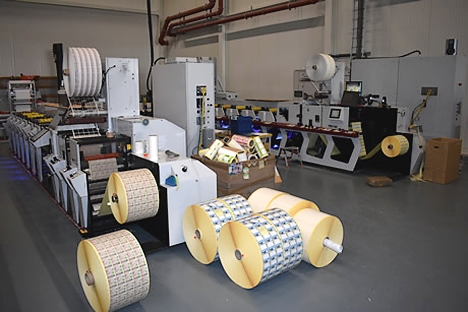 "The situation is really bizarre. I used to buy truck loads at the same time and the delivery was reasonably quick, but now an order time of ten, twelve weeks is no longer an exception. What's more, the price has tripled in the meantime. Label printers are already at a standstill. For us, the supply of Polypropylene-PP (**) is the biggest challenge at the moment. We are working day and night to get that supply”. (See also FINAT’s position paper in the additional information below).
March 2022: European label industry is now facing raw materials shortage
Whereas in 2020, excessive demand for self-adhesive labels was driven by the need for labels in essential sectors like food, personal care, medical and pharmaceutical products, demand peaked again in the second and third quarters of 2021 due to the unexpected strong economic recovery around Europe. However, after emerging general supply chain disruptions since last summer, the fortunes of the label industry have turned dramatically since the beginning of 2022 by long-lasting union strikes in a specialty paper mill in Finland and recently, another supplier in Spain.
The mills on strike are responsible for more than 25% of the paper grades used for the manufacture of materials used to print, embellish and cut self-adhesive labels in Europe. Persistent self-adhesive materials shortages could then severely disrupt the supply of functional and regulatory labels and packaging in food, pharmaceutical, healthcare and logistics sectors around Europe.
Labels are used for everyday products and services like packed meat and poultry, beverages, readymade meals, personal care items at the drugstore, prescribed medication, supermarket price-weigh tagging, warehousing, home deliveries, passenger tagging etc. etc. As part of the total product value, the cost of a single label may be low, but the damage of its lack of availability to goods manufacturers, logistics companies, consumers and ultimately European economies and societies is considerable.
Since the end of January, FINAT, national label associations and individual label printers have appealed to the parties concerned in the strike to take into consideration the broader impact of the dispute to their downstream customers: labelstock producers, label manufacturers, brand-owners, retailers and, finally, the consumers in the shops or online. So far, these appeals have not been reflected in an acceleration of the negotiation process.
Indispensable labels
 FINAT President Philippe Voet comments: “As we have seen during the Pandemic, labels are an indispensable component of the essential infrastructure that are difficult to replace. […] We don't like to see the relationship we have with [our customers] mortgaged by this ongoing dispute. Without an adequate pipeline of raw materials, label converters will be forced to extend lead times, prioritize customers, put part of the capacity on hold and send workers on leave because there are simply not enough materials to convert to labels. We once again appeal to the partners engaged in the dispute to do everything possible to resume production without further delay. Against the already tight supply chain conditions since last summer and now the hideous invasion of Ukraine, a further extension of the strike even beyond the current date of 2 April would be socially and economically unsustainable.”
FINAT Managing Director Jules Lejeune concludes: “This is not just about labels making and printing sectors. There are many supply chains, also nearby, that have the same ‘defect’ of global dependency on an ever smaller number of leaner players. Going forward beyond the current crisis, FINAT and the members of the European Label Community would like to use the lessons learned from the current case to engage in a cross sector dialogue to better spread the risk to societies, in terms of supply chain management education, in terms of industry collaboration and in terms of public policy.”
Some complementary data
In 2021, European self-adhesive labelstock demand increased by 7% to almost 8.5 billion square meters, after an increase of 4.3% in 2020.
Assuming an average ‘gross’ size of 10 cm2 per label, 8.5 billion square meters consumed in Europe per annum corresponds with an astronomic amount of nearly 16.5 billion labels consumed each week. That’s nearly 50 labels per capita per week!
(*) FINAT: an abbreviation of the French title: Fédération Internationale des fabricants et transformateurs d'Adhésifs et Thermocollants sur papiers et autres supports – International Federation of Manufacturers and Converters of Adhesives and Iron-Ons on Paper and Other Supports).
To access FINAT’s position paper,
For further information, click here
(**) Polypropylene is suitable for safe use in the pharmaceutical and food industry, and widely used as a packaging material for packaging products such as snack foods, fresh produce and confectionery.
Sources: finat.com, freshplaza.com








Latest news
Tomato Products Wellness Council Redefines Quality
California: Weekly tonnage as of 17 October 2026
Heritable and Kagome Partner on AI-Driven Disease-Resistant Crops
Final results of the 2026 campaign in Northern Italy: yields among the lowest in recent years
Global Tomato Paste Trade in 2025/2026: slow emergence of secondary origins